
The Kilopixel Project: Where a Raspberry Pi Robot Paints the Internet’s Imagination, One Wooden Block at a Time
What if your digital doodle could manifest physically, not on a blazing-fast screen, but through the deliberate, rhythmic clatter of tiny wooden blocks, orchestrated by a patient Raspberry Pi robot? In an era of instant digital gratification, Ben Holmen’s “Kilopixel” project stands as a charmingly inefficient yet revolutionary counterpoint. This unique Raspberry Pi-powered installation transforms user-submitted pixel art from across the internet into tangible physical form using a 1,000-block wooden grid. More than just a technical marvel, Kilopixel embodies the collaborative spirit of open-source hardware, invites artistic participation regardless of skill, and forces a reflection on the value of slowness in a fast-paced world. This project highlights the incredible potential of the humble Raspberry Pi as a bridge between the digital and physical realms, creating art in a way that feels both delightfully low-tech and profoundly futuristic.
The Anatomy of Deliberate Creation: How Kilopixel Works
-
The Heart: Raspberry Pi Control Center: At its core, a Raspberry Pi acts as the project’s brain. It constantly monitors submissions via its website (kilopx.com), processes the digital pixel art data, and translates it into precise instructions for the mechanical system. This demonstrates the Pi’s versatility – far beyond simple computing tasks, it integrates web connectivity, database management, and real-time robotic control.
- Key Pi Roles:
- Web Server Interface: Hosts the website where users submit and view art.
- Job Queue Manager: Prioritizes, sequences, and schedules submitted pixel images.
- Motion Controller: Calculates exact paths and movements for the robotic arm.
- Sensor Monitor: Tracks the position and state (black/white) of blocks.
- Live Stream Handler: Encodes and transmits the real-time building process.
- Key Pi Roles:
-
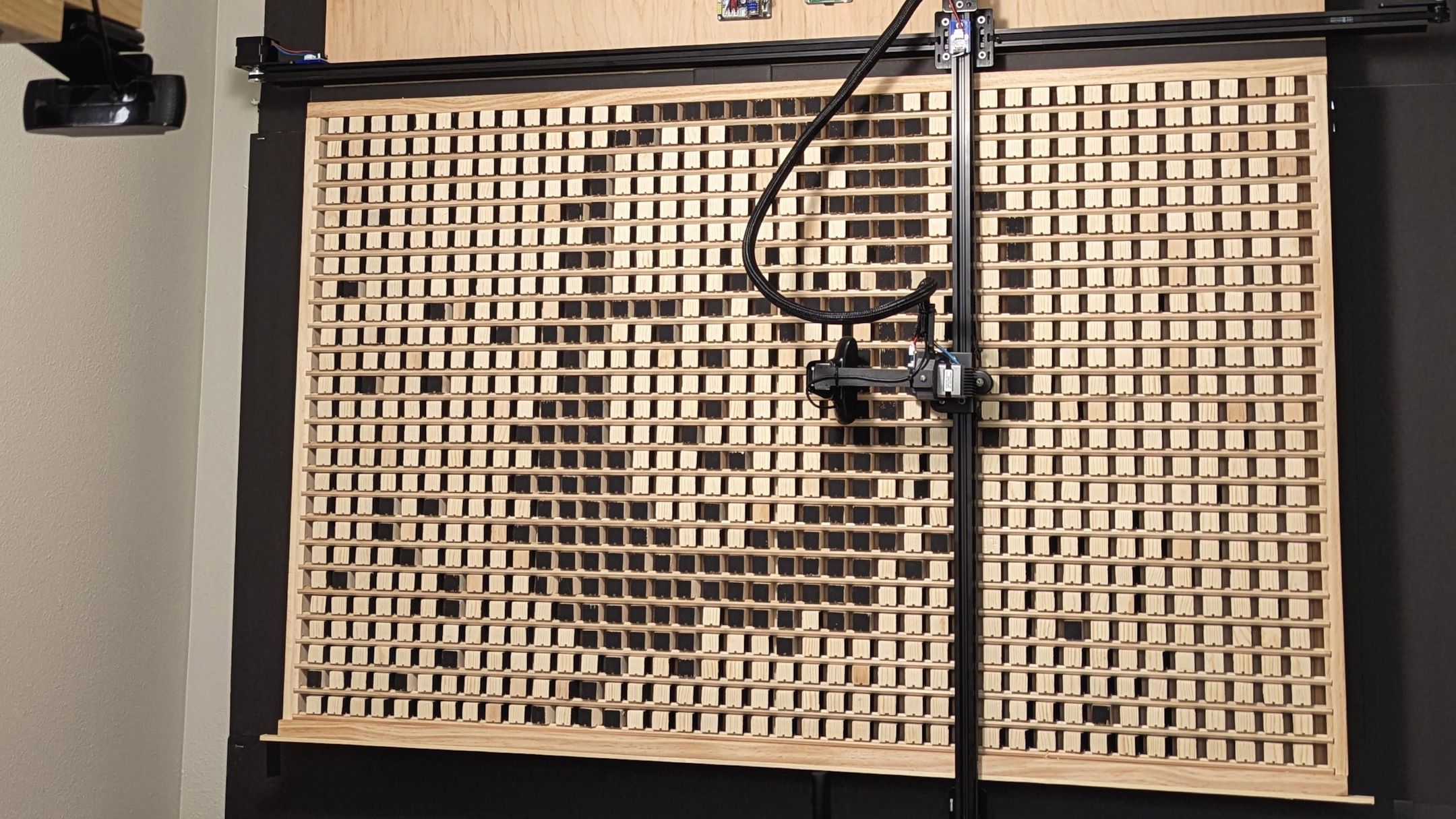
The Canvas: The Grid of 1000 Blocks: Kilopixel’s display is a physical 40×25 grid, totaling exactly 1,000 individual wooden blocks (Kilopixel = 1,000 pixels). Each block is essentially a hinged or mounted tile, painted white on one side and black on the other. Crucially, these “pixels” are binary – black or white only – embracing the fundamental simplicity of early pixel art. The scale itself is significant. Compared to micro-scale digital pixels, these ~1-2 inch wooden squares create a distinctly tangible presence. ([Source: Ben Holmen’s Blog Documentation]).
-
The Arm: The Patient Artist: A custom-built robotic mechanism, controlled by the Raspberry Pi, performs the physical transformation. A small arm, likely guided by stepper motors or servos on an X-Y gantry system, moves precisely to each block coordinate. Upon reaching its target, it gently “pokes” the block, causing it to flip and reveal either its black or white face, depending on the desired pixel state. This elegant but simple solution avoids complex actuators on each block.
-
The Tempo: Embracing Inefficiency: The defining characteristic, and arguably the soul, of Kilopixel is its deliberate slowness. While modern digital displays update millions of pixels 60 times per second, Kilopixel lumberously changes a single pixel approximately every 6 seconds (10 pixels per minute). Rendering a full 1,000-pixel image requires a staggering ~100 minutes (over 1.5 hours).
- Efficiency vs. Engagement: A Comparison
| Feature | Modern Digital Display | Kilopixel Wooden Grid |
| :——————– | :——————— | :——————– |
| Pixels | Millions | 1,000 (Kilopixel) |
| Update Rate | 60+ FPS (Full frame) | ~10 Pixels/Minute |
| Time per Full Frame | ~16 ms | ~100 Minutes |
| Color | Full Spectrum | Monochrome (B/W) |
| Power Consumption | Significant | Minimal (Servos/Pi) |
| User Experience | Instant Gratification | Anticipation, Focus |
| Tangibility | None | Physical Presence |
This inefficiency is not a flaw; it’s a design philosophy. Watching the slow, methodical assembly creates anticipation and mindfulness, forcing viewers (and contributors) to engage differently with the art.
- Efficiency vs. Engagement: A Comparison
Community & Art: The Internet Becomes an Artist Collective
Kilopixel transcends being merely a robot; it’s a participatory art portal driven by a Raspberry Pi.
- Submission Portal (kilopx.com): The core community interaction happens here. Users can:
- Draw & Submit: Create simple 40×25 black-and-white pixel art directly through a web interface. (Requires Bluesky account for submission to deter spam).
- View Queue: See submitted images waiting to be rendered.
- Upvote/Engage: Influence the community gallery by upvoting favored submissions.
- Watch Live: Observe the robot patiently assembling the current piece via live video stream.
- Gallery: Browse through the archive of previously completed drawings. ([Source: kilopx.com Functionality]).
- Democratized Artistry: Kilopixel lowers the barrier to creating “exhibited” art. You don’t need engineering skills to build the robot, nor elite artistic skill to create compelling pixel art. Simple hearts, smileys, text, mini-scenes, or abstract patterns all find their place on the grid. The project celebrates the collaborative output of an anonymous internet collective.
- The Joy of Shared Anticipation: The slowness fosters shared experience. Seeing your piece slowly materialize, block by block, over hours, creates a unique connection to the physical artifact born from your digital idea. Watching someone else’s piece being built encourages appreciation for the communal effort and diverse creativity.
- Historical Context: Kilopixel draws inspiration from digital art predecessors like the “M.E.A.T. Magazine Pager Motel” (ASCII art over pagers) and old-school digital billboards. However, its unique blend of user-generated art, internet connectivity via Raspberry Pi, and a physical, slow-build kinetic sculpture sets it apart. It adds a temporal dimension lacking in purely digital collaborative canvases.
Philosophical & Creative Resonance: Why Slow Tech Matters
Beyond the fascinating tech and community elements, Kilopixel prompts deeper reflection, powered by its creative inefficiency.
- Critique of Instantaneity: In a world saturated with notifications, faster processors, and ephemeral digital content, Kilopixel boldly embodies “Slow Technology.” As proposed by researchers like Hallnäs & Redström, slow tech prioritizes reflection, anticipation, and the experience itself over speed and efficiency. Watching Kilopixel is inherently contemplative.
- The Analogue-Digital Bridge: The project creates a unique resonance. A strictly digital input (pixel data sent online) results in a strictly analogue physical output (wooden blocks). The modern Raspberry Pi acts as the perfect translator for this hybrid existence. The tactile nature of the final image – the physical presence, the sound of blocks flipping – grounds digital creativity in the material world.
- Embracing Constraint: The limitations are sources of creativity. The monochrome palette forces simplicity and clarity. The 40×25 grid demands abstraction and efficient visual storytelling. The slow speed encourages thoughtful submissions. Constraints often yield more interesting results than unlimited possibilities.
- Impermanence and Flow: While the completed image stands as a physical object, its duration is transient. It will eventually be overwritten by the next piece, reflecting the natural flow of internet culture and ideas. This temporary nature adds value to the act of creation and witnessing.
Conclusion: A Pixel Perfect Paragon of Raspberry Pi Possibility
Ben Holmen’s Kilopixel is far more than a slow-moving wooden robot. It’s a masterclass in Raspberry Pi utility, showcasing its ability to control complex physical systems, manage real-time web interactions, and build accessible community platforms. It transforms the Pi into a conduit for collaborative global art. The project’s perceived “inefficiency” is its genius, fostering mindful engagement, celebrating tangible creation over ephemeral pixels, and offering a refreshingly deliberate counterpoint to the relentless speed of the digital age. Through the patient clatter of a thousand wooden blocks, Kilopixel reminds us that there’s profound beauty in the journey of making, not just the instant result. It invites us to pause, create a simple block of pixels, and participate in the slow, shared wonder of watching the internet’s collective imagination turn real.
So, what will your small piece of the internet look like when patiently built from wood? Head over to kilopx.com, draw your creation, and join this fascinating experiment in slow, collaborative, Raspberry Pi-powered art. What simple design would you submit?
Sources & Further Reading:
Original article at www.xda-developers.com


