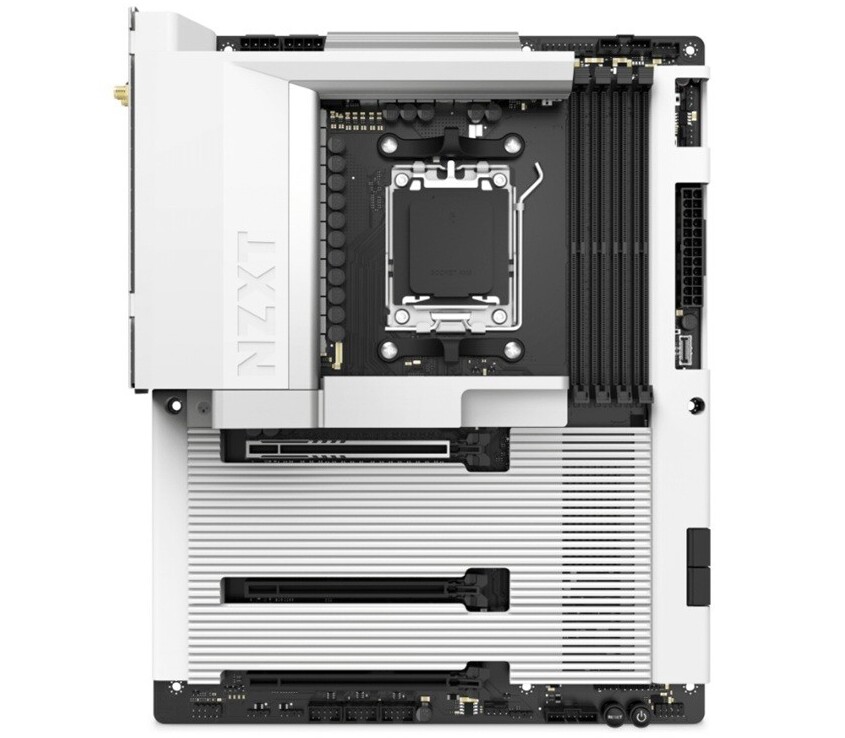

The NZXT N7 B850: Sleek Aesthetics Meets AM5 Muscle for Enthusiast Builds
Is visual design finally catching up to raw performance in the motherboard arena? NZXT, renowned for its minimalist case and cooling solutions, responds emphatically with the launch of its N7 B850 Socket AM5 motherboard. Targeting builders who refuse to compromise between a clean aesthetic and powerful foundation, the N7 B850 leverages AMD’s latest platform, promising robust features wrapped in signature NZXT elegance. Available in pristine all-black or a striking black-and-white “2-tone” variant, this board isn’t just about looks. It packs AMD’s modern B850 chipset, PCIe Gen 5 readiness, and advanced connectivity, positioning it as a compelling core for today’s Ryzen 7000/8000 series systems and a future-proofed AM5 motherboard. Its blend of style and capability directly addresses the growing demand for high-performance hardware that complements, not clashes with, meticulously crafted custom PCs.
Dissecting the N7 B850: Form Meets Future-Proof Functionality
NZXT’s design philosophy shines through immediately with the N7 B850. Its defining characteristic is the extensive shrouding, covering the majority of the front panel, VRM heatsinks, rear I/O area, and M.2 slots. The all-black model offers seamless uniformity, while the 2-tone variant skillfully blends black PCB and shroud base with contrasting matte white accents across the key heatsinked areas, creating a visually striking effect perfect for monochromatic or two-tone builds. Critically, NZXT maintains its sleek aesthetic without sacrificing practicality; underneath this clean exterior, the foundation is built for demanding processors.
Harnessing AMD’s Cutting-Edge Platform: The B850 Chipset and Socket AM5
The N7 B850 is built around AMD’s Socket AM5, the exclusive home for Ryzen 7000 (“Zen 4”), Ryzen 8000 (“Zen 4” with RDNA 3 iGPU), and expected future generations, guaranteeing a clear upgrade path. Leveraging the B850 chipset – positioned as a successor to B650 with a focus on refined power delivery and connectivity – this board taps into the platform’s inherent strengths:
- DDR5 Exclusive: AM5 mandates DDR5 memory, abandoning DDR4 for higher bandwidth and future scalability. The N7 B850 supports up to 256GB (4x DIMMs) and boasts official speeds up to DDR5-8000 (likely via overclocking/XMP/EXPO profiles). (Source: AMD on DDR5 and AM5))
- PCIe 5.0 Foundation: Direct lanes from the Ryzen CPU enable next-gen speed tiers. The primary GPU slot (PCIe 5.0 x16) and two M.2 slots benefit from this blistering bandwidth.
- Enhanced Chipset Connectivity: While offering fewer raw lanes than the flagship X870E/X670E, the B850 efficiently manages additional connectivity like extra M.2, SATA, and USB ports wired through it.
Robust Power Delivery: Fueling High-Performance Ryzen CPUs
Powering demanding Ryzen processors requires a stout VRM (Voltage Regulator Module). NZXT engineered a substantial 16+2+1 phase design for the N7 B850. Crucially, every power phase dedicated to the CPU core (Vcore) and SOC (integrated components like memory controller, iGPU) utilizes 80 A DrMOS power stages:
- 80A DrMOS: These integrated power stages combine high-side and low-side MOSFETs with their driver into a single chip. 80A per phase signifies an exceptionally high power-handling capability per stage, enabling cleaner power delivery, lower temperatures, and support for high-core-count CPUs even under heavy overclocking loads.
- 16+2+1 Design: The “16” refers to the primary CPU core phases. The “+2” are dedicated to the SOC, vital for memory stability and iGPU functionality. The “+1” typically handles the standalone AUX power.
- Premium PCB Construction: The 8-layer PCB with 2 oz copper layers provides superior signal integrity, reduces electrical noise (crosstalk), and significantly enhances thermal dissipation compared to cheaper 4 or 6-layer boards. Thicker copper layers offer lower impedance, further improving power delivery efficiency and stability. (Source on PCB Layers – Electrical Engineering Portal)
- Dual 8-Pin EPS Connectors: Ensures ample, stable power draw from the PSU, preventing bottlenecks and improving overclocking headroom, especially crucial when pushing high-performance CPUs. (Source on EPS12V Standard – ATX Specification)
Memory and Storage: Bandwidth Galore
The N7 B850 excels in providing high-speed bulk storage and memory expansion:
-
Memory:
- 4 x DDR5 DIMM Slots
- Supports up to DDR5-8000+ (OC – dependent on CPU IMC and memory kit quality)
- Maximum Capacity: 256GB (4x 64GB modules)
- Supports both EXPO (AMD) and Intel XMP 3.0 profiles for one-click optimized performance.
-
Storage: Cutting-Edge NVMe & Legacy SATA
Slot Connection Speed Source Typical Use Case M.2_1 CPU Lanes (PCIe 5.0) Up to 126+ GB/s Direct to AM5 CPU Primary OS/Gaming Drive (Fastest) M.2_2 CPU Lanes (PCIe 5.0) Up to 126+ GB/s Direct to AM5 CPU Secondary Fast Drive / RAID M.2_3 B850 Chipset (PCIe 4.0 x4) Up to ~7.8 GB/s Via Chipset High-Capacity Storage Drive SATA Ports B850 Chipset (SATA 6 Gbps) Each up to ~600 MB/s Via Chipset SSDs, HDDs, Optical Drives Key Lane Sharing: The third PCIe x16 slot (physical size, electrical x4) shares bandwidth with M.2_3. Using one disables the other. The bottom x1 slot is standalone. This trade-off is common on mid-range boards.
Connectivity: Modern High-Speed and Legacy Options
NZXT provides a balanced mix of high-bandwidth and legacy ports:
- Rear I/O (External):
- USB: 1x USB 3.2 Gen 2×2 Type-C (20 Gbps – Note: Source says 10Gbps; clarify spec/part), 2x USB 3.2 Gen 2 Type-A (10 Gbps), 4x USB 3.2 Gen 1 Type-A (5 Gbps), 2x USB 2.0 Type-A.
- Video Output: HDMI – Crucial for processors with integrated Radeon graphics (e.g., Ryzen 7000G/8000G).
- Networking: RJ-45 5 Gbps Ethernet (Realtek 8126), Wi-Fi 6E Antenna Ports (MediaTek RZ608 supporting Bluetooth 5.2). (Source on Wi-Fi 6E – Wikipedia))
- Internal Headers:
- USB: 1x USB 3.2 Gen 2 (10 Gbps) Type-C Front Panel Header, 2x USB 3.2 Gen 1 (5 Gbps) Headers -> typically supports 4 more Type-A ports via front panel/case.
- Fan/Pump Headers: Multiple (exact count typically announced in manual) for comprehensive cooling control.
- NZXT CAM Integration: RGB lighting headers compatible with NZXT RGB/fan ecosystem, controllable via the CAM software suite for unified lighting and cooling synchronization.
Smart Control: The NZXT CAM Advantage
A hallmark of NZXT motherboards is deep integration with NZXT CAM software, offering a centralized hub for:
- Real-time System Monitoring: Track CPU/GPU temps, voltages, clock speeds, fan RPMs, RAM usage, and network speeds with precision.
- Precise Cooling Control: Customize fan and pump curves directly on a per-header basis for optimal acoustics and thermals. Pre-configured profiles simplify setup.
- Advanced Lighting Synchronization: Seamlessly control NZXT RGB components (DRAM, fans, strips) and compatible third-party hardware synchronized to the motherboard lighting. Numerous lighting effects and customization options are available.
- Performance Tuning (Limited): Provides tools for basic performance adjustments and monitoring overclocks. Extensive overclocking is typically managed via BIOS.
Audio and Networking: Capable Foundation
While high-end audiophile solutions start on pricier boards, the N7 B850 includes competent baseline features:
- Audio: Realtek ALC1220 audio CODEC. While not the absolute top-tier (like ALC4080), the ALC1220 remains a high-quality 7.1-channel solution offering excellent sound clarity, low distortion, and sufficient power for most gaming headsets and entry-level speakers. Premium capacitors (audibly grade) enhance sound quality. (Source on Realtek ALC1220 – TechPowerUp))
- Networking: The MediaTek RZ608 WLAN adapter is the Wi-Fi 6E/Bluetooth 5.2 solution, offering significant improvements over older Wi-Fi 5/6 standards, including access to the uncongested 6 GHz band for reduced latency in crowded environments. The Realtek RTL8126 PHY drives the 5 Gbps Ethernet port, delivering wired speeds far exceeding standard Gigabit, crucial for fast file transfers and high-bandwidth internet connections.
Who is the NZXT N7 B850 For?
This motherboard is the ideal spine for builders seeking:
- Aesthetic Purity: Those prioritizing clean, minimalistic design without compromise, especially within the NZXT ecosystem.
- Enthusiast-Level Components: Users pairing high-core-count Ryzen CPUs (even 7950X/7950X3D, 7900X, Ryzen 9 9950X future-proofed) needing robust VRM.
- Future-Focused Speeds: Builders desiring PCIe Gen 5 SSDs/GPUs and DDR5 memory support for maximum future bandwidth.
- Organized Control Freaks: Gamers and creators who value NZXT CAM for unified lighting, fan control, and system monitoring.
- Leveraging Integrated Graphics: Users planning to use CPUs like the Ryzen 7 8700G immediately or having video output as a backup.
Conclusion: A Balancing Act Achieved
The NZXT N7 B850 masterfully blends its distinctive minimalist aesthetic with the robust core capabilities demanded by modern high-performance AMD builds. Its potent 16+2+1 phase VRM with 80A DrMOS and premium 8-layer PCB provides the foundation for powerful Ryzen processors. Support for DDR5-8000 and dual PCIe Gen 5 M.2 slots guarantees headroom for tomorrow’s storage and memory advancements. Thoughtful connectivity, including modern USB ports (up to 20 Gbps?), 5 Gbps Ethernet, and Wi-Fi 6E, paired with capable Realtek ALC1220 audio and comprehensive NZXT CAM software control, rounds out a compelling package. While the lane sharing for the third M.2/x4 slot necessitates choice and the audio/networking could be slightly higher tier on paper in a perfect world, these are minor compromises rarely felt in typical enthusiast builds. Ultimately, for creators and gamers sculpting a visually stunning PC that refuses to lag in performance, the N7 B850 proves AM5 motherboards can be both beautiful beasts and technological powerhouses. What features matter most to you in a motherboard – raw power delivery, aesthetics, or cutting-edge connectivity? Share your build priorities in the comments below!
Sources & Further Reading:
Original article at www.techpowerup.com


