
The Great Switch 2 Cartridge Shift: How Smaller Cards Might Save Physical Games
Ever gazed at a shelf full of beloved game cartridges and wondered: twenty years from now, will your digital library be just as accessible? That question fuels the debate surrounding Nintendo Switch 2’s “Game Key Cards.” Loved by publishers for cutting costs, these download-only prompts raised serious alarms among players yearning for true physical ownership and preservation of their purchases. Yet, Nintendo may be responding to this preservation dilemma in a surprisingly tangible way, balancing publisher economics with gamer anxieties through a strategic hardware tweak.
Why Game Key Cards Sparked Player Outcry
Game Key Cards, essentially elegant slips of cardstock containing only a download code, were Nintendo’s controversial answer to soaring cartridge production costs for its next-generation console. The appeal for publishers was immediate and financially compelling:
- Massive Cost Reduction: Unlike traditional Switch cartridges brimming with expensive NAND flash memory, Game Key Cards eliminate this hardware entirely. Reports consistently indicate flash memory contributes significantly – often the significant portion – to a cartridge’s final manufacturing cost.
- Simplified Logistics: Lighter weight, smaller physical footprint, and no sensitive electronic components make storage and shipping vastly cheaper and less complex than handling fragile cartridges.
- Publisher Profit Margin Protection: In an era of ballooning development costs, Game Key Cards offered a way to keep physical retail boxes economically viable, especially for smaller publishers and niche titles like retro compilations or indie darlings.
However, gamers quickly identified critical downsides undermining the promise of “physical” media:
- The Illusion of Ownership: Purchasing a Game Key Card box feels physically substantial, yet the essential game data resides only on Nintendo’s servers and the Switch console’s storage once downloaded. Crucially, it lacks the enduring portability and offline independence of a cartridge.
- Preservation Peril: Game preservation advocates sounded the alarm. If Nintendo’s eShop eventually shuts down (as the Wii Shop Channel already has), redeeming Game Key Cards becomes impossible. Owners only possess a worthless piece of plastic – their purchase effectively vanishes. This directly threatens long-term access viewed as a core benefit of buying physical media [wikipedia.org/wiki/Video_game_preservation].
- Resale & Trade Debilitated: Physical carts retain value and are easily traded or sold second-hand. An unredeemed Game Key Card technically has some secondary market value, but once redeemed, it becomes intrinsically tied to the buyer’s Nintendo account, crippling traditional game ownership rights. [wikipedia.org/wiki/First-sale_doctrine & game resale discussions].
The Publisher’s Bind: Balancing Budgets and Boxes
For publishers, the allure of Game Key Cards clashed directly with market realities. While saving considerable upfront costs, they risked alienating discerning customers acutely aware of preservation issues. This tension recently snapped into sharp focus during an ongoing dispute concerning R-Type Dimensions III.
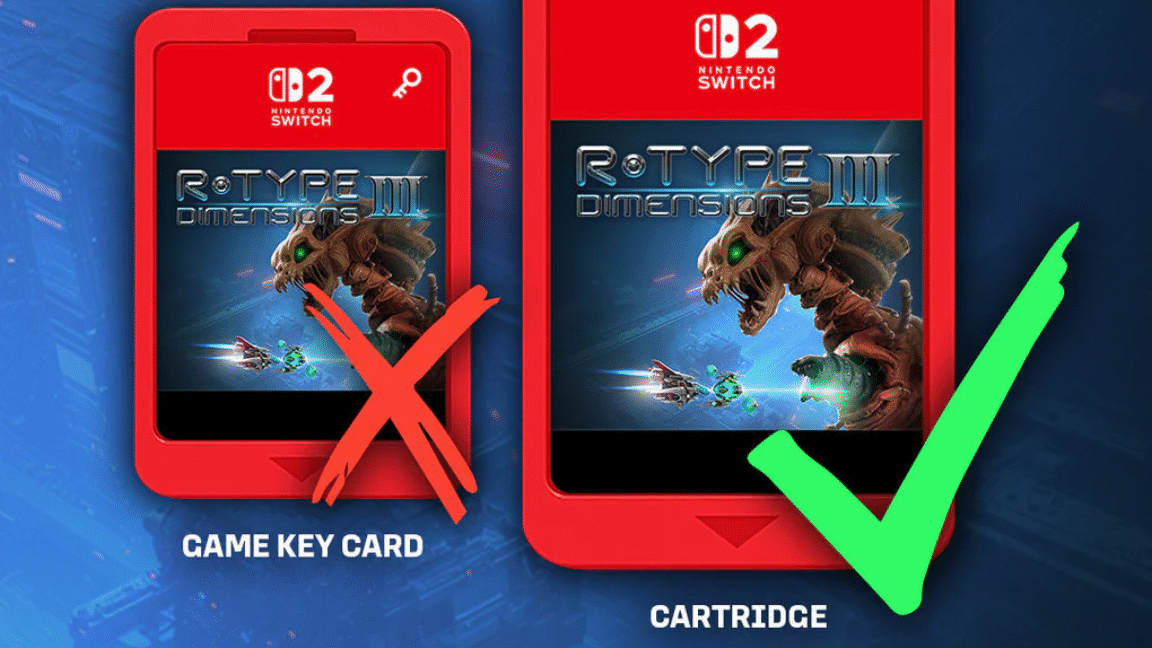
Developer Inin Games publicly explained why their upcoming Switch 2 collector’s edition initially planned Game Key Cards instead of a cartridge. The reasoning was brutally economical: their manufacturing cost analysis showed swapping the Game Key Card for a full physical cartridge containing the game data would necessitate a steep retail price hike. They explicitly stated this would “force us to increase the retail price by at least €15 [about $20].”
This candid disclosure highlighted a stark reality: even publishers wishing to offer true physical editions often found themselves economically constrained by the high expense of Nintendo’s cartridges, especially for games that weren’t projected megahits. The Game Key Card was a necessary compromise to preserve the viability of putting anything resembling a physical product on store shelves at an acceptable price point.
Nintendo’s Game-Changer: Introducing Smaller, Cheaper Cartridges
Ground-shifting news emerged just days after Inin’s initial statement. The publisher revealed that Nintendo had announced two new, smaller storage capacities for Switch 2 cartridges. While exact sizes remain officially unconfirmed, industry speculation points towards capacities significantly lower than the base Switch’s meagre initial options – potentially offerings well below 8GB. This implication carries enormous weight.
Manufacturing costs for flash memory chips are intrinsically tied to their storage capacity. Smaller chips require less silicon, fewer production steps, and are overall cheaper to produce. Historically, Nintendo charged publishers progressively more for carts with higher capacities – a primary driver discouraging full-game cart releases for larger titles on the original Switch, where many publishers opted for partial downloads even on cartridges.
Estimated Cost Factors Comparison: Switch-Style Cartridges vs. Game Key Cards
| Cost Component | Traditional Cartridge (Higher Capacity) | New Smaller Cartridge | Game Key Card |
|---|---|---|---|
| Flash Memory Chip Cost | Very High (Primary Cost Driver) | Significantly Lower | None |
| Packaging Hardware & Format | Moderate | Moderate | Very Low |
| Licensing Fees (Nintendo) | Included | Included | Included |
| Perceived Player Value | Highest | High ≈ Cartridge? | Lowest |
By introducing smaller capacities at presumably lower price tiers, Nintendo effectively widened the viable threshold for publishers considering a true cartridge release. Games whose code size fits comfortably on these smaller (and cheaper) chips suddenly saw a much more financially feasible path to being a genuine physical purchase. This fundamentally alters the calculus.
Case Study: Inin Games Reverses Course Thanks to Smaller Carts
Inin Games immediately capitalized on this newly available option. Within two days of Nintendo announcing the smaller capacities, they issued a dramatic reversal. Their statement declared: “there is no better timing”. Utilizing Nintendo’s new, cheaper cartridge options allowed them to “recalculate production in a way that wasn’t possible before.”
The significant consequence: Inin Games officially switched R-Type Dimensions III’s retail release from a Game Key Card to a full physical cartridge. This proves the tangible impact smaller carts can have on publisher decisions almost instantly.
There are financial implications, but they are notably tempered:
- The game’s price will increase by €10, not the previously projected €15+.
- This represents a smaller “cost gap” between Game Key Cards and cartridges – roughly €10 vs a potential €20+ delta previously suggested.
- Crucially, early adopters and pre-order holders are shielded entirely from this price hike, maintaining goodwill.
This real-world scenario demonstrates how smaller carts act as a cost mitigation lever. Publishers still pay a premium over Game Key Cards for true physical media, but Nintendo’s new offerings have demonstrably reduced that premium, making cartridges a practical choice for more games previously teetering on the edge.
Implications: A Brighter Future for Physical Switch 2 Games?
The swift shift by Inin Games serves as a potential bellwether for the wider Switch 2 physical game landscape. Several broader implications emerge:
- Increased Physical Release Viability: Expect far more budget-conscious publishers and niche game developers – especially those producing titles with manageable file sizes – to opt for genuine cartridges using the smaller capacities. This could significantly swell the library of true physical Switch 2 games available.
- Consumer Confidence Boost: Players demonstrating vocal preference (sometimes boycotts) against Game Key Cards prove manufacturers listen. Offering a feasible physical alternative addresses core concerns about ownership decay, preservation, freedom, and resale value directly.
- Market Segmentation: Larger AAA games requiring hefty storage may still necessitate cartridges combined with downloads or higher-cost, larger-capacity carts. However, Nintendo introducing multiple cheaper tiers suggests they intend the small carts to be the default for standard-sized indie, retro, and AA releases – significantly reducing Game Key Card dominance.
- Preserving the Niche: Collector’s editions and premium physical releases (like Limited Run Games) gain more affordable ammunition. Their raison d’être as bastions of preservation becomes much easier to fulfill cost-effectively on the Switch 2 platform.
While Game Key Cards undoubtedly won’t vanish entirely due to their unmatched affordability, Nintendo’s move cleverly contrains their proliferation. Smaller carts offer a palatable compromise: publishers save some costs compared to larger cart options, while genuinely answering the preservation and consumer rights demands loudly voiced by gamers. This strikes a delicate balance practicality and principle, potentially resurrecting the true cartridge for a wider range of Switch 2 experiences.
Nintendo’s introduction of cheaper, smaller cartridges marks a promising pivot point. While publishers inevitably weigh costs against passions, this development significantly tilts the scales towards tangible ownership for countless Switch 2 titles previously bound for purely digital destinies wrapped in plastic boxes. It addresses the alarming preservation gap inherent in Game Key Cards, restoring a vital link between purchasing a physical item and genuinely possessing the game it contains. The R-Type Dimensions III reversal exemplifies the swift practical impact – and suggests a looming renaissance for authentic cartridge releases across the Switch 2 ecosystem. What’s your stance – is Nintendo’s compromise enough to safeguard the future of your game collection? Share your thoughts below.


