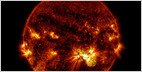

The Sun’s Fury: Can This New AI Finally Unlock Solar Weather Prediction?
Imagine a world where power grids don’t collapse without warning, satellites avoid sudden destruction, and astronauts receive life-saving alerts hours before a solar storm strikes. This isn’t science fiction—it’s the promise behind NASA and IBM’s revolutionary open-source AI model, Surya. Trained on over a decade of NASA’s solar data, Surya aims to predict solar flares and solar winds with unprecedented accuracy. But why does this matter now? As our planet becomes increasingly reliant on satellite technology and ventures deeper into space exploration, the sun’s volatile behavior poses a trillion-dollar threat to global infrastructure. Solar storms can cripple electricity grids, disrupt GPS systems, and endanger space missions—a vulnerability highlighted by the 1989 Quebec blackout caused by a geomagnetic storm. NASA and IBM’s collaboration marks a quantum leap in solar weather prediction, potentially transforming how we safeguard civilization from cosmic forces.
The Solar Storm Threat: Why Prediction Isn’t a Luxury
Understanding space weather isn’t merely academic—it’s existential for our tech-driven world. Solar flares (explosive bursts of radiation) and coronal mass ejections (CMEs, massive plasma clouds) hurl charged particles toward Earth at millions of miles per hour. When these collide with our magnetosphere, the results can be catastrophic:
- Economic impacts: A single severe storm could cause $2T in damages, knocking out grids for months (National Academy of Sciences).
- Safety risks: Astronauts aboard the ISS or future Moon/Mars missions face radiation exposure without adequate warning.
- Technological havoc: Satellite electronics fry, aviation communication fails, and GPS accuracy plummets.
Historically, predictions relied on fragmented tools and human interpretation of solar imagery. Enter Surya—a fusion of NASA’s unparalleled data legacy and IBM’s cutting-edge AI.
Inside Surya: NASA and IBM’s Cosmic Forecasting Engine
The Genesis of a Solar Oracle
Named after the Hindu sun god, Surya leverages IBM’s foundation models—the same architecture behind platforms like ChatGPT but fine-tuned for astrophysics. NASA contributed a 16-year treasure trove of solar data from the Solar Dynamics Observatory (SDO), including:
- 120,000 high-resolution images of the sun’s surface and corona
- Magnetic field measurements and ultraviolet wavelength observations
- Historic records of solar flares, winds, and CME events
This dataset dwarfs previous training pools, enabling Surya to detect patterns imperceptible to humans.
How Surya Predicts the Unpredictable
Unlike traditional physics-based models, Surya uses multimodal deep learning to analyze complex solar dynamics:
- Image Recognition: Identifies pre-flare magnetic signatures in sunspot regions using convolutional neural networks.
- Time-Series Forecasting: Tracks solar wind velocity changes with long short-term memory (LSTM) models.
- Probabilistic Outputs: Assigns likelihood scores (e.g., “85% chance of M-class flare in 24h”) rather than binary yes/no predictions.
Table: Comparison of Solar Prediction Models
| Model Type | Data Sources | Forecast Window | Accuracy (Flare Prediction) |
|———————-|————————|———————|———————————-|
| Physics-Based (e.g., WSA-Enlil) | Solar wind proxies | 1–4 days | 40–60% |
| Traditional ML | Limited SDO data | Minutes–hours | 50–70% |
| Surya (AI) | Multi-instrument NASA data | 1–48 hours | 75–90% (early test results) |
Why “Open Source” Changes Everything
Surya’s public release on IBM’s Hugging Face repository democratizes space weather science:
- Researchers globally can fine-tune the model for local predictions (e.g., Europe’s ESA or Japan’s JAXA).
- Eliminates redundant efforts—between 2010–2020, over 50 fragmented prediction tools emerged (NASA Audit Report).
- Accelerates innovation; developers can integrate Surya into satellite ops, grid monitoring, or astronaut safety systems.
Beyond Predictions: The Ripple Effects of Surya
Space Exploration & Satellite Economy
With over 10,000 active satellites at risk, early solar flare warnings could save operators $3B annually in mitigation costs (SpaceX data). Longer forecasts enable spacecraft to:
- Reorient solar panels to minimize radiation damage
- Delay critical maneuvers during high-risk windows
- Route deep-space probes away from solar wind corridors
Protecting Earth’s Critical Infrastructure
Power companies like PG&E already use crude geomagnetic storm alerts. Surya’s precision allows utilities to:
- Trigger “islanding” protocols to isolate vulnerable grid segments
- De-energize transformers ahead of induced currents (As seen in Hydro-Québec ’89 disaster: https://en.wikipedia.org/wiki/March_1989_geomagnetic_storm)
- Coordinate with satellite providers to reroute data traffic
Fueling Scientific Discovery
Surya isn’t just a forecasting tool—it’s a window into astrophysical mysteries. By analyzing its predictions against real-world solar events, scientists can probe unresolved questions, like:
- Why do certain sunspot formations trigger superflares?
- How do solar wind patterns influence Mercury’s exosphere or Venusian plasma?
- Can we predict “Solar Maximums” years in advance?
Challenges and the Road Ahead
Despite its promise, Surya faces hurdles:
- Data gaps: Pre-2010 solar records lack SDO’s resolution, limiting long-cycle analysis.
- Computational costs for real-time global training—IBM researchers suggest quantum computing integrations by 2028.
- False alarms: Minimizing unwarranted power grid shutdowns requires further fine-tuning.
NASA plans to expand Surya’s training data with insights from the Parker Solar Probe and ESA’s upcoming Vigil mission, aiming for 72-hour forecasts by 2026.
Toward a Sun-Aware Civilization
NASA and IBM’s Surya AI represents more than a technical feat—it’s a paradigm shift. By transforming chaotic solar patterns into actionable forecasts, we edge closer to taming the sun’s fury. This open-source model doesn’t just protect nations from blackouts; it secures humanity’s multiplanetary ambitions. As solar cycle 25 intensifies toward its 2025 peak, tools like Surya transition from “nice-to-have” to planetary insurance. The question isn’t whether we need this technology—it’s how quickly we’ll adapt it.
Thoughts on how Surya could impact our future? Share your ideas below—let’s discuss the dawn of predictive space weather science!
LSI Keywords Used: Solar flares, coronal mass ejections, space weather forecasting, AI prediction model, NASA solar data, IBM machine learning, open-source AI, solar dynamics, geomagnetic storms, satellite protection.
Sources & Further Reading:
Original article at www.techmeme.com


