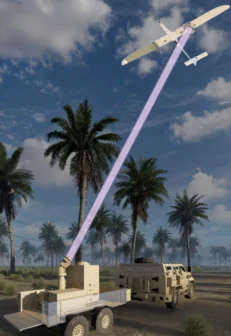

The Sky Charging Solution: How Lasers Are Breaking Drone Battery Limits
Imagine a drone quietly monitoring disaster zones, delivering medical supplies, or inspecting infrastructure – but never landing. What if critical unmanned aircraft didn’t suddenly plummet when their batteries ran dry? This isn’t science fiction swirling through a physicist’s daydream; it’s the tangible future ignited by advancements in laser power beaming, fundamentally challenging the constraints of wireless power transfer for aerial platforms. Washington-based PowerLight Technologies just propelled this concept dramatically closer to reality, validating core tech that promises truly persistent drone flight. This breakthrough in dynamic wireless power transmission, propelled by U.S. Department of Defense backing, could revolutionize how unmanned aerial systems (UAS) operate globally.
Wireless Power Transfer Takes Flight: The Beacon from PowerLight
The Achilles’ heel of modern drones is unquestionably battery life. Limited endurance forces constant landings for recharging or expensive, risky battery swaps, drastically reducing mission effectiveness and range. PowerLight’s pioneering approach tackles this head-on with a sophisticated end-to-end system dubbed “wireless power beaming.” Forget cumbersome cables or risky mid-air rendezvous; their solution harnesses light itself as an energy conduit.
Central to the system are two core components revealed in their December press release:
- Ground-Based Laser Transmitter: An intelligent, steerable laser source capable of delivering kilowatts of power. Crucially, it doesn’t just fire blindly; it actively communicates with the drone, tracking its precise position, velocity, and trajectory.
- Onboard Laser Receiver: Designed for integration onto UAS, this remarkably compact unit weighs approximately 6 pounds (2.7 kg). It houses specialized laser power converters (LPCs) – photovoltaic cells optimized not for sunlight, but for efficiently converting the specific wavelength of the directed laser beam into usable electricity to charge the drone’s battery. An integrated control module ensures seamless two-way communication with the ground station.
PowerLight Chief Technology Officer Tom Nugent emphasized this isn’t mere point-to-point charging. He described a nascent “intelligent mesh energy network capability,” suggesting a future where multiple transmitters and receivers could create resilient power supply webs for fleets of drones and potentially other systems.
Achieving the Connection: Miles High at Speed
The core challenge of laser-based remote drone charging isn’t just generating power; it’s delivering it accurately over kilometers to a rapidly moving target. PowerLight’s recent successful preliminary tests tackled this head-on:
- Altitude Milestone: The system demonstrated consistent power beaming to aircraft flying as high as 5,000 feet (1,524 meters). This represents a significant leap in operational altitude for practical laser charging.
- Dynamic Tracking Validated: Crucially, the tests confirmed the sophisticated tracking algorithms work, with Nugent stating, “Our transmitter communicates with the UAS, tracks its velocity and vector, and delivers energy exactly where it’s needed.” This precision targeting is essential for maintaining connection while avoiding unintended beam exposure.
- Foundation Secured: PowerLight confidently announced that these tests validated the “core architecture” needed for their imminent, crucial phase: fully integrated flight demonstrations scheduled for early 2026. These aim to showcase “infinite flight” capability – drones operating far beyond conventional battery limits.
(Table: PowerLight Tech Milestones)
| Technology Component | Current Achievement (Dec 2025 Tests) | Next Goal (Early 2026) |
| :————————— | :———————————– | :—————————– |
| Operational Altitude | Up to 5,000 feet (1,524 meters) | Demonstrate higher altitudes |
| Tracking Capability | Validated algorithm, dynamic tracking | Real-world flight endurance |
| Power Transmission Proof | Kilowatts successfully transmitted | Scale power & demonstrate recharge |
| Full System Integration | Separate components validated | Integrated flight demonstrations |
Beyond Just Charging Drones: The Strategic Vision of PTROL-UAS
This project isn’t a standalone experiment. It’s a cornerstone of the Power TRansmitted Over Laser to UAS (PTROL-UAS) program – a dedicated initiative funded by the U.S. Department of Defense. The military implications of persistent air power are profound. Uninterrupted intelligence, surveillance, reconnaissance (ISR), communications relays over contested areas, and border patrols without landing gaps represent strategic advantages.
Fatema Hamdani, CEO of Kraus Hamdani Aerospace (PowerLight’s partner on PTROL-UAS), captured the strategic essence: “A platform that doesn’t need to land to refuel or recharge is one that never blinks.” This relentless persistence fundamentally changes mission planning and tactical capabilities for military UAS.
The DoD’s investment signifies a strong belief in the maturity of power beaming technology. Its potential reaches far beyond immediate military uses:
- Emergency Response: Extended drone flights over wildfires or disaster zones for damage assessment and search/rescue coordination.
- Critical Infrastructure Monitoring: Continuous inspection of power lines, pipelines, or offshore wind farms without pilot fatigue limitations.
- Agriculture: Persistent crop monitoring over vast fields.
- Space Exploration: As PowerLight showcased previously through its collaboration with Blue Origin, lunar rover charging on missions avoiding prolonged darkness periods.
Navigating the Horizon: Challenges, Scale, and the Infinite Flight Promise
While the breakthrough is monumental, commercialization pathways involve tackling significant engineering hurdles:
- Atmospheric Interference: Fog, heavy rain, and significant dust/smoke can scatter or absorb laser beams, disrupting power transmission efficiency and requiring robust adaptive systems. (Wikipedia on Laser Propagation).
- Beam Safety: Ensuring precise targeting to avoid unintended human or animal exposure to high-power laser beams necessitates stringent fail-safes internationally recognized autonomous deactivation protocols. Regulatory frameworks will evolve alongside technology. (Laser Safety Standards)
- Power Scaling: Transmitting enough kilowatts efficiently to swiftly recharge larger drones carrying heavier payloads requires scaling transmitter power and receiver efficiency.
- Size, Weight, and Cost: Reducing receiver weight beyond 2.7kg for smaller drones and making system costs viable for widespread commercial adoption beyond high-value military applications.
Despite these barriers, PowerLight’s PTROL-UAS program aims for a quantum leap soon. Integrated flight testing slated for 2026 seeks to demonstrate “infinite flight” – drones operating continuously solely powered by remote laser charging cycles. Success would represent a cornerstone achievement for the entire field of mid-air drone recharging.
Illuminating the Future of Autonomous Operations
PowerLight’s progress transcends a clever trick for extending drone flights. Validating kilowatt-level laser power transmission while dynamically tracking aircraft thousands of feet high signifies a pivotal moment. Overcoming the battery tether unlocks unprecedented endurance and possibilities for unmanned systems. From enabling truly persistent military surveillance and communications to revolutionizing disaster response missions and industrial supply chain logistics, platforms that no longer need to land merely to refuel offer transformative operational concepts. As testing moves towards “infinite flight” demonstrations, the vision of drones operating continuously over vast distances inches closer from lab prototype toward reshaping entire industries reliant on aerial autonomy. What critical mission could an “always-on” drone help solve in your industry? Share your thoughts below!


