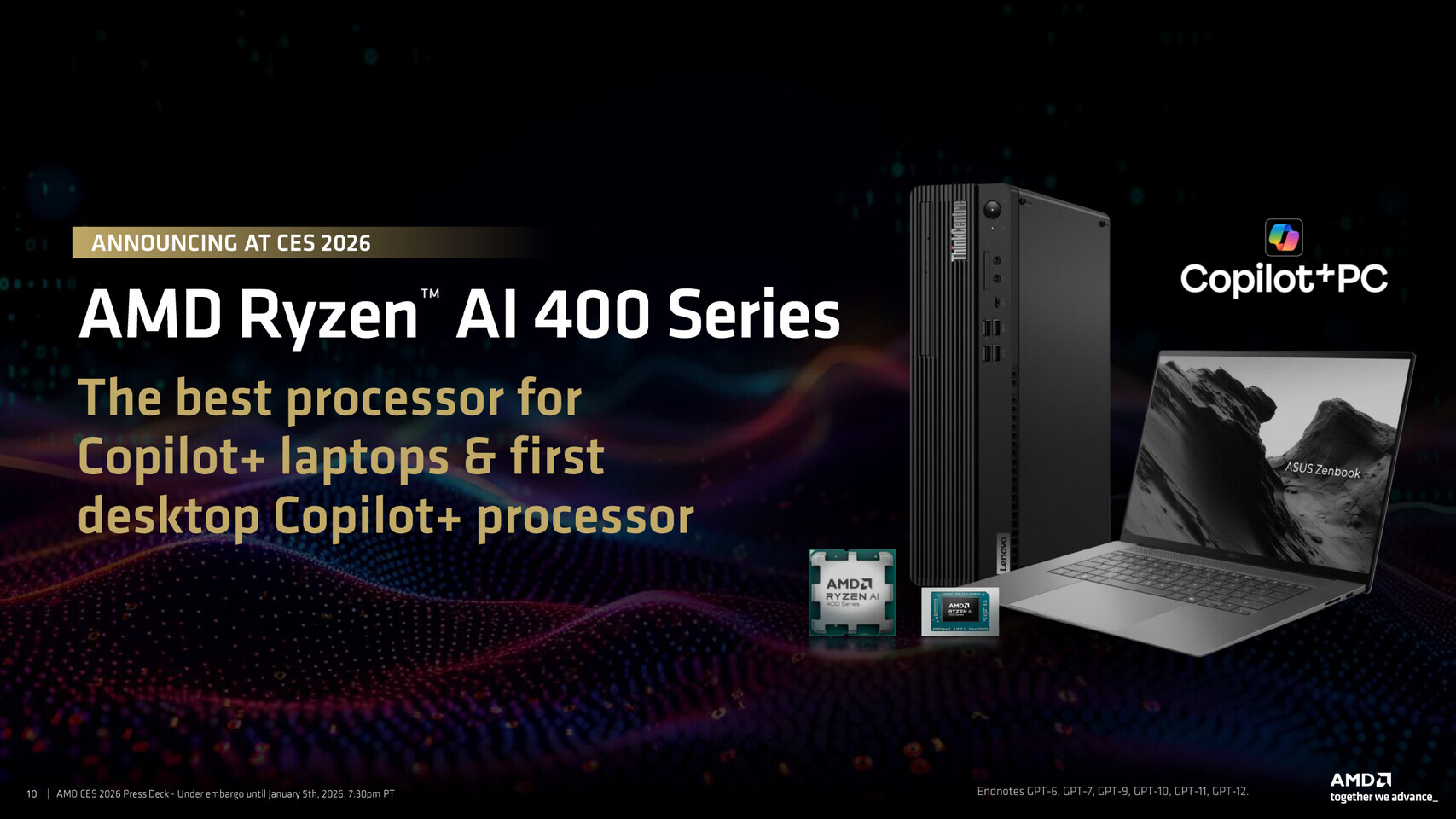

AMD Upends Expectations: Ryzen AI 400 Series Marks Desktop APU Renaissance
Remember when integrated graphics were merely a backup for emergencies? Or desktop APUs felt like mobile cast-offs? Brace for impact. Shifting tactics hinted throughout CES 2026 culminated in a presentation slide leak confirming AMD’s audacious plan: truly next-generation Ryzen AI 400 Series APUs are breaking free from laptops, heading for desktop dominance. This isn’t a mere spec bump—it represents a fundamental rethinking of performance integration, bringing AMD’s cutting-edge 4 nm AI silicon directly to socketed AM5 motherboards. This seismic move signals AMD’s intent to redefine mainstream computing, injecting potent dedicated Neural Processing Units (NPUs) and advanced graphics deeply into the desktop psyche. The implications for creators, developers, and everyday users are profound and signal a deliberate shift away from past desktop APU conventions.
Deciphering the Lenovo Tech World Clue: A Slide Reveals All
The journey to this confirmation was decidedly modern—a blend of trade show absence followed by online vigilantism. While AMD teased select press about the existence of desktop-bound Ryzen AI 400 silicon early the previous week, concrete visuals remained elusive. Speculation focused on the transition of the “Gorgon Point” monolithic chip, initially destined for mobile devices, to the different thermal and performance demands of desktop chassis.
Then, eagle-eyed observers at VideoCardz spotted gold in a social media post. Saša Marinković, AMD’s Senior Director of Global Consumer Marketing, captured CEO Dr. Lisa Su presenting at Lenovo Tech World. Crucially, in the background, a slide projection showcased AMD’s upcoming processor families:
- EPYC: Server CPUs for hyperscale computing.
- Instinct: Accelerators boosting AI/ML workloads.
- Ryzen AI PRO 400: Represented clearly in a desktop socketed format, unmistakably seated on the AM5 platform.
This visual evidence was the missing puzzle piece. Gone was ambiguity – AMD is committing its highest-tier APU branding, centered around AI acceleration, to the desktop arena. This depiction instantly validated rumors questioning the company’s approach beyond the Ryzen 8000G series.
Breaking Tradition: The End of the “G” and the Rise of AI Branding
Prior to 2026, AMD’s desktop APU lineage followed a predictable pattern: Ryzen 5000G (Zen 3) gave way to Ryzen 7000G mobile variants on AM5’s infancy foot-hockey, and expectations pointed squarely towards a Ryzen 9000G series to succeed the Ryzen 8000G (Phoenix) models. CES 2026 was widely anticipated as the launchpad. Instead, AMD disrupted expectations.
- Nomenclature Revolution: The slide featured “Ryzen AI PRO 400”. This strongly indicates AMD intends to align its desktop APUs under the new “Ryzen AI” branding umbrella. References to “Ryzen 9000G” references will likely fade into obsolescence. This consolidation simplifies marketing and communicates the primary technological thrust unambiguously: these chips are about accelerated intelligence.
- Mobile-to-Desktop Parity: Historically, desktop APUs lagged behind their mobile counterparts in architectural adoption or feature sets. Placing the Ryzen AI 400 Series lineage directly onto AM5 signifies AMD treating desktop APUs as first-class citizens, potentially debuting technology simultaneously or very close to mobile counterparts. The monolithic “Gorgon Point” die transitioning effectively, albeit likely with higher power limits, reinforces this.
Zen 5 & RDNA 3.5: The Potential Powerhouse Combination
Leaked information points to powerhouse foundations beneath the AI branding:
-
Zen 5 Core Architecture: Expect tangible generational leaps over Zen 4. Projected gains include:Reference: AMD Zen Architecture Wiki
- Enhanced Instructions Per Cycle (IPC).
- Wider execution pipelines & improved branch prediction.
- Larger caches & improved memory latency handling.
- Support for next-gen technologies like DEEPSLEEP power states.
-
Hybrid Zen 5/Zen 5c Core Configuration: Intel pioneered Hybrid designs with P-cores and E-cores. AMD is expected to follow suit in specific Ryzen AI 400 SKUs, blending standard high-performance Zen 5 cores with dense, power-efficient Zen 5c cores. This aims to deliver:
- Excellent single-threaded performance.
- Strong multi-threaded throughput for productivity.
- Optimized background task handling without stalling main cores.
- Adapting Endeavor core-genius combinations to varied desktop usage patterns.
-
RDNA 3.5 Integrated Graphics: Building upon the proven RDNA 3 technology (found in Ryzen 7000G/RX 7000 GPUs), RDNA 3.5 promises refinements boosting efficiency and performance:Reference: AMD RDNA Wiki
- Potential architectural tweaks enhancing clock speeds or reducing latency.
- Improved Ray Tracing capabilities within integrated graphics – unprecedented for mainstream non-discrete GPUs.
- Meaningful performance uplift for eSports and AAA gaming at modest settings/resolutions.
- Accelerated rendering in creative applications leveraging


