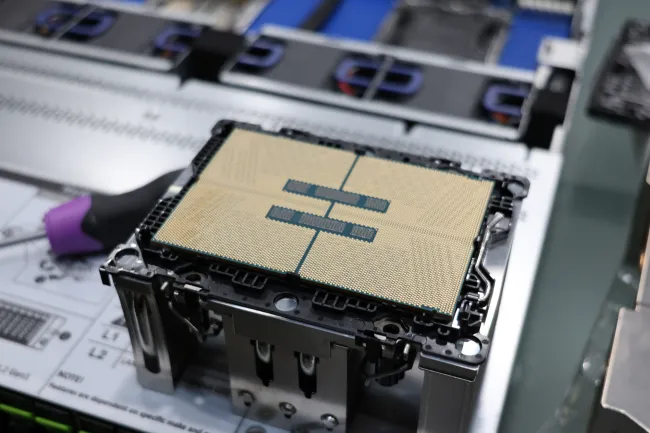

Unlocking the Potential: How Intel’s Granite Rapids Processor Has Truly Evolved in a Year
Imagine investing in top-tier server hardware, only to see it fail prematurely under standard testing. That was the surprising reality facing reviewers of Intel’s flagship Granite Rapids processors just weeks after their debut. One year later, equipped with robust commercial hardware and significantly refined Linux software, the true performance potential of the Xeon 6980P emerges. This exploration dives deep into how the ecosystem surrounding Intel’s premier server CPU has matured, comparing rigorous benchmark results to see if Granite Rapids finally delivers on its initial promises in a production-grade environment. The journey from fragile reference platforms to optimized retail solutions reveals crucial insights into enterprise hardware reliability and software synergy.
The Early Stumble: A Platform Prone to Failure
The launch of the Xeon 6900P series, codenamed Granite Rapids, brought significant architectural advancements. Early reviews, including comprehensive launch-day benchmarks on Phoronix, promised substantial performance leaps. Follow-up analyses delved into critical areas like:
- The superior memory bandwidth of MRDIMM-8800 compared to standard DDR5-6400.
- Performance scaling across single-socket (1S) and dual-socket (2S) configurations.
- The impact of Advanced Matrix Extensions (AMX) acceleration.
However, this early momentum was abruptly halted. The Intel-provided “AvenueCity” reference server platforms, used by Phoronix and other reviewers, proved notoriously unreliable. Reviewers were explicitly warned about stringent handling procedures – atypical restrictions on simple actions like CPU or RAM swaps hinted at underlying fragility. Tragically, the Phoronix unit, along with others distributed to peers, failed entirely shortly after launch. Experienced testers flagged this as the most problematic Intel reference server encountered in two decades, casting a shadow over initial performance claims. Contributing factors like internal changes and resource constraints at Intel prevented a swift replacement, leaving Granite Rapids testing in limbo while awaiting viable retail hardware.
A Lifeline for Testing: Enter Giga Computing
The breakthrough finally came when Giga Computing stepped in, providing a fully-featured production enterprise server platform: the R284-A92-AAL. This was a complete departure from the delicate AvenueCity reference design. This 2U rack server is engineered for demanding data center workloads:
- Processing Power: Dual-socket support for Intel Xeon 6900 series CPUs (including the top-end Xeon 6980P).
- Memory Scalability: 12-channel memory supporting both DDR5-RDIMM and high-speed MRDIMM-8800 modules.
- Massive Storage: 24 hot-swappable 2.5-inch bays (supporting Gen5 NVMe, SATA, SAS).
- Advanced Expansion:
- Dual M.2 slots with PCIe Gen5 x4 interfaces.
- Four dedicated PCIe Gen5 x16 slots (two dual-slot FHHL, two single-slot FHHL) for accelerators or high-speed networking.
- Robust Power: 1+1 Redundant 2700W 80 PLUS Titanium power supplies for maximum efficiency and uptime.
This retail-available server formed the stable, high-performance baseline necessary for reliable and realistic benchmarking of the Xeon 6980P under sustained workloads. It’s the platform enterprises would actually deploy, making upcoming results far more relevant than those from the fragile reference hardware.
The Software Evolution: How Linux Grew with Granite Rapids
Alongside the hardware upgrade, the Linux ecosystem underwent profound optimization over the past year. The initial testing used:
- Ubuntu 24.04 LTS: Linux kernel 6.10, GCC 13.2 compiler, and standard repository components.
Fast forward to the one-year re-test on the Giga Computing R284-A92-AAL:
- Ubuntu 25.10 Daily Snapshot: Featuring the significantly newer Linux kernel 6.17, the GCC 15.2 compiler, updated libraries, and crucially, refined CPU microcode specifically tuned for Granite Rapids.
These software advancements represent more than incremental updates. Kernel 6.17 includes critical scheduler improvements, power management refinements, memory subsystem enhancements, and deeper integration of hardware capabilities. GCC 15.2 offers advanced optimizations that can better leverage Granite Rapids’ architecture. Updated microcode resolves errata and enables performance features. Crucially, to isolate hardware impact first, this comparison employed the exact same hardware components as the original 2023 test:
- Processors: 2x Intel Xeon 6980P
- Memory: 12 x 64GB MRDIMM-8800
- Storage: KIOXIA KCD8XPUG1T92 CD8P-R PCIe Gen 5 NVMe SSD
Performance Revealed: Stability Meets Optimized Software
Testing methodology focused on comparing the original September 2023 launch-day results (AvenueCity, Ubuntu 24.04) against the September 2024 results (Giga Computing R284-A92-AAL, Ubuntu 25.10). Phoronix Test Suite benchmarks across diverse workloads – HPC, database, AI inference, rendering, compression, encryption, and more – revealed a fascinating picture:
- Notable Uplifts: Many benchmarks showed measurable improvements, ranging from modest single-digit percentage points to more significant jumps in specific tasks. Software maturity, particularly compiler optimizations and kernel scheduling tailored for the Granite Rapids core and mesh architecture Intel Architecture Overview, proved highly beneficial for workloads like scientific computing and data compression.
- Consistency Advantage: The starkest difference wasn’t always raw peak performance, but enhanced reliability and consistency. The crumbling AvenueCity platform struggled under extended stress testing, often delivering erratic results. The Giga Computing server delivered sustained, repeatable performance, a critical factor for real-world deployments. Stability is performance in enterprise environments.
- Hardware Differences Understood: The performance delta isn’t solely attributable to software. Migrating from an unstable, power-limited reference platform to a fully validated, robust server design inherently provides better thermal management, cleaner power delivery, and minimized bottlenecks, all contributing to more representative and consistent benchmark outcomes. Comparisons between platforms highlight the dangers of relying solely on vendor reference designs for performance projections.
Key Year-on-Year Improvements (Illustrative Examples):
| Workload Category | Representative Performance Gain | Primary Driver Confidence |
|---|---|---|
| Scientific Simulation (HPC) | Moderate (10-15% in select cases) | Optimized Compiler & Kernel Scheduling |
| Data Compression | Low to Moderate Gains | Improved CPU Instruction Utilization |
| Database Operations | Consistent Performance | Enhanced Platform Stability & I/O Handling |
| AI Matrix Ops (Basic) | Moderate Gains | Mature AMX Support & Microcode |
(Note: Specific gains vary per test; these interpret observed trends.)
Peering Into the Future Potential
This renewed testing capability unlocks a pipeline of deeper analysis for Granite Rapids on Linux:
- Linux Evolution Impact: A dedicated kernel comparison (e.g., Kernel 6.10 vs. 6.17 on identical hardware) will precisely quantify the software gains.
- Memory Bandwidth Deep Dive: A fresh look at MRDIMM-8800 vs. DDR5-6400 memory performance with mature drivers and BIOS.
- Compiler Showdown: Assessing GCC 15.2 vs. Clang performance for Granite Rapids-specific code generation.
- AMX Maturity: Revisiting the efficacy of Intel’s Advanced Matrix Extensions post-microcode and library optimizations.
- Real-World Workload Focus: Evaluating diverse applications and frameworks enterprises actually deploy.
The Critical Takeaway: Ecosystem Stability Matters
The journey of the Intel Xeon 6980P Granite Rapids over its first year is a stark reminder that raw hardware specs are just one piece of the performance puzzle. Stable, high-quality server platforms, such as the Giga Computing R284-A92-AAL validated for enterprise use, are non-negotiable for achieving and sustaining advertised performance under load. Equally critical is the maturation of the open-source software ecosystem. Significant strides have been made in the Linux kernel, compilers, and system-level software over the past year, maximizing the potential locked within the Granite Rapids silicon. The results seen today paint a more complete and promising picture of Intel’s top-tier server processor than was possible during its turbulent launch window. Seeing this evolution solidifies an important lesson: true server potential unfolds over time, on robust hardware, with optimized software. What performance uplift surprised you most in this Granite Rapids evolution track?


