
The Algorithm’s Appetite: Is YouTube Feeding New Users a Tsunami of AI-Generated Slop?
Have you ever clicked a bizarrely captivating YouTube thumbnail promising a “mind-blowing” hack or “unbelievable” facts, only to realize minutes later you’ve watched nonsensical gibberish generated by a machine? You’re not alone. A startling new study by Kapwing reveals that a staggering portion of YouTube recommendations, especially to new users, consists of vacuous, machine-made videos dubbed “AI slop” – low-effort, algorithmically optimized junk designed solely to harvest views. This isn’t just clutter; it’s a systemic challenge reshaping online discovery, diverting attention from human creators, and raising profound questions about platform governance. Understanding the scale and impact of AI slop is crucial for anyone navigating today’s digitally saturated media landscape.
The Scale of Digital Detritus: Unpacking Kapwing’s Findings
Kapwing embarked on a simple yet revealing experiment: creating a fresh YouTube account devoid of viewing history. They then meticulously tracked the first 500 videos recommended algorithmically by the platform. The results were alarming:
- 21% AI Slop: Specifically, 104 videos were classified as verifiably AI-generated content, identifiable by robotic narration, incongruous imagery, recycled templates, and manufactured narratives devoid of authentic human input.
- 33% Brainrot Content: An additional 165 videos (roughly one-third) fell into the broader “brainrot” category. Defined by repetitive loops, hypnotic sequences, nonsensical text overlays, or bizarre scenarios that demand little cognitive effort but induce passive scrolling, this content often blurs the line between AI-generated and human-made low-quality fodder.
Collectively, over half (54%) of the initial recommendations presented to a user exploring YouTube for the first time lacked substantive value. This onboarding experience paints a bleak picture: rather than introducing diverse perspectives or talented creators, YouTube’s algorithm often prioritizes easily digestible, engagement-maximizing fluff.
Beyond Random Clutter: The Massive Global Footprint of AI Slop Channels
Don’t mistake AI slop for a fringe annoyance. Kapwing’s researchers dug deeper, analyzing YouTube’s trending channel rankings across countries. Their discovery? Entire channels built purely on AI-generated sludge are mainstream players:
- 278 Identified Channels: Researchers found 278 distinct channels classified as “100% AI slop” residing within the top 100 trending channels across various global markets. This signifies these channels aren’t hidden corners but actively pushed content factories.
- Billions Served: These channels aren’t obscure. Their combined metrics are staggering:
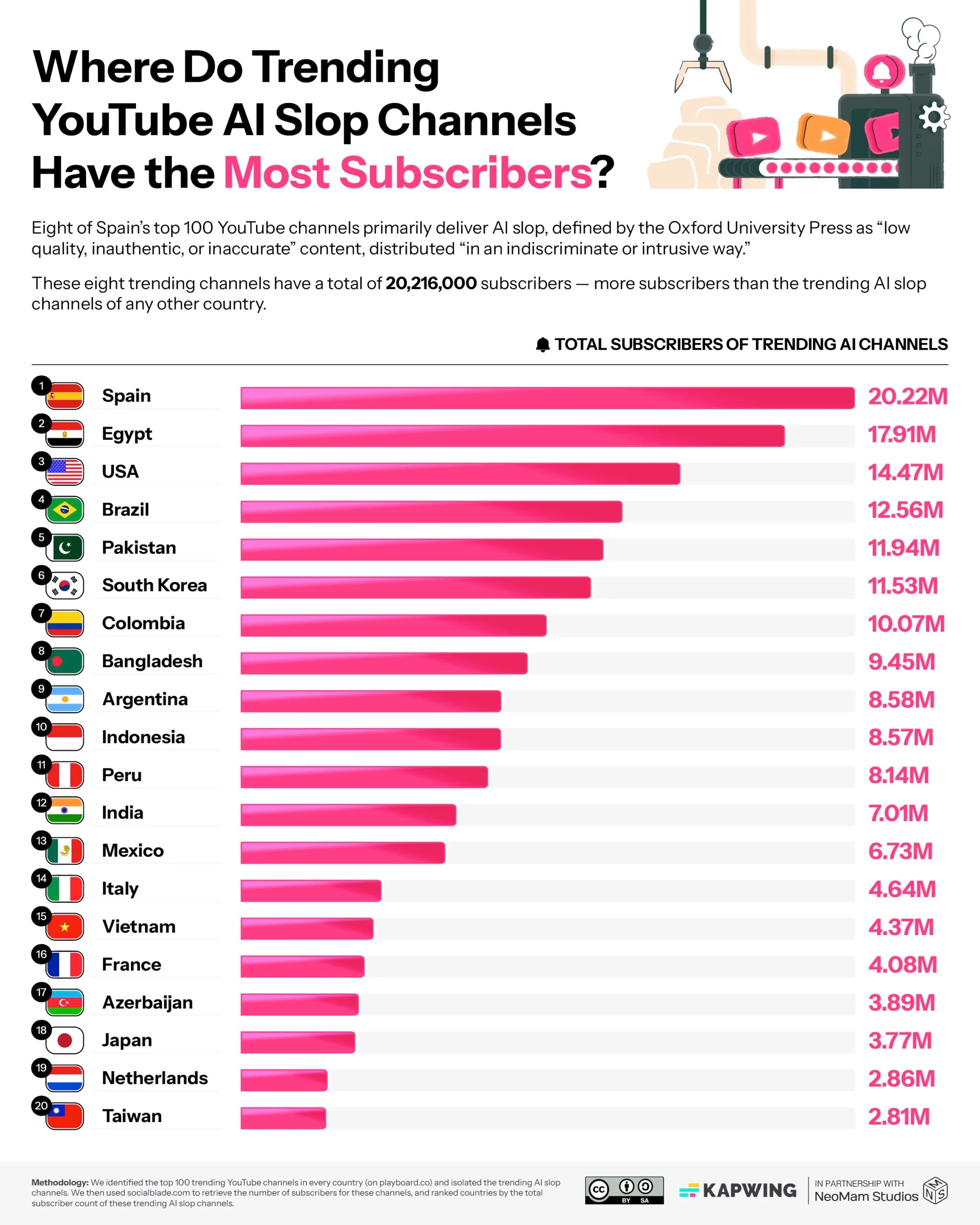
- Subscribers: Tens of millions globally. Spain leads with AI slop channels commanding over 20 million combined subscribers, exceeding totals in larger markets like the US or Brazil.
- Views: Astronomical figures, especially in key regions:
- South Korea: Over 8.45 billion views across AI slop channels.
- India: A single AI slop channel surpassed 2 billion views.
- Significant Ad Revenue: Scalpell LLC analysis highlights that conservatively estimated revenues per 1,000 ad views combined with these view counts translate into tens of millions of dollars annually siphoned towards creators of this inherently low-value content. As noted by computer science research groups (example study on algorithm reward structures), platforms rewarding mere clicks inevitably incentivize volume over value.
| Region | Total AI Slop Views | Key Metric |
|---|---|---|
| South Korea | >8.45 billion | Combined views across channels |
| India | >2 billion | Single largest channel |
| Spain | >20 million | Combined subscribers |
| Global | Tens of millions | Revenue estimate |
Feeding the Algorithmic Beast: Why AI Slop Spreads Like Wildfire
The proliferation of low-quality AI videos isn’t primarily driven by malicious actors. It’s a symptom of deeply embedded platform dynamics skewed towards maximizing user engagement time:
- Economies of Frictionless Production: Generating AI video requires minimal investment. Tools synthesize voices, stitch stock footage or AI-generated imagery, and write basic scripts. This enables creators to flood platforms with voluminous content at negligible cost per piece. As described in MIT Technology Review pieces on synthetic media costs (https://www.technologyreview.com/2023/09/27/1080341), AI drastically lowers barriers to entry in content creation, safely bypassing traditionally resource-intensive processes.
- Algorithmic Optimization: These videos are meticulously crafted for the recommendation engine’s preferences:
- Click-compelling thumbnails (bright, bizarre, promises of shock/revelation).
- Short, repetitive loops encouraging sustained passive viewing.
- Rapid pacing preventing users from seeking a “stop” point.
- Titles leveraging curiosity gaps (“You Won’t Believe What Happened Next!”).
- The New User Trap: Kapwing’s findings illuminate a critical vulnerability: users without established viewing histories. With no personalized data, the algorithm defaults to broad, highly optimized content proven to elicit clicks and prolonged watch time globally. This traps new users in a cycle where their initial impressions and subsequent recommendations are disproportionately polluted by brainrot and AI-generated sludge before organic discovery pathways emerge. A Stanford University paper on algorithmic bias (Link) discusses how such “cold start” problems inherently favour homogenized, sensationalistic content.
The Ripple Effects: From User Experience to Internet Degradation
The dominance of AI-generated content carries profound implications:
- Stifled Creators: Human creators competing against hyper-efficient AI slop factories face an uneven battlefield. Genuine, nuanced content struggles for visibility against mass-produced, algorithmically favored fluff flooding recommendations. Niche topics suffer particularly.
- Misinformation Pathways: While Kapwing’s study focused on low-quality gibberish rather than overt disinformation, the method used is identical. Flooding platforms with plausible-looking videos manufactured at scale creates pathways for disinformation actors hiding harmful narratives amidst the sludge. Stanford Internet Observatory studies underscore this tactic (https://seo.stanford.edu/).
- Degraded Information Ecosystem: An AWS institute report cited by Kapwing suggests 57% of the entire internet might constitute “AI sludge” – translated text, synthetic summaries, templated blogs – severely diluting the web’s informational integrity. Tools like DuckDuckGo’s “AI Downgrade” filter and extensions like “Slop Evader” are direct responses, attempting to clean users’ feeds by filtering out detectable AI-generated text and visuals and reverting website designs.
- The Platform Dilemma: Platforms like YouTube prioritize engagement metrics. Kapwing’s findings force an uncomfortable question: If significant fractions of highly-engaged views come from AI slop designed purely to trigger passive consumption, how sustainable is this model for cultivating genuine user connection or fostering valuable content creation long-term? TikTok’s moves towards labeling AI-generated content indicate platforms are grappling with this, but Kapwing argues stronger user controls are needed.
Navigating the Slop: Beyond Platform Fixes
Addressing the AI slop flood requires multifaceted solutions:
- Platform Adaptations: Explicit labeling of AI-generated content, enhanced tools allowing users to limit exposure to synthetic media, and re-evaluating recommendation algorithms to prioritize genuine engagement signals or verified creators are crucial first steps. Wayback Machine archives (archive.org) ironically become tools to recall what user-centric content discovery felt like.
- Critical User Literacy: Users must cultivate skepticism towards bizarrely addictive low-effort videos and actively train algorithms by selectively subscribing and sharing authentic creators. Software tools (Slop Evader, AI filters) offer aid.
- Ethical AI Development: Financial incentives driving large-scale AI slop production demand consideration. Can creators harness AI efficiencies without sacrificing value? Could AI be directed towards automating mundane tasks to free creators for deeper work?
The revelation that over half of YouTube’s welcoming committee for new users consists of vapid AI slop isn’t just a quirky internet phenomenon; it’s a symptom of priorities clashing with quality. As generative AI tools grow exponentially cheaper and more accessible, the challenge intensifies. Platforms must decide: Will engagement metrics continue to crown the king, regardless of content provenance? Or will we consciously reshape recommendation algorithms to foster genuine connection and discoverability? The quality of our collective digital experience hangs in the balance. Perhaps it’s time to demand more substantial fare from the algorithmic feast. What steps do you think platforms and users should prioritize to combat AI sludge?


