
Unlocking Language Mastery On Your E-Reader: How Kindle Became My Secret Tutor
Imagine investing hundreds in language apps and courses, only to discover your dusty old Kindle holds the key to genuine fluency. That’s the surprising reality I stumbled into. Is it possible that a simple e-reader, designed for leisure reading, can outperform dedicated language learning tools for building vocabulary, enhancing comprehension, and fostering immersion? The answer, revealed through my journey with Spanish, is a resounding yes. What began as a convenient way to access Spanish short stories transformed my Kindle foreign language learning journey into something deeply immersive and fundamentally effective. This powerful, often overlooked device offers tools that create a portable, personalized language lab, seamlessly integrating practice into daily life and making progress feel effortless and natural.
From Frustration to Fluency: The Power of Instant Translation
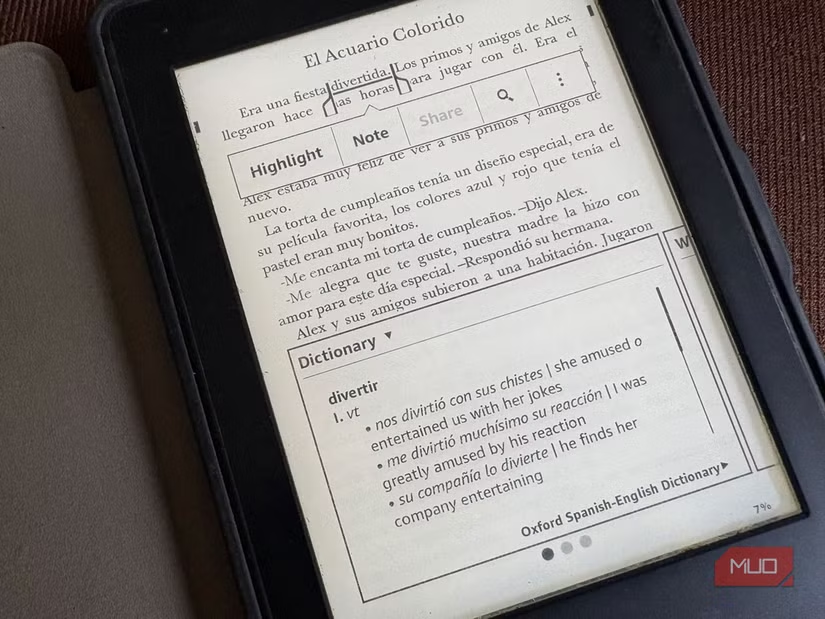
The initial hurdle in reading a foreign language is ubiquitous: the unknown word. My early attempts resembled a frustrating juggling act – Kindle in one hand, phone frantically open to Google Translate in the other, constantly breaking my focus. I nearly gave up. Then I discovered the Kindle’s unsung hero: its built-in dictionary and translation system. A simple tap on any word instantly reveals its meaning in your chosen language. This transformed the reading experience from stop-start agony into smooth sailing.
The real epiphany came when I switched to a monolingual dictionary. By navigating Settings > Language & Dictionaries > Dictionaries on my Paperwhite and selecting a Spanish-Spanish dictionary, I forced my brain to think in Spanish. Instead of translating “casa” back to “house,” the definition might present “edificación para habitar.” This small cognitive leap significantly boosted my comprehension and accelerated fluency over time. Installed dictionaries are neatly organized in the Collections folder at the end of your Library view. This immediate, contextual access ensures vocabulary is learned not in isolation, but embedded within stories and ideas, enhancing retention – a core principle of language acquisition.
Building a Robust Vocabulary: Beyond Ephemeral Notes
We’ve all been there: diligently scribbling new words into a notebook only to forget it exists. Kindle’s Vocabulary Builder directly tackles this flaw. Every single word you look up using the dictionary is automatically captured and stored within this feature. Suddenly, your sporadic lookups become a personalized database. The beauty lies in the built-in flashcard system. You can actively review these words, marking them as “Mastered” once you’re confident, creating an automated, contextual revision tool.
- My Routine: I commit to reviewing just five words daily. Known words get “Mastered.” The tricker ones get manually copied (typing them reinforces memory!) into a powerhouse spaced repetition system (SRS) like Anki. This leverages the scientifically proven spacing effect, where reviewing information at increasing intervals drastically improves long-term recall. Yes, the lack of a bulk export feature is inconvenient, but the manual transfer itself becomes a valuable learning step. You can also highlight difficult words and illustrative sentences, enriching your flashcard review with crucial context. Context is king for moving vocabulary from passive recognition to active use.
Opening the Literary Floodgates: Beyond the Kindle Store
Relying solely on Amazon for content is costly and limiting. I unlocked a universe of free material by sideloading books. Public domain goldmines like Project Gutenberg and the Open Library offer countless classics, folk tales, and more in numerous languages. Simply download the EPUB or compatible file and email it to your Kindle’s Send-to-Kindle address with the subject line “Convert”. Kindle instantly transforms it into a readable, dictionary-compatible file.
For beginners, graded readers are indispensable. These are stories specifically written for different proficiency levels (A1, A2, B1, B2, C1, C2). Starting with A1 materials when I was struggling prevented overwhelming frustration. They scaffold success, introducing manageable vocabulary and grammar structures, building confidence and momentum crucial for lasting motivation. Sites like LearnLanguagesThroughStories.com or LingQ (which has a vast library, including free content) specialize in leveled texts, though the Kindle easily imports materials from anywhere.
Your Personalized Phrasebook: Beyond Random Highlights
Passive highlighting is useless; active review is transformative. Transforming Kindle highlights into a structured knowledge base was revolutionary. My tool of choice is Notion – a phenomenal app for organizing complex information. As I read on my Kindle, I highlight useful phrases, idioms, captivating sentences, and examples of tricky grammar structures. All Kindle highlights (for books purchased and sideloaded) sync automatically to read.amazon.com/notebook.
Here, I systematically curate them:
- Copied: Transferred to Notion into categorized sections (Phrases, Grammar Patterns, Beautiful Sentences).
- Categorized: Tagged by topic, difficulty, or theme.
- Reviewed: Integrated into daily or weekly revision sessions. This curated collection becomes my personal phrasebook, far more relevant than any generic one. For sideloaded books, exporting highlights as a TXT file provides raw data to import into Notion or other platforms like Obsidian or a simple spreadsheet. Review snippets during idle moments – commuting, waiting in line – maximizes passive time.
Mastering Sound and Rhythm: Audiobook Synergy & Text-to-Speech
Reading comprehension is just one pillar; listening and pronunciation are equally vital. Kindle’s Whispersync for Voice technology is a game-changer. Purchasing a Kindle eBook often allows adding the Audible narration at a steep discount. Now, I can read the Spanish text while simultaneously listening to the professional narration. Hearing the natural flow, intonation, and pronunciation while seeing the words on the page creates powerful neural connections. It significantly accelerated my listening comprehension – I started catching nuances and subtle sounds previously lost. Bilingual storybooks with matching Audible versions are particularly potent, letting you flick between languages instantly to verify meaning without disrupting the narrative.
When human narration isn’t available, Text-to-Speech (TTS) steps in. While not perfect (it lacks the natural cadence of a human), it’s surprisingly effective, especially on the Kindle app (iOS/Android). Switching your phone’s system voice to a native speaker of your target language (e.g., a Spanish voice for Spain) allows your Kindle app to read any book aloud. It’s my go-to for tired eyes. Following the text while listening boosts exposure to correct pronunciation. I often use this for shadowing practice: pausing after a sentence and mimicking the TTS voice aloud, replicating its rhythm and intonation – a cornerstone technique for accent reduction.
Deconstructing Language: Parallel Texts and Thematic Organization
For intermediate learners, the mental load shifts from basic vocabulary to understanding how the target language constructs meaning differently. Parallel text books are invaluable here. These editions display the original language (e.g., Spanish) alongside a high-quality translation (e.g., English), usually paragraph-by-paragraph or page-by-page. Seeing the “how” and “why” behind translations illuminates grammar complexities, nuanced idioms, and cultural expressions in a way no grammar drill can. While I found them initially available on Amazon, dedicated language publishers often offer superior scholarly editions.
Structure breeds motivation. I abandoned the chaos of a single, massive “Spanish” collection. Instead, I meticulously organized my library using Kindle Collections labeled by CEFR level (A1, A2, B1, etc.) and theme (Grammar, Short Stories, Dialogues, Novels). Finishing an A1 book and moving it into the A2 folder provides a tangible, deeply satisfying marker of progress. It offers the subtle reward recognition of gamified language apps, without forced notifications, fostering intrinsic motivation. This simple system reminds me constantly of how far I’ve journeyed and what exciting challenges await, keeping me consistently engaged.
The Silent Immersion Engine: Why Reading Reigns Supreme
After years navigating flashcard mountains, grammar drill valleys, and the ever-tempting siren call of new language apps, my profound realization was this: nothing replicates the deep, contextual, sustained exposure of reading. The Kindle became, almost invisibly, my most effective language immersion tool. It sidesteps the artificiality of “study sessions.” Immersing myself in stories, articles, or dialogues simply feels like reading. Opting for native sources over sanitized learning materials accelerates familiarity with authentic language patterns and cultural context. Consistent, compelling content sustains motivation inherently. Paired with Audible, TTS, vocabulary building, and active highlighting review, it creates a continuous feedback loop of learning. This constant, enjoyable engagement within the language – effortlessly integrated into everyday downtime – is the irreplaceable magic that transforms knowledge into intuitive understanding and fluency. That organic feeling of progress is priceless.
Forget the costly subscriptions and intense flashcards gathering dust. The versatile foundation for genuine language acquisition might be quietly waiting in your bag or on your nightstand. Turning your Kindle into a sophisticated language learning accelerator hinges on strategically combining its native features – taps, dictionaries, flashcards, highlights – with smart external tools (Notion, Anki, Audible) and accessible content sources. The essence isn’t merely skimming text; it’s thoughtful engagement: defining words in context, listening and repeating, systematically building personalized resources, and progressively challenging yourself with authentic materials. It transforms passive consumption into active acquisition. Ready to breathe new life into your language journey? Dust off that Kindle, tweak those settings, and unlock its potential. What’s the first language story you’ll dive into? Share your Kindle language hacks below!


