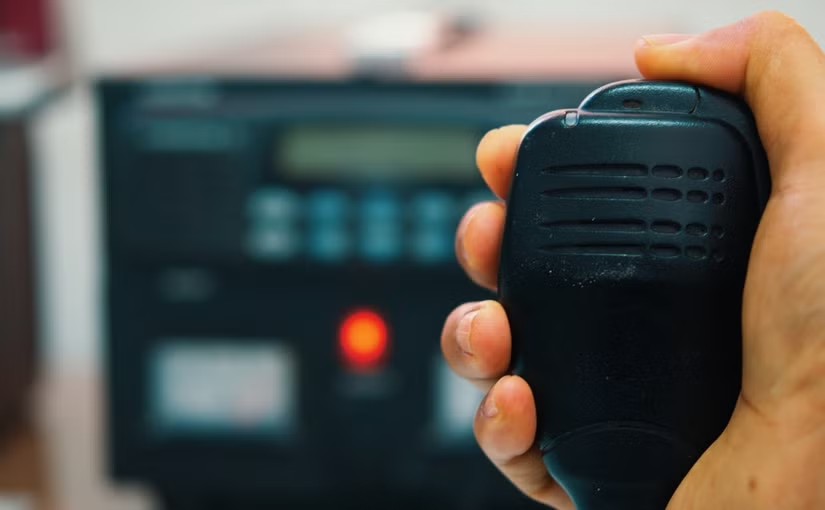

The Unseen Lifeline: Why Your Smartphone Isn’t Enough in a Blackout World
Imagine a hurricane tears through your city. Cell towers collapse, internet cables snap, and suddenly, your smartphone becomes little more than a sophisticated paperweight. How would you call for help or know if your loved ones are safe? This exact scenario played out during Hurricane Helene and countless other disasters, highlighting a critical truth: our hyper-connected world relies on fragile infrastructure. Enter the humble ham radio license. Often dismissed as outdated tech, amateur radio thrives precisely when modern systems fail. Mastering this enduring skill isn’t just nostalgia; it’s a tangible tool for resilience, connection, and even career advancement in our unpredictable world.
Navigating the Airwaves Legally: Understanding Ham Radio License Tiers
Operating on amateur radio frequencies isn’t a free-for-all. The Federal Communications Commission (FCC) mandates licensing to prevent interference with critical services like aviation, emergency responders, and military communications. There are three escalating license levels in the U.S., each unlocking distinct privileges:
- Technician: This entry-level license requires passing a single 35-question exam covering regulations, basic electronics, and operating procedures. It grants primary access to frequencies above 30 MHz (VHF/UHF bands), enabling robust local and regional communication across North America, plus very limited access to global HF frequencies. Perfect for beginners delving into local nets, digital modes, and FM repeater use.
- General: Passing another 35-question exam (after obtaining Technician) unlocks this intermediate tier. Crucially, it opens up significant privileges on HF bands (shortwave), enabling reliable long-distance voice and data communication worldwide via ionospheric reflection. This is where amateur radio transcends local chatter, connecting continents on solar power and minimal equipment.
- Amateur Extra: The pinnacle demands passing a challenging 50-question exam after meeting Technician and General requirements. It provides unrestricted access to all U.S. amateur bands and modes. This deep knowledge is prized by serious experimenters, satellite operators, low-power enthusiasts, and those seeking access to exclusive slices of spectrum reserved for top-tier operators. Licenses are valid for ten years with straightforward renewal.
Disaster Lifeline: When Every Other Communication Channel Falls Silent
Modern telecommunications form an intricate, yet brittle, web. Natural disasters like Hurricane Maria in Puerto Rico (2017) showcase its fragility. When Maria struck, it obliterated Puerto Rico’s entire telecom infrastructure overnight. The island went dark. In this void, FCC-licensed amateur radio operators (“hams”) became the nervous system for relief. The Red Cross urgently appealed for volunteers, and hundreds responded:
- Hams passed casualty reports, supply requests, and critical messages using HF radios to reach the mainland when local systems were destroyed.
- Operators set up temporary stations coordinating life-saving logistics for supplies and medical aid distribution.
- Operators acted as relays between isolated communities and emergency operations centers.
The FCC itself recognizes Amateur Radio’s vital role in disaster recovery, often designating it a formal component of FEMA’s National Incident Management System. Personal accounts, like those during Helene, reinforce this: “Communications became extremely spotty… days when I couldn’t call anyone.” Radio, powered by generators, batteries, or even solar panels, remains resilient. Having a license isn’t just about yelling for personal help; it empowers you to actively assist others by joining groups like the Amateur Radio Emergency Service (ARES) or Radio Amateur Civil Emergency Service (RACES).
Beyond Civilization’s Edge: Your Voice in the Wilderness
Disasters aren’t the only places where cell signals vanish. For adventurers, the connection gap poses inherent risks:
- Hikers/Kayakers: Deep canyons, dense forests, and mountainous terrain frequently block cellular signals. A portable VHF/UHF rig provides a vital safety net.
- Off-Roaders/Overlanders: Exploring deserts or remote trails? Ham radio offers reliable comms when miles from the nearest cell tower.
- Aviation (Private Pilots/MARS): Pilots often hold licenses for air-to-ground communication frequencies managed by groups like the Military Auxiliary Radio System (MARS).
- Off-Grid Living: For homesteaders, radio provides critical contact with the outside world without relying on external infrastructure.
According to data compiled by the U.S. Forest Service (linked via FCC resources), large swathes of wilderness and rural America, encompassing roughly 40% of land area, suffer unreliable or nonexistent cellular coverage. Satellite messengers are popular but require a subscription and clear sky views; ham radio, operating peer-to-peer without dependence on satellites, fills this gap effectively. Being able to directly communicate real-time coordinates or needs to a search team dramatically increases survival odds during emergencies far from help.
A Surprising Career Catalyst: Radio Skills Beyond the Mic
While operating a rig might not be core to most jobs, possessing a ham radio license signals valuable transferable skills highly desirable in numerous fields:
Industries That Value Ham Radio Skills:
| Industry | Direct Relevance | Transferable Skills Demonstrated |
|---|---|---|
| Emergency Services | Direct radio comms, incident command support | Crisis comms protocols, radio procedure, logistics, problem-solving |
| Engineering | RF design, antenna systems, signal propagation analysis | Electronics theory, troubleshooting, hands-on technical skills |
| Information Tech | Network protocols (esp. digital ham modes), cybersecurity basics | Understanding protocols, data transmission concepts |
| Aerospace/Aviation | Air-ground comms (MARS), coordination | Clear concise comms, system knowledge |
| Broadcasting/Tech | Signal processing, frequencies | Audio concepts, spectrum understanding |
- Technical Expertise: Studying for license exams builds a foundational understanding of radio wave propagation, electronics, antenna theory, digital protocols, and troubleshooting – directly applicable to electrical engineering, computer networking, consumer electronics design, and even cell tower technology (IEEE Spectrum often highlights these crossovers).
- Operational Skills: Clear communication discipline (using phonetics, standardized protocols), meticulous logging, rapid problem-solving under pressure (crucial during equipment failure or at-sea adventures), understanding complex regulations – these soft skills enhance teamwork, project management, and operational maturity prized by employers.
- Resume Differentiation: In competitive fields like aviation or emergency dispatch, a ham license demonstrates initiative, technical aptitude, and commitment to communication mastery – instantly setting a candidate apart.
Connecting Worlds: From Your Backyard to the Space Station
Beyond practicality, ham radio offers unique experiences impossible elsewhere:
- Chatting with Astronauts: Programs like Amateur Radio on the International Space Station (ARISS) allow licensed operators worldwide to schedule direct vocal contacts with astronauts aboard the ISS ([NASA’s ARISS page](https://www.nasa


