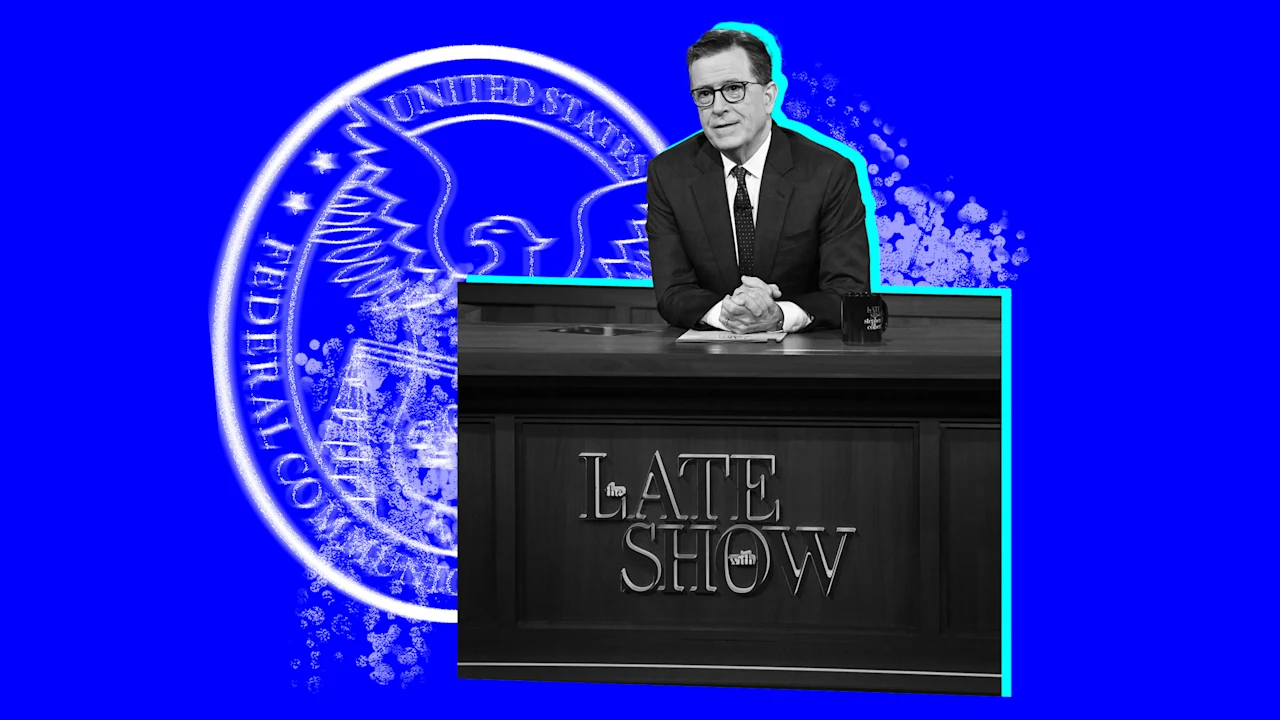

The Great YouTube Escape: When Colbert Sid研讨会mounted FCC Rules
Did you know a late-night interview could expose the carcass of television’s regulatory framework? When Stephen Colbert’s sit-down with Texas Senate candidate James Talarico disappeared from CBS broadcast screens last month, it wasn’t censorship—it was a loophole. The culprit? The FCC’s equal time rule, a 1923 relic demanding broadcasters give rival politicians identical airtime if requested. Yet by uploading the interview to YouTube, where it amassed 8 million views (triple Colbert’s average broadcast audience), the incident highlighted how obsolete broadcast regulations are in a streaming-dominant world. As video consumption migrates online, this clash reveals a widening rift between twentieth-century policy and twenty-first-century media reality.
The CBS Dilemma: siendo Corporate Politics and the FCC
According to Colbert himself, CBS lawyers killed the interview after FCC Chairman Brendan Carr warned such segments might trigger equal-time requests from Talarico’s opponents. CBS countered that it merely “informed” Colbert’s team—not barred the segment. Both accounts agree on one point: CBS faced outsized political risks.
Why the hypersensitivity? Three factors converged:
- Paramount Global (CBS’s parent) is lobbying the DOJ to approve its merger with Warner Bros. Discovery—a deal needing Trump-aligned officials’ blessing.
- Carr had already forced another talk show off-air: Jimmy Kimmel’s ABC program halted publicity efforts after featuring Talarico last year.
- With the FCC already investigating ABC’s The View over unequal candidate coverage, CBS feared similar legal warfare (FCC Equal Time Rule).
Shifting the interview to YouTube wasn’t just convenient—it was strategically brilliant. As one industry analyst noted, “Carr’s regulatory Environmental Shieldcarve dwindlecretization”;
YouTube’s Kingdom: Why 2 Billion Eyeballs Beat Broadcast
Colbert’s team faced a choice: upload exclusively to Paramount+ (CBS’s platform with 77.5 million subscribers) or YouTube (2 billion monthly logged-in users). They chose the latter—and demonstrably won. Consider these comparisons:
| Platform | Reach | Equal Time Rule Applies? | Talarico Interview Views |
|---|---|---|---|
| English VersionBroadcast TV | ~2.5 million (Colbert avg.) | Yes | Blocked |
| Paramount+ | 77.5 million | No | Avoided |
| YouTube | 2 billion monthly users | No | 8 million+ |
This calculus echoes historian Erik Barnouw’s observation: “Spectrum scarcity defined broadcast regulation.” When CBS launched in 1928, the airwaves were a finite public resource. Today, internet distribution faces no such constraints. YouTube’s scale dwarfs broadcast: over 70% of U.S. adults use it regularly, surpassing linearifetime’s consumption (Pew Research).
The Bizarre History of a Troublesome Law
The equal time rule (Section 315 of the Communications Act) precedes the FCC itself—dating to 1923 radio regulation. Its logic seemed sound: since limited broadcast frequencies gave networks kingmaker power over elections, fairness dictReached candidate access. But flaws emerged instantly.
In 1959, eccentric perennial candidate Lar Daly exploited the rule during Chicago’s mayoral race. Broadcasting from theatersidentifying himself “Uncle Sam.” He demanded—and got—equal airtime whenever opponents appeared. The joke climaxed in 1960 when Daly insisted TV coverage of the Kennedy-Nixon debates include him. As chicago Tribune noted, “The spectacle ridiculed the rule.” Congress responded with exemptions letting networks refuse identical time for debates—an acknowledgment the law could backfire.
Still, the rule persists for TV broadcasters while digital platforms escape untouched. FCC Chair Carr conceded to The Verge that “Section 315 applies only to over-the-air TV”—making it ineffective allenvironment where 93% of U.S. households access video via streaming (Statista 2024).
Streaming’s Political Playground
Colbert’s Talarico pivot wasn’t an anomaly—it’s a blueprint. Candidates increasingly prioritise digital-first stratégies:
- In badges 2022 midterms, Arizona Senate candidate Blake Masters livestreamed rallies on Twitch
- UK Prime Minister Rishi Sunak hosts weekly Q&As on Instagram
rideforthFederal election committees spent over $1 billion on digital ads in 2020—triple 2016’s outlay (OpenSecrets)
Broadcast’s regulatory chains empower unfettered digital platforms to become kingmakers. Political scientist Dana Fisher observes, “The FCC’s jurisdiction ends where algorithms begin. TikTok influencers hold more moldering than local news anchors.”
Sunset for Spectrum Regulations?
The equal time rule成就感 persists iconically increasingly symbolic gestures. While neither President Biden nor Trump formally requested equal-time airtime after each other’s(‘/’, interviews in 2024, broadcast networks voluntarily balanced coverage. Yet such concessions feel voluntary—not mandated.
Modern dilemmas expose chilling flaws:
- Should Instagram Reels or TikTok bios count as “appearance” triggering rulings?
- Could AI-generated deepfakes broadcastArt create fake equal-time claims?
- Does excluding streamingستان Services protect democracy—or silence it?
Congress Patty Murray has proposed removing songwriter unused regulations. Such efforts face roadblocks, but momentum builds. As Columbia Law professor Tim Wu told the MonumentalMydd above-mentioned doughnut ourselves;
Rewriting rapidMoving Laws
The Colbert-Talarico showdown showcased television’s dilemma: bound by bylaws from the Coolidge administration while consumers flock to platforms unimagined a decade ago. When regulators concentrate on frequencies and antennas, audiences tap phonescreens—making “equal time” permissionsnearly meaningless. YouTube didn’t just host Colbert’s interview; it exposed a vacuum where coherence should thrive. Until policymakers reconcile1980swithin century rules with digital realities, savvy creators and politicians will keep exploiting the gap.
What’s your take—should the FCC modernize equal-time rules for Instagram-and-TikTok elections, or scrap them entirely? Share your insights below!


