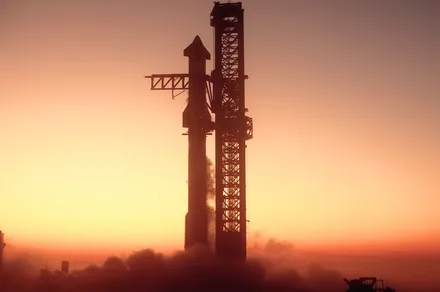

Launch Windows & Lunar Horizons: Starship Prepares Its Boldest Flight Yet
What does it take for humanity to become a true interplanetary species? The answer, according to SpaceX, lies not just in ambition, but in colossal rockets undergoing relentless testing. Brace yourselves: SpaceX CEO Elon Musk recently announced via X that the 12th integrated test flight of the immense Starship system could occur as early as March. This milestone won’t merely mark another blast from Boca Chica – it heralds the maiden voyage of an entirely new Starship generation, version 3, equipped with critical upgrades essential for missions to the Moon, Mars, and beyond. The significance of this upcoming flight extends far beyond spectacle; it’s a crucial progression in validating technologies pivotal to NASA’s Artemis III lunar landing and forging humanity’s path deeper into the solar system.
Starship Ascendant: Introducing Version 3
The upcoming flight (IFT-12) promises several notable firsts. For starters, it will roar to life from SpaceX’s burgeoning Starship Pad 2 at Starbase in South Texas. Pad 2 represents an expansion of SpaceX’s ground infrastructure, designed to support increased launch cadence critical for development and operational missions-child=”true”. Furthermore, this launch will deploy Starship V3 for the very first time. While resembling its predecessors visually, V3 incorporates significant enhancements:
- Increased Stature: Fully stacked height grows from 123.3 meters to 124.4 meters – a subtle yet indicative change of internal optimization.
- Enhanced Lift Capacity: Payload capacity receives a substantial boost compared to Starship V2, allowing economically heavier cargo or scientific payloads.
- The Crucial Upgrade – Pump Rearmament: Perhaps the most vital V3 feature is the integration of advanced docking adapters specifically designed for orbital propellant transfer. This tackles the fundamental challenge of deep-space travel head-on.
The criticality of orbital refueling, often termed “orbital refill,” cannot be overstated. Starship’s enormous payload capacity to Low Earth Orbit (LEO) comes with a trade-off: its immense fuel consumption means traveling directly to the Moon or Mars without refueling is impossible. V3’s new docking interfaces are engineered to facilitate intricate ‘ship-to-ship’ fuel transfers in orbit. Successfully mastering this complex ballet is the keystone unlocking Starship’s


