
From Speed King to Lagging Star: Why Malaysia’s High-Stakes 5G Gamble Is Faltering
Imagine launching one of the world’s fastest mobile networks, only to watch its performance collapse spectacularly within two years as millions jump aboard. This isn’t a hypothetical nightmare; it’s the stark reality unfolding in Malaysia’s ambitious 5G rollout. Boasting impressive coverage exceeding 82%, the dream of unmatched connectivity is crumbling under crushing demand and a controversial transition to dual networks, raising profound questions about cost, efficiency, and the true path to digital leadership.
The numbers paint a shocking picture. According to Ookla’s detailed analysis, Malaysia’s median 5G download speed collapsed by a staggering 46%, plummeting from 451.79 Mbps in Q4 2023 to just 242.92 Mbps by Q3 2025. Upload speeds fared no better, plummeting 41%. This “deteriorating performance,” as Ookla noted, stands in stark, embarrassing contrast to stable gains in neighboring markets like South Korea (consistently above 528 Mbps) and Singapore (near 350 Mbps).
The Rise and Fall of the Single Wholesale Dream
Malaysia’s initial trajectory seemed bold and efficient: a state-owned Single Wholesale Network (SWN) operated by Digital Nasional Berhad (DNB). By centralizing infrastructure, the government aimed to accelerate rollout and avoid costly duplication. Initially, it worked. Late 2023 saw blistering speeds. Then came the tidal wave of users. 5G subscriptions exploded, rocketing six-fold from 4.6 million in November 2023 to 28.7 million by November 2025. User penetration exceeded 53% by end-2024.
The SWN model, DNB’s shared infrastructure serving all major telcos (CelcomDigi, Maxis, Yes, U Mobile), buckled catastrophically under this unprecedented load. A fundamental limitation emerged: all traffic funneling through a single pipe, using a finite pool of spectrum, inevitably led to spectrum congestion. The sheer volume crippled the network DNB had built, transforming what was once a speed champion into a lagging contender. (Source: Malaysian Communications and Multimedia Commission (MCMC)
Entering Uncharted Territory: The Dual-Network Pivot
Facing intense pressure, the government pivoted dramatically. DNB’s monopoly was terminated on December 31, 2024. By March 2025, U Mobile was formally launched as Malaysia’s second 5G network operator. This transition, however, came with significant immediate costs and unresolved long-term questions:
- Spectrum Sacrifice: To accommodate U Mobile’s competing network, DNB was forced to surrender half its vital 3.5GHz spectrum holdings – dropping from 200MHz to just 100MHz. This fragmentation directly attacked network capacity.
- DNB’s Warnings Realized: DNB had warned back in December 2022 that spectrum splitting would degrade performance and necessitate an additional 8,000 sites costing a massive RM5.4 billion to maintain quality. Their prediction proved prescient.
- Belated Spectrum Boost: Only in October 2025, via Ministerial Direction No. 7, did the government allocate an additional 100MHz (3.3-3.4GHz) to DNB – a tacit admission of the earlier capacity crunch. “Certain spectrum was taken away from us, but now, it is being reassigned to DNB,” acknowledged CEO Datuk Azman Ismail.
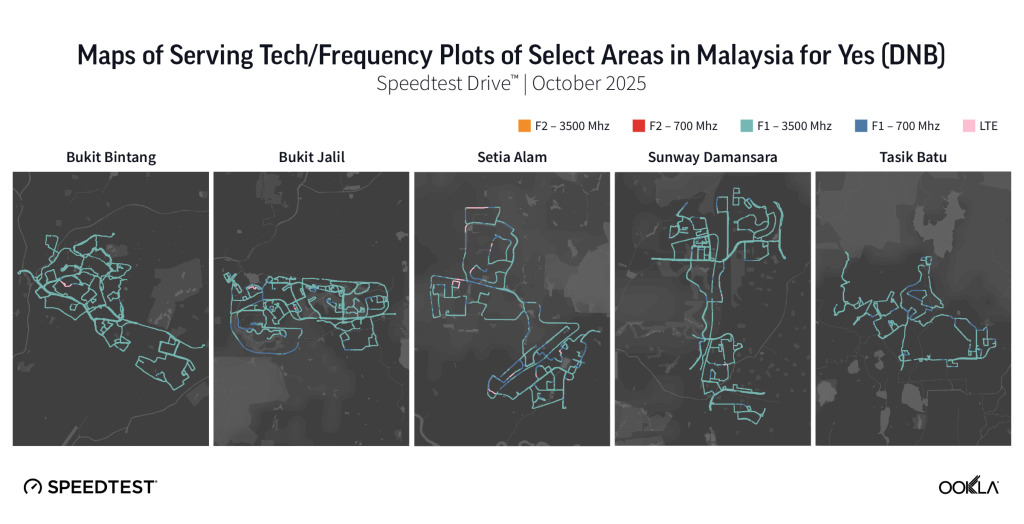
- Massive Dominance Persists: Even with U Mobile building its network, DNB carried a colossal 84.2% of Malaysia’s total 5G traffic as of October 2025, serving nearly 29 million subscribers. U Mobile’s own network handled a mere 16.8% of its users’ connections then, revealing the sheer scale of the build-out still required (Source: Ookla Speedtest Drive analysis)
The Persistent Hole in the Coverage Map: Rural Disconnect
Boasts of “82.4% coverage” obscure troubling geographic inequality. Beneath the headline figure lie persistent gaps, particularly in rural heartlands:
- Sarawak and Sabah had coverage trailing significantly at 62% and 68.6% respectively as of mid-2025.
- Coverage plateaued throughout 2025, stuck at 82.4% from February onwards – signaling significant hurdles in harder-to-reach regions.
The economics of rural deployment remain a fundamental barrier. Gayan Koralage, Strategy Director at Edotco Group (Asia’s leading integrated telecommunications infrastructure services company), highlighted the stark imbalance: rural towers typically cost three times more to deploy than urban ones while generating only one-third the revenue. While initiatives like JENDELA (National Digital Network) saw Edotco deliver over 100 rural towers, the sustainability of unsubsidized rural expansion remains questionable.
The dual-network approach intensifies these concerns. Koralage pointedly questioned, “whether the dual-network model will accelerate or complicate rural deployment,” fearing potential parallel infrastructure inefficiencies diverting resources.
| Region | 5G Coverage (Mid-2025) | Key Challenges |
|---|---|---|
| National Average | 82.4% | Plateaued growth, urban focus |
| Sarawak | 62.0% | Terrain, lower population density, high deployment costs |
| Sabah | 68.6% | Similar challenges to Sarawak, remote areas |
| Klang Valley (Urban) | >95% (estimated) | Spectrum congestion, high population density |
U Mobile’s Everest: Building a Competitive Network Overnight
Having divested its 16.28% stake in DNB in May 2025, U Mobile faces a monumental task:
- Massive Build-Out Commitment: Partnered with Huawei and ZTE, U Mobile must race to achieve 80% coverage of populated areas by mid-late 2026 – an incredibly ambitious 15-18 month timeline.
- Overwhelming Reliance: Despite “active deployment,” Ookla’s October 2025 findings showed U Mobile subscribers still depended on DNB infrastructure for 83.2% of connections (only 16.8% on U Mobile’s own network). This underlines the immense groundwork still needed.
- Significant Financial Stress: The dual-network transition comes with hefty financial baggage:
- Telcos must repay the government’s initial RM950 million DNB funding.
- They also absorb government-guaranteed loans taken by DNB.
- An additional RM350 million injection (split between CelcomDigi, Maxis, and YTL) into DNB occurred in August 2025 to stabilize its finances amidst potential customer attrition risk from U Mobile’s build-out.
The Silent Struggle: Enterprise Adoption Lag
While consumer uptake boomed, the crucial driver for Malaysia’s Digital Economy aspirations – enterprise adoption – lagged significantly:
- Despite 80% of devices being 5G-capable by Q3 2025, users spent only 29.8% of their connected time actively using 5G networks. (Source: Ookla Speedtest Intelligence)
- Only an estimated 20% of mobile data traffic had migrated to 5G networks by mid-2025. Most users experienced little practical difference from 4G.
- Communications Minister Fahmi Fadzil openly acknowledged many SMEs weren’t utilizing 5G’s potential, citing needs for greater awareness and support.
Initiatives like DNB’s partnership with Ericsson for 5G Advanced industrial zones, U Mobile’s Enterprise Innovation Platform with Huawei, and the government’s 5G Enterprise and AI City Grants signal recognition of the gap – alongside ambitious targets like Prime Minister Anwar Ibrahim’s goal for 98% 5G coverage by 2030.
2026: The Watershed Year for Malaysia’s Dual-Network Gamble
Multiple critical, interconnected questions hang over Malaysia’s strategy as 2026 unfolds:
- Infrastructure Efficiency & Cost: Does the duplication of network build-out under competing operators make economic sense? Edotco’s


