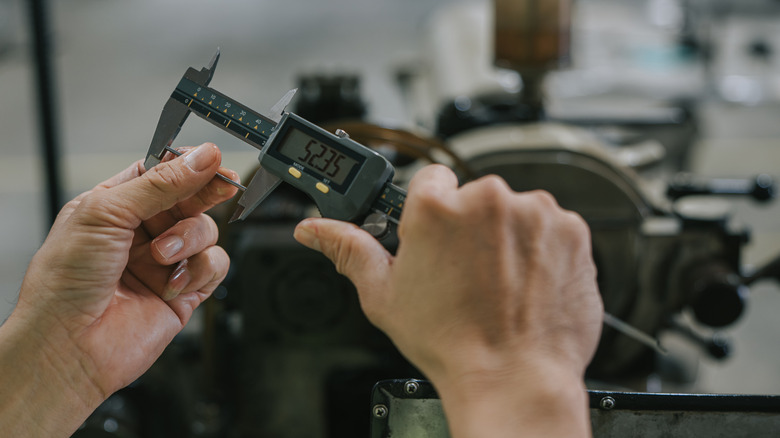

Unlocking Measurement Perfection: Rise of the Pocket-Sized Precision Tool
Imagine needing to measure the thickness of a smartphone’s curved edge or the exact diameter of a tiny charging port. If you’ve ever wrestled with a tape measure or ruler trying to accomplish this, you may have ended up frustrated—or worse, with inaccurate readings. According to the National Institute of Standards and Technology, dimensional inconsistencies cause 14% of manufacturing defects, often due to improper tools. This precision gap is exactly where digital calipers, affordable and intuitive instruments, become indispensable. Whether you’re a hobbyist assembling drones or a technician verifying aerospace components, these tools transform complex dimension readings into simple digital snapshots. Let’s explore why tech reviewers, engineers, and DIY enthusiasts increasingly rely on calipers as their first-choice measuring solution.
Beyond the Ruler: Calipers Conquer Measurement Chaos
The Anatomy of Precision
Unlike flat-edge rulers, digital calipers employ three specialized features to tackle varied geometry:
- Outside Jaws: Slide against an object’s external surfaces to instantly record width/thickness (e.g., verifying Honor Magic V5’s “world’s thinnest foldable phone” claim).
- Inside Jaws: Expand inside cavities to measure internal diameter (discovering whether a new gadget’s USB-C port aligns with universal specs).
- Depth Probe: Extends vertically from the caliper’s end to gauge recessions—crucial for assessing smartphone camera protrusions affecting stability.
A locking screw preserves measurements for repeated accuracy. Eschewing analog scales, digital units display metrics clearly in millimeters, inches, or fractions, avoiding interpretation errors present in manual systems.
Industries Transformed by Digital Calipers
From garage workshops to robotics labs, these handheld instruments solve sector-specific dilemmas:
- 3D Printing: Verifies filament diameters (±0.03mm accuracy prevents nozzle clogs).
- Automotive Testing: Measures brake pad thickness or engine valve depths during diagnostics.
- Jewelry Crafting: Precisely calibrates gemstoneavuator settings or metal chain links.
二醇Even non-technical tasks benefit: The MIT Fab Lab Foundation highlights calipers’ role in everyday citizen science projects like ergonomic tool design.
Defeating Ruler Limitations: Curves, Holes, and Gaps
Traditional tapes fail with chamfered edges and concave structures. Calipers thrive here:
- Irregular Contours 📐
Smartphones taper toward edges—where rulers misread, the caliper jaws clamp perpendicularly anywhere along the slope. - Micro-Diameter Assessment 🔍
Measuring pinholes? Inside jaws find true circle centers through mechanical alignment (unlike rulers struggling with Pi-based math). - Depth in Tight Spaces ⚙️
A ruler’s bulk can’t sink into screw holes; caliper probes extend like needles (<1mm tips possible).
| Calipers vs. Rulers: Decision Matrix |
|——————————————|—————————————|
| Scenario | Optimal Tool |
| Flat object dimensions | Ruler (acceptable) |
| Curved electronics casings | Calipers |
| Internal diameters | Calipers |
| Shallow depth pockets | Ruler (barely) |
| Deep/shallow recesses | Calipers |
Democratizing Precision: Affordability Meets Accuracy
Material Choices: Plastic vs. Metal
Budget digital calipers start shockingly low—$5–$7 for functional plastic versions ideal for scratch-sensitive electronics testing. Professional stainless-steel variants ($35–$50) enhance durability and positional consistency. A Journal of Precision Engineering meta-study confirms stainless-steel calipers maintain <0.001″ tolerance longer under daily use—critical for manufacturing teams. Yet for domestic duties like furniture adjustments, plastic suffices flawlessly.
Effortless Sourcing
Availability drives adoption:
- Amazon lists >10K plastic caliper units (many launching from $6.99).
- Hardware retailers: Home Depot stocks Mitutoyo-grade options ($42+).
- Harbor Freight offers $12–$60иболеецусков adjusted for weekend DIY builders.
Researchers consistently rate brands like Neiko and Vinca as top performers in sub-$100 tiers per ToolGuyd Lab reports.
Real-World Precision Heroes
Calipers solve routine dilemmas rulers mishandle:
- 📱 Smartphone QA Testing: Gauging bezel symmetry to ensure screen uniformity.
- 🚗 Auto Repair: Measuring brake rotor thickness decrements below safe thresholds.
- 🔩 3D Printing: Validating resin mold dimensions match CAD designs within ±0.05mm thresholds.
- 🛋️ Home Reno: Confirming drawer glide depths before installation.
As open-source prototyping rises, accessible tools bridge digital designs and physical execution reliably and cheaply. Modern calipers embody tactile precision where screens and eyeballing falter.
Calipers: Quintessential Quantifiers
Once the domain of expensive machining shops, digital calipers now empower millions with pocket-sized accuracy. They demystify complex geometries in smartphones, auto parts, and custom inventions—replacing manual estimating with quantified certainty. Plastic variants democratize access, while stainless instruments assure engineering-grade precision under $50. Forget skewed readings from angled rulers or tape sags; these tools lock dimensions verbatim, proving that nuanced measurement shouldn’t break budgets or sanity. When blurry approximations plague your projects, calipers deliver pixel-perfect reality.
Have you swapped rulers for calipers yet? Tell us your measurement success stories! 💬


