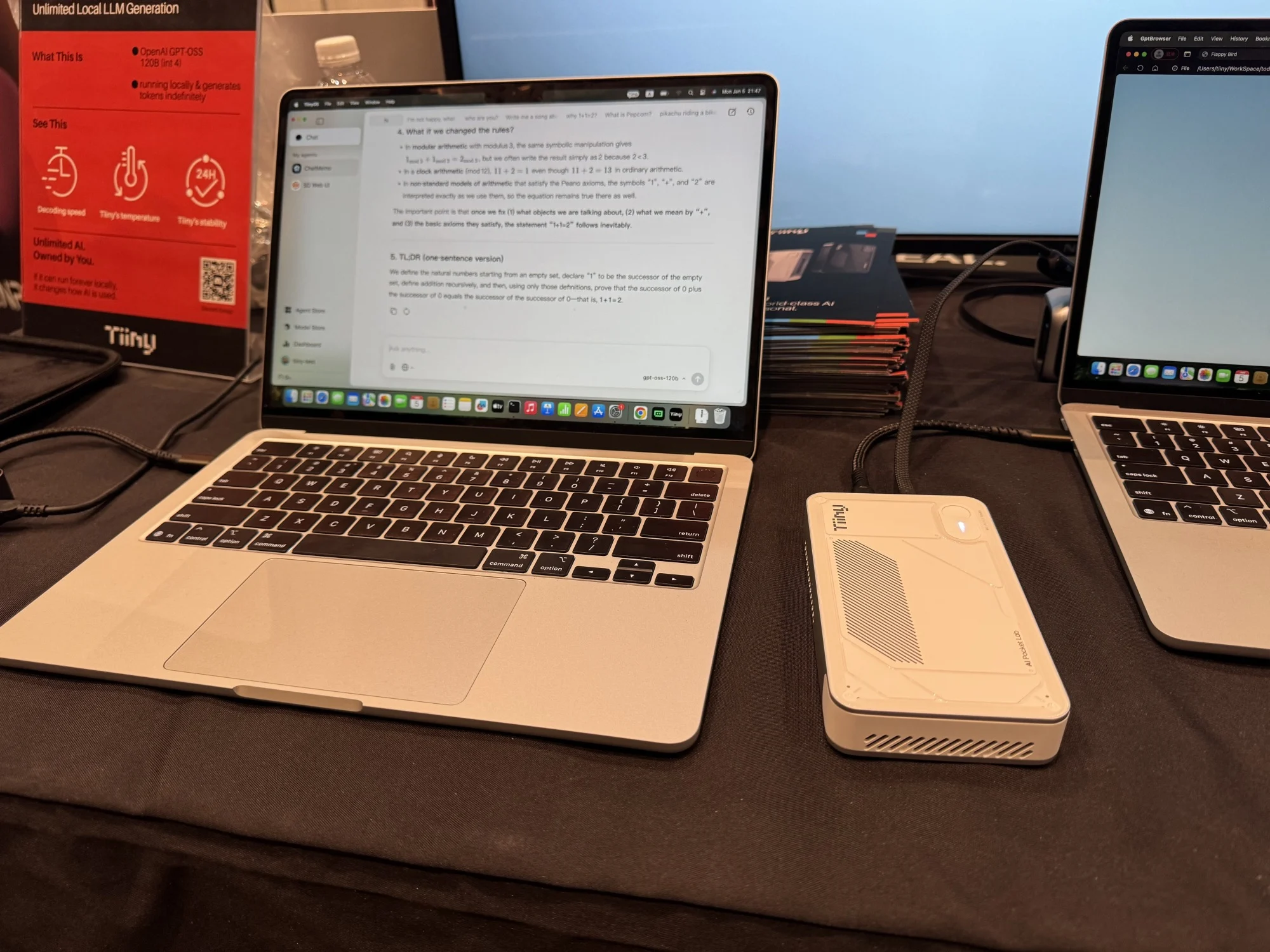

Could This Pocket-Sized Powerhouse Finally Unlock Private, Affordable AI for Everyone?
While flashy wearables dominate chatter at CES 2026, a quieter revolution is brewing: the rise of truly capable AI PCs – dedicated computers engineered from the ground up to run complex Large Language Models (LLMs) locally. Leading this charge is the staggering Tiiny AI Pocket Lab, unveiled at Pepcom. Dubbed “the world’s smallest mini PC” by Guinness World Records, this Tiiny device packs supercomputer-level specs into a form factor smaller than your smartphone, promising powerful AI processing entirely offline. It directly tackles the twin giants of modern AI frustration: reliance on expensive cloud subscriptions and pervasive data privacy concerns. This mini marvel isn’t just portable power; it represents a potential paradigm shift towards personalized, private artificial intelligence untethered from the cloud. Can such raw computational strength genuinely fit in your pocket without compromise?
From Power Bank Pretender to Processing Powerhouse: Defying Size Expectations
The first encounter with the Tiiny AI Pocket Lab often elicits disbelief. Its rectangular, brick-like silhouette is utterly unassuming, easily mistaken for a chunky power bank or perhaps an external hard drive. Pick it up, and the illusion deepens – it feels incredibly lightweight. This is where the astonishment begins. Guinness World Records officially recognizes it as the “world’s smallest mini PC,” a claim visibly validated by witnessing it nestle completely within the palm of a hand. Yet, tucked inside this minuscule chassis is nothing short of engineering wizardry:
- Massive Memory: 80GB of RAM – multi-tasking juggernaut territory.
- Ample Storage: 1TB SSD ensures swift data access and ample space for multiple large AI models and datasets.
- Specialized Processing: Hardware specifically optimized for the parallel computation demands of neural networks driving LLMs and generative AI.
This dense concentration of resources is solely focused on one goal: executing computationally intensive AI tasks completely on the device itself. Forget needing gigabit internet; Tiiny operates autonomously.
Privacy First: Liberating AI from the Cloud’s Shadow
The “why” behind needing such a powerful portable AI computer boils down to two critical modern concerns: privacy and cost.
- Your Data, Your Device: Unlike popular cloud-based AI services (like ChatGPT or Midjourney), every prompt, every input, every generated output stays confined within the Tiiny AI Pocket Lab. Nothing travels over the internet to a server farm. For professionals handling sensitive data (legal, medical, engineering prototypes), freelancers safeguarding unpublished creative work, or simply privacy-conscious individuals wary of data collection practices, this localized processing is revolutionary [Wikipedia Cloud Storage Privacy Concerns].
- Escape the Subscription Trap: Modern AI often feels locked behind paywalls. Cloud services rely on costly infrastructure, translating into monthly fees or metered usage. Tiiny eliminates the recurring cost burden. Pay once upfront ($1,399), and the AI capabilities are yours permanently, avoiding unpredictable service pricing hikes.
Tiiny AI positions its device as the ultimate solution for users demanding both uncompromising privacy and freedom from subscription models, delivered in an unprecedented portable form.
Democratizing AI: Accessibility Beyond Developers
Packing immense power into a pocket-sized computer is only half the battle if using it requires a PhD in machine learning. Tiiny AI wisely addressed this barrier through its intuitive companion desktop application. This software abstraction layer means users don’t need to be AI wizards:
- User-Friendly Interface: Simplified controls and prompts accessible to non-technical users.
- Model Marketplace: Direct access and straightforward management of dozens of pre-configured AI models – including cutting-edge generative models for creating images, video, text, and code.
- Point-and-Click Operation: Run sophisticated models without wrestling with command lines or complex setups.
This democratization transforms Tiiny from a niche developer tool into a viable platform for artists, writers, researchers, entrepreneurs, and tech enthusiasts seeking powerful AI tools without the steep learning curve. It brings the potential of generative AI literally to anyone’s desktop.
Performance Punch: Speed and Surprisingly Cool Operation
Initial hands-on testing at CES delivered promising performance insights. When prompted to generate content, Tiiny reportedly responded swiftly. Crucially, impressions noted its speed was “as fast, if not faster, than many popular cloud AI services.” This challenges the assumption that local processing, especially in a device this small, must inherently lag behind massive cloud clusters.
Perhaps the most surprising revelation was thermal performance. Intensive AI processing is notorious for generating significant heat, often necessitating complex cooling solutions (large heatsinks, fans, even liquid cooling) in high-end desktop AI PCs. After running demos throughout the day, the Tiiny unit held by Mashable felt only slightly warm to the touch – far cooler than even many conventional laptops under load. This efficient thermal dissipation within such a compact footprint suggests sophisticated engineering prioritizing both power density and power efficiency. It defies expectations and mitigates one of the primary headaches associated with portable high-performance computing: excessive heat and fan noise.
Pricing the Pocket Supercomputer: Value in Context
With a planned Kickstarter launch soon and an anticipated retail price tag of $1,399, the Tiiny AI Pocket Lab necessitates value assessment. Compared to traditional mini-PCs (often $200-$800 focusing on basic computing), $1,400 sounds steep. However, context is critical within the niche landscape of dedicated AI PCs:
- High-End Desktop AI Workstations: Machines optimized for intensive local LLM running typically start above $2,000 and can easily soar past $5,000 or more, while being bulky desktop-bound hardware [Example High-End AI Workstation].
- High-End Gaming Laptops: Devices boasting comparable RAM (64GB-128GB) and high-performance CPUs/GPUs suitable for some AI tasks often land in the $1,500-$3,000+ range and lack specialized AI optimizations [Example High-Performance Laptop].
Tiiny occupies a unique spot: offering specialized, verified high-capacity RAM/storage AI processing capabilities comparable to much larger, more expensive machines, while adding the unprecedented advantage of extreme portability and robust privacy. Its price positions it as a premium yet surprisingly accessible compared to alternatives in its specific performance class.
Disrupting the Compute Landscape: A Sign of Things to Come
The Tiiny AI Pocket Lab signifies more than just an innovative gadget; it represents a tangible step towards a decentralized AI future. It embodies several converging trends:
- Hardware Advancements: Continuous miniaturization and efficiency gains enable previously impossible levels of performance in small packages.
- Demand for Privacy: Growing public consciousness and regulatory pressure (like GDPR, CCPA) are accelerating the need for tools keeping sensitive data local [Wikipedia Privacy Concerns Related to AI].
- Democratization of AI: Lowering barriers to entry for powerful tools fosters innovation beyond tech giants.
The impressive thermal management shows that tackling heat – AI’s traditional Achilles’ heel in compact designs – is becoming feasible. While niche initially, Tiiny defines a category: truly personal AI hardware optimized for offline generative tasks. Its success on Kickstarter and beyond will be a litmus test for consumer demand in this burgeoning space. If adopted, it could inspire a wave of competitors pushing portable, private AI further.
This pocket-sized powerhouse proves that the future of computing might not reside in colossal data centers alone, but increasingly in compact, secure devices under our direct control, putting sophisticated artificial intelligence within literal reach, anywhere. Its combination of stealth performance, ironclad privacy, growing accessibility, and breakthrough thermal efficiency offers a compelling glimpse into the next wave of personalized technology.
The Tiiny AI Pocket Lab challenges our notions of where powerful computing belongs, proving that staggering AI capability can indeed rest securely—and coolly—in the palm of your hand. It empowers creators, professionals, and privacy advocates with genuinely portable generative power, liberated from the cloud’s constraints and subscriptions. While the price reflects its specialized niche, its value proposition becomes clear when compared against bulkier, more expensive alternatives. As innovation inevitably drives prices down, Tiiny lays the blueprint for truly personal AI—a future where powerful intelligence walks with us, not just follows us online. Could this diminutive lab be the first step toward making private, on-device AI as ubiquitous as smartphones? We’d love to hear your thoughts – does this shift excite you? Comment below!


