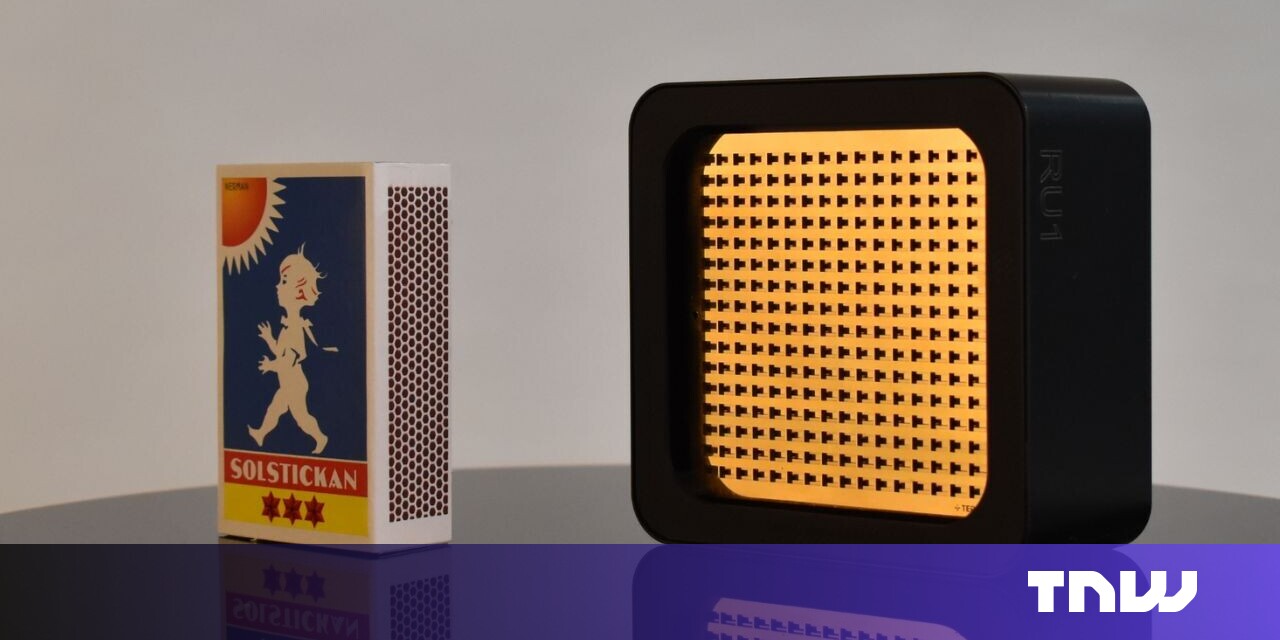

The Pocket-Sized Disruptor: Can TERASi’s RU1 Outmaneuver Starlink in Secure Military Communications?
Imagine a world where battlefield communications aren’t reliant on the whims of a single billionaire. In an era increasingly defined by geopolitical instability, the security and reliability of military communications have become paramount. The reliance on commercial solutions like Starlink, while initially beneficial, has exposed critical vulnerabilities. Enter TERASi, a Swedish startup, with its RU1 device, a potential game-changer in secure military communications. This article dives into the capabilities of the RU1, exploring its potential to offer a more secure and sovereign alternative to Starlink for critical operations.
TERASi’s RU1: A New Paradigm for Tactical Communications
TERASi’s RU1 is making waves as a potential disruptor in the tactical communications landscape. Billed as the world’s smallest and lightest mm-Wave radio, the RU1 promises blazing-fast speeds and massive bandwidth in a package that’s as portable and easy to deploy as a GoPro. But what exactly makes this device stand out, and how does it address the limitations of existing solutions like Starlink?
RU1: The “GoPro of Backhaul Radios” – A Closer Look
The RU1 is designed for rapid deployment in dynamic environments. According to TERASi CEO James Campion, the devices can be set up in minutes on tripods or drones, creating a resilient mesh network for mission-critical applications. This mesh network facilitates essential operations such as:
- Live drone video: Real-time situational awareness is crucial on the battlefield.
- Autonomous fleet control: Coordinating unmanned vehicles requires reliable, low-latency communication.
- Sensor data fusion: Integrating data from various sensors provides a comprehensive operational picture.
This ease of deployment and self-sufficiency are critical advantages over systems requiring extensive setup or relying on existing infrastructure.
The Sovereignty Advantage: Removing Third-Party Control from Military Communication
The core differentiator of the RU1 is its inherent security. Unlike Starlink, which can be remotely disabled or controlled by its operator, the RU1 provides users with complete control over their communications. This is a crucial factor, as highlighted by recent events in Ukraine. The reliance of the Ukrainian military on Starlink for critical communications was beneficial, but also made the country vulnerable to the political calculations of a private entity. Elon Musk’s decision to restrict coverage during a Ukrainian counteroffensive demonstrated the inherent risk of relying on a system susceptible to external influence.
How Does Starlink Work?
- Satellite constellation: Starlink utilizes a large network of low Earth orbit (LEO) satellites. (Source: Starlink Website)
- User terminals: Users require a Starlink terminal to connect to the satellite network.
- Global coverage: Aims to provide high-speed internet access globally.
- Potential vulnerabilities: Susceptible to jamming, interception, and control by SpaceX.
Starlink’s Limitations: The Ukraine Case Study
The situation in Ukraine brought the limitations of Starlink into sharp focus. Here’s a brief timeline of key events:
- February 2022: Elon Musk provides Starlink to Ukraine following the Russian invasion.
- Autumn 2022: Musk orders coverage cut during a Ukrainian counteroffensive in Kherson.
- Later 2022: Musk refuses to activate Starlink near Crimea for a naval drone strike.
These instances highlight the potential for a private company’s CEO to influence military operations, raising significant ethical and security concerns. The RU1 eliminates this risk by empowering users to create and control their own secure networks.
RU1 vs. Starlink: A Performance and Security Showdown
Beyond sovereignty, TERASi emphasizes the RU1’s superior performance and security compared to Starlink in specific scenarios.
Focused Beams and Jamming Resistance
The RU1 uses highly focused antennas with narrow, “laser-like” beams, making it extremely difficult to jam or intercept. These beams create small ground footprints (less than 3km), reducing the risk of detection. Starlink, on the other hand, covers larger areas (around 1,000 km) using lower-frequency radio waves, making it more susceptible to interception.
Speed and Latency: The Need for Real-Time Response
TERASi claims the RU1 supports data rates of up to 10 Gbps, which is 50 times faster than Starlink. Future versions promise 20 Gbps. Latency is also significantly lower, at under 5 milliseconds, compared to Starlink’s latency. This low latency is critical for applications requiring rapid response times, such as drone detection and autonomous vehicle control.
| Feature | TERASi RU1 | Starlink |
|---|---|---|
| Data Rate | Up to 10 Gbps (future 20) | Significantly lower |
| Latency | < 5 milliseconds | Higher latency |
| Beam Focus | Narrow, laser-like | Wider coverage |
| Interception Risk | Low | Higher |
| Control | User-controlled | SpaceX-controlled |
Beyond the Battlefield: Diverse Applications of mm-Wave Technology
While initially targeted at military applications, TERASi envisions the RU1 providing high-speed communications in various challenging environments:
- Disaster Relief: Quickly restoring gigabit links for first responders.
- Remote Industry: Enabling temporary, high-capacity networks for construction, mining, and energy sites.
The ability to rapidly deploy a secure, high-bandwidth network in areas with limited infrastructure makes the RU1 a valuable tool for a wide range of applications. Millimeter wave frequencies have been explored for their capabilities to provide high throughput with secure connectivity. The adoption of the technology in areas such as Industrial IoT and disaster relief could bring a wide range of solutions to areas with previously limited connectivity.
The Future of Tactical Communications: A Shift Towards Sovereignty
The emergence of the RU1 signifies a potential shift in the tactical communications landscape, moving away from reliance on centralized, commercially controlled systems towards decentralized, user-controlled networks. While Starlink offers valuable wide-area coverage, the RU1 provides a unique combination of speed, security, simplicity, and sovereignty.
TERASi is currently working to integrate the RU1 into systems with tactical communications providers and drone makers, further expanding its potential applications. James Campion emphasizes that the RU1 offers different strengths than Starlink: satellite communication excels at connecting static, low data rate sensors to a global network, while the RU1 allows users to build sovereign networks on-the-fly.
Even if the RU1 cannot match Starlink’s global reach, its unique capabilities could prove compelling for organizations seeking secure, high-performance communications without the risks associated with external control.
Conclusion: The Rise of Decentralized Communications
The TERASi RU1 represents a significant step forward in the evolution of tactical communications. By offering a secure, high-performance, and user-controlled alternative to systems like Starlink, it empowers users to create sovereign networks tailored to their specific needs. While Starlink has proven to be invaluable, the incidents in Ukraine highlight the inherent vulnerabilities of relying on commercial solutions controlled by external actors. The RU1, with its focus on sovereignty, speed, and security, could revolutionize the way military and civilian organizations approach critical communications in challenging environments. What do you think about this technology? Do you see this type of approach as the future of communication? Comment below!
Sources & Further Reading:
Original article at thenextweb.com


