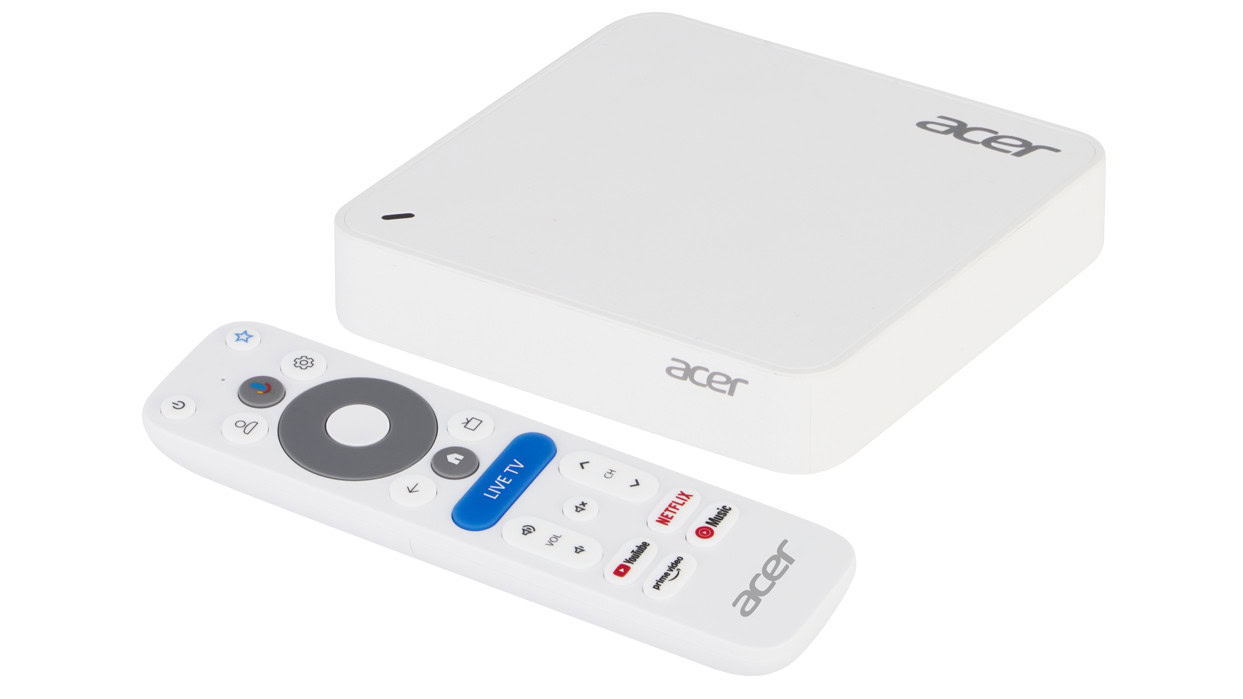

The Curious Case of Acer’s Google TV Box: Promising Ports, Hasty Corrections, and a South African Debut
Did Acer just stumble out of the gate in the crowded streaming box market? The tech giant, better known for laptops and monitors, made waves with the surprise announcement of its first-ever Acer 4K UHD Google TV Box – the AiTV – only to find itself issuing significant hardware corrections just two days later. This launch saga highlights the fierce competition in the sub-$100 streaming arena and the critical importance of technical accuracy. With an appealing $80 price tag and a rare collection of physical ports promising enhanced connectivity, the AiTV initially seemed like a potent contender directly targeting cost-conscious, feature-seeking viewers. Yet, its abrupt spec downgrade and current confinement to South Africa raise glaring questions about its potential impact and Acer’s strategic approach to a challenging market ruthlessly dominated by Google, Amazon, and Roku. The trajectory of this box serves as a fascinating case study in platform usability expectations and spec misconceptions in the streaming world.
1. The Unveiling: Acer Ventures into Google TV Territory
Acer’s entry into the streaming device market in late August 2025 was unexpected but not unwelcome. Departing from its traditional product lines, the company unveiled the “Acer 4K UHD Google TV Box” (AiTV), seemingly targeting users who prioritize connectivity above all else. Unlike the minimalist design cues dominating the sector (think Chromecast or Fire TV Stick Lite), Acer’s approach screamed utility. The core promise was Google TV’s acclaimed content aggregation and recommendation interface, wrapped in a chassis that offered the potential for serious peripheral expansion. This move positioned Acer as a potential solution for cord-cutters with complex AV setups still reliant on legacy equipment, a niche often underserved by ultra-compact streaming sticks that rely heavily on wireless connections and have limited expandability.
2. Standing Out: The Allure of Comprehensive Connectivity
The AiTV’s most unambiguous strength remains its extensive port selection, seemingly undiminished after the spec corrections. This feature set remains a significant differentiator in the mid-tier market segment:
- HDMI Output: Essential for 4K video and audio delivery to modern TVs (HDMI Forum).
- USB-C Port (Non-Power): Crucially dedicated purely for data/accessories thanks to…
- Separate Power Input: Frees up the USB-C port for external drives, peripherals, or hubs, a flexibility rare in competitors.
- USB-A Port: Directly accommodates legacy flash drives, older peripherals, or game controllers.
- Ethernet Port: Enables stable, high-bandwidth wired networking – vital for smooth 4K/HDR streaming and superior to Wi-Fi 6 in high-interference environments (IEEE standards).
- MicroSD Card Slot: Allows storage expansion beyond the built-in capacity for downloaded apps, games, or media libraries – a rarity Google famously removes in its own devices.
- S/PDIF Optical Audio Out: Provides a dedicated, high-fidelity audio path to compatible soundbars or AV receivers for uncompressed surround sound formats like Dolby Digital/DTS – a boon for home theatre enthusiasts.
This density of physical interfaces bypasses the dongle dependency common with many competing devices, offering true plug-and-play versatility straight out of the box.
3. Specifications: Initial Excitement Meets Corrected Reality
The initial announcement painted a picture of a potentially formidable device. The press release on August 29th listed ambitious specs:
- Processor: Amlogic S905X5 (Quad-core ARM Cortex-A510 CPU, Mali-G310 GPU)
- AI Capability: A 4 TOPS (Tera Operations Per Second) Tensor Processing Unit (TPU) for AI tasks like advanced upscaling.
- Memory: Conflicting reports – 3GB RAM (Press Release) vs. 2GB RAM (Pre-order page).
- Storage: 32GB internal capacity (confirmed).
- Video: 4K UHD (3840 x 2160) support with super-resolution upscaling.
- Connectivity: Wi-Fi 6, Bluetooth (version unspecified), all the physical ports listed above.
- Remote: Standard Google TV voice remote with dedicated buttons for YouTube, YouTube Music, Netflix, Prime Video, and a prominent “Live TV” button for quick access to FAST channels.
However, on August 31st, Acer Africa issued a significant correction based on communication from Android Authority:
- RAM Reduced: Confirmed 2GB RAM, not 3GB. This settles the initial conflict definitively on the lower end.
- Chipset Downgraded: Actual chip is the Amlogic S905X5M, not the S905X5.
- No AI TPU: The chipset lacks the 4 TOPS TPU previously advertised.
- Storage Confirmed: 32GB remains intact.
This correction fundamentally altered the device’s perceived performance tier. The S905X5M is a known quantity (Amlogic Reference), but it’s decidedly more budget-oriented than the higher-end variants found in premium streaming boxes. The absence of the TPU eliminates sophisticated AI-driven upscaling features seen in rivals like Nvidia Shield. Crucially, just 2GB RAM is widely considered borderline insufficient for the increasingly feature-rich Google TV platform, potentially leading to app reloads, sluggish multitasking, and a less fluid overall experience compared to devices sporting 3GB or 4GB (Android TV OS Resource Requirements).
4. The Correction Fallout: Why Accuracy Matters
Acer’s swift backtrack exposed the perils of getting core specs wrong at launch. The switch from 3GB to 2GB RAM isn’t minor – it fundamentally impacts performance and longevity expectations:
- User Experience Impact: Devices with 2GB RAM are more prone to reloading apps and delaying inputs when switching tasks. With Android OS versions and apps demanding more resources, 2GB feels increasingly constrained (Android Developer Guidelines on Performance).
- Market Perception: Pre-launch excitement hinges on accuracy. The downgrade risks eroding trust and positioning the AiTV as less capable than projected.
- Value Proposition: The inclusion of ample 32GB storage partially mitigates the RAM disappointment, showing Acer recognizes the need for space in modern streaming. However, storage doesn’t compensate for lack of processing overhead.
The separate power input proactively addressing a common user complaint (keeping USB-C free for data) highlights smart design, a positive note amidst the spec confusion.
5. Market Niche: South African Focus and Competitive Pricing
Currently, the Acer AiTV is exclusively available for pre-order in South Africa for 1,499 ZAR (approximately $80 USD). This regional launch strategy suggests testing waters in a specific market before a potential global rollout. By focusing on South Africa, Acer enters a territory where established players like Google and Amazon certainly operate, but perhaps with less monolithic dominance than in North America or Europe.
Pointedly, the ~$80 price tag positions it directly against competitors like the Xiaomi TV Box 3rd Gen (often found around $80-$100), which also emphasizes ports but similarly struggles with limited RAM compared to ultra-premium options. This pricing tier sits between budget sticks ($30-$50) and high-end streamers like the Shield TV Pro ($200+), targeting users who want solid 4K performance and connectivity flexibility without premium cost.
6. Competitive Landscape: Jostling for Position
How does the corrected AiTV stack up in the mid-range battlefield? Here’s a snapshot:
| Feature | Acer AiTV (Corrected) | Mi Box S 2nd Gen | Onn 4K Pro (Android TV) | Chromecast w/ Google TV (4K) |
|---|---|---|---|---|
| Processor | Amlogic S905X5M | Amlogic S905X4-Y | Unisen S805X2 | Amlogic S805X2-G |
| RAM | 2GB | 2GB | 2GB | 2GB |
| Storage | 32GB | 8GB | 16GB | 8GB |
| USB Ports | USB-C + USB-A | Micro USB | USB-A | None |
| Network | Wi-Fi 6 + Ethernet | Wi-Fi 5 + Ethernet | Wi-Fi 5 + Ethernet | Wi-Fi 5 |
| Audio Out (Digital) | S/PDIF Optical | None | None | None (HDMI only) |
| Expandable Storage | MicroSD | None | None | None |
| AI Features | Basic Upscaling | AI Upscaling (Basic) | AI Upscaling | Advanced upscaling (via GPU) |
| Key Strength | Port Diversity & Storage | Price Track Record | Bargain Price | Software/Interface & Price |
| Approx. Price (USD) | $80 (SA) | $50-$60 | $50 | $50 |
(Sources: Manufacturer specs, major tech retailer listings, Android Authority reporting)
The analysis is stark: Acer’s true advantage lies in its unrivaled port selection and superior built-in storage compared to most direct $50-$60 competitors. It compensates for the shared constraint of 2GB RAM – common at this price point – with tangible utility. The Wi-Fi 6 inclusion is also a future-proofing plus not always found at $80. However, lacking the AI processors of some rivals, its core processing and upscaling prowess remain modest. Competitors win largely on price for equivalent core specs, making Acer’s AiTV a tougher “value” sell outside of users specifically craving extensive physical connectivity.
7. The Big Question: Beyond South Africa?
For consumers elsewhere, the AiTV’s fate remains uncertain. Acer hasn’t clarified plans for North America, Europe, Asia, or other regions. The muted global reaction to the corrected specs doesn’t bode well for urgent demand, but the unique connectivity remains a compelling argument for a subset of users. Expanding internationally requires competing aggressively on value proposition given the stiff competition and the initial spec confusion raising skepticism. The AiTV needs a clear messaging reboot focused firmly on its strength: serving users building rich, wired media center environments without breaking the bank.
Ports Reign, But Can Acer Navigate the Stream?
The Acer 4K UHD Google TV Box saga underscores a crucial dynamic in the streaming device world: connectivity and storage are powerful tangible features, but core performance specs like RAM are non-negotiable for a seamless experience. The AiTV arrives with undeniable strengths – its rich array of ports (USB-A, Ethernet, MicroSD, Optical Audio) and the generous 32GB storage make it a uniquely flexible plug-and-play hub for complex setups. While Acer’s stumble with the initial (overhyped) specs was significant, the actual device fills a genuine niche for users prioritizing wired reliability, future-proofed Wi-Fi 6 bandwidth, and juggling multiple peripherals or large media libraries.
However, the 2GB RAM limitation, downgraded chipset, lack of its promised AI TPU, and regional confinement temper the enthusiasm. Its primary appeal lies squarely with tech-savvy cord-cutters in South Africa who specifically need what it offers uniquely at its price point: abundant connectivity. The AiTV isn’t the performance powerhouse touted initially, but it is a uniquely adaptable workhorse. Whether this vision resonates beyond its initial market, or forces a rethink on specs for future iterations targeting the US or Europe, remains an open question.
For the relentless streamers demanding optionality beyond Wi-Fi and minimal ports, Acer’s box delivers tangible choices. Yet, the company faces the vital balancing act of correcting its messaging, demonstrating the box’s value against cheaper alternatives without its flex points, and navigating the choppy waters of consumer expectations in a market where perceived power matters enormously. What’s your take? Would Acer’s focus on ports and storage outweigh its performance compromises for your entertainment setup? Could its launch confusion jeopardize its success? Sound off below!
Sources & Further Reading:
Original article at www.androidauthority.com


