
The CPU Value Race: Why Intel Is Narrowing AMD’s Bang-for-Buck Lead
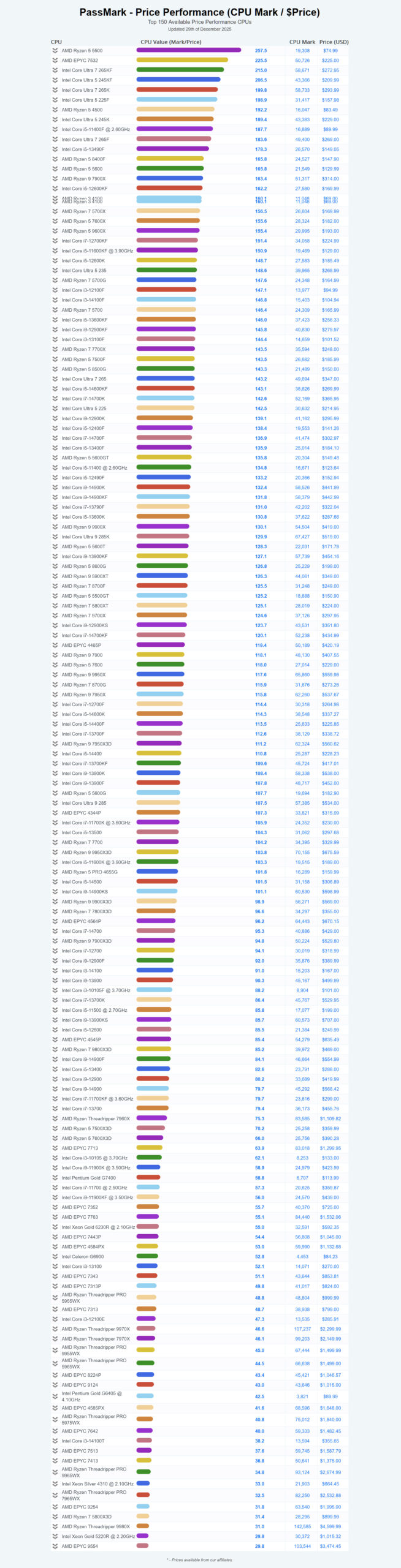
Is AMD’s long-standing reputation for price-performance dominance finally eroding? Recent data from PassMark Software, a leading benchmark provider, delivers a surprising verdict: Intel CPUs now hold seven spots in the price-performance top ten rankings – a dramatic shift seemingly unimaginable just a few years ago. While AMD grabs the headline-grabbing top two positions, a deeper dive reveals these wins rely heavily on discounted clearance items or non-standard market listings, painting a nuanced picture of real-world CPU value. This unexpected Intel surge underscores a crucial shift in the desktop processor landscape, emphasizing that genuine price performance depends not just on peak benchmarks but on consistent availability and predictable pricing across mainstream retail channels. For budget-conscious builders and upgraders, understanding this distinction between fleeting deals and sustainable value is critical.
Decoding PassMark’s Rankings: Beyond the Headlines
PassMark’s price-performance chart evaluates CPUs by calculating a score based on raw benchmark performance (PassMark’s proprietary CPU Mark) divided by the processor’s typical retail price. A higher score signifies better value – more performance per dollar spent. Analyzing the current leaderboard provides immediate insights:
- Intel’s Top-Ten Onslaught: Intel occupies a commanding seven positions within the Top 10. Models span generations, including newer Core Ultra chips and older Core i5/i3 variants. This widespread representation signals a concerted value push across Intel’s portfolio.
- AMD’s Top Spot Reality Check: While AMD holds positions #1 and #2, context is crucial:
- Position #1: Often identified as a specific Ryzen 5 model benefiting heavily from aggressive clearance pricing, likely due to imminent replacement or overstock. Its dominance stems from a drastically reduced price point, not raw power rivaling AMD’s own newer mid-range or high-end desktop parts.
- Position #2: Frequently an EPYC server-grade processor. Its appearance raises flags regarding pricing sourcing – PassMark listings suggest prices potentially pulled from second-hand or refurbished markets rather than standard retail channels for new components. This significantly skews the value proposition compared to buying brand-new desktop retail CPUs.
The Core Discrepancy: Intel’s placements appear less reliant on volatile fire-sale discounts. Their clustered entries suggest a more consistent application of competitive pricing across various models readily found at major retailers like Amazon, Newegg, or Best Buy. This translates to a broader range of viable options for shoppers.
Why Consistent Availability Defines Real-World Value
A key limitation of PassMark’s ranking, as noted even within its own descriptions, is its aggregation methodology. The chart blends:
- Current retail CPUs at MSRP or common retail pricing
- CPUs on deep clearance discounts
- Non-standard listings (like used, refurbished, or OEM-pulled parts)
While potentially insightful for bargain hunters scouring all corners of the market, this blending creates ambiguity:
- The Window Shopper Dilemma: Seeing the #1 Ryzen 5 or EPYC chip might excite a buyer, but if that CPU is unavailable at the listed price from standard retailers the moment they decide to purchase, its ranking becomes theoretical, not practical. Finding it requires luck and timing, which contradicts predictable value.
- Intel’s Consistency Advantage: Intel’s dominance in the Top 10 leverages processors that are overwhelmingly current stock at predictable price points. You’re far more likely to walk into a store (online or physical) today and find an Intel Core i5-13400F or i3-13100 listed at or near PassMark’s reference price than you are to snag the deeply discounted Ryzen clearance chip at its fleeting sale price. This widespread availability enhances Intel’s practical value proposition significantly.
The Impact: For system builders prioritizing guaranteed availability and avoiding aftermarket uncertainty, Intel’s PassMark chart success translates more reliably into tangible purchasing guidance.
AMD’s Value Gap Beyond the Discount Bin
Peeling back the Top 10 reveals another critical trend: AMD struggles to excel in price-performance once you move past clearance deals into its mainstream, readily available desktop lineup.
- Higher Cores, Lower Value?: AMD CPUs known for offering high core and thread counts (like Ryzen 7 7700X or Ryzen 9 7900X) often exhibit weaker price-performance rankings compared to similarly priced Intel alternatives. Why?
- Pricing Pressure: While these chips offer superior raw multi-threaded performance, their retail pricing often doesn’t dip enough to compensate competitively on the performance-per-dollar metric against Intel’s Core i5/i7 offerings.
- Platform Costs: Building with AMD’s latest platforms can sometimes involve slightly higher motherboard costs (though this gap has narrowed), indirectly impacting the total system value equation, though PassMark focuses purely on CPU price/performance.
- Lagging Mainstream Options: Outside its heavily discounted outliers near the very peak, PassMark’s data indicates that many current-generation AMD Ryzen 5 and Ryzen 7 CPUs inhabiting the $200-$400 mainstream sweet spot tend to trail their Intel Core counterparts in the same price brackets. Their superior absolute performance fails to convert into superior daily-driver value after pricing is plugged into the formula.
This creates a purchasing paradox: AMD shines brightest in value when its products are either on their way out (clearance) or sourced outside typical retail, while its latest, widely available chips face stiffening competition.
Intel’s Calculated Value Offensive: More Than Just Discounts
Intel’s strategy appears focused on offering strong processor efficiency across a wide spectrum rather than chasing top spots with potentially unsustainable tactics.
- Portfolio Breadth: Intel places CPUs across various price points within that Top 10 bracket ($100-$300), indicating attention to value-seekers regardless of exact budget.
- Predictable Pricing Strategy: Intel’s Core i3/i5 chips, especially prior-generation models still in production/supply like the 12th/13th Gen, seem consistently priced at levels that hit PassMark’s value sweet spot without needing temporary fire sales. Partners frequently bundle them competitively.
- Platform Maturity: Established platforms like LGA1700 (supporting 12th, 13th, and 14th Gen Intel Core) offer mature, cost-optimized motherboard options (B660, H610, B760), further enhancing the overall system value proposition, even if PassMark itself isolates the CPU (Intel LGA 1700 Platform Overview).
- Hybrid Core Optimization: Efficient scheduling by modern operating systems maximizes performance from Intel’s hybrid Performance/Efficient core designs on Core Ultra chips, translating real-world multitasking strength into strong benchmark-per-dollar results.
Essentially, Intel is leveraging established architectures, aggressive mainstream pricing (MSRP and sustained retail), and platform consolidation to saturate the value spectrum effectively.
Navigating CPU Value: What Matters When You Buy?
For buyers prioritizing pure performance per dollar, PassMark’s current snapshot strongly indicates Intel holds the overall advantage for readily available, current-generation desktop CPUs. This signifies a major competitive shift. While AMD unquestionably produces powerful processors and holds the ultimate performance crown in peak workloads, turning that leadership into consistent everyday value across its active lineup is currently proving challenging. Their strongest PassMark showings stem from exceptional deals on outgoing products or non-retail sources, narrowing their broad-market applicability.
Your Buying Blueprint:
- Context is King: Treat top-ranked PassMark entries with caution unless you confirm current pricing/availability. That #1 chip might be impossible to find cheaply tomorrow.
- Prioritize Availability: If steady stock and predictable pricing matter (e.g., for a planned business rollout or a timely personal build), Intel’s widespread Top 10 presence reflects greater consistency.
- Look Beyond the Peak: Consider the entire price bracket. Intel offers competitive options abundantly across $100-$350.
- Scrutinize AMD Deals: If a specific AMD chip is listed cheaply now and meets your needs, it’s a great buy – but recognize it might be a temporary outlier, not the norm.
- Platform Costs: Factor in motherboard prices realistically for your total budget assessment.
The silicon pendulum has swung significantly. Intel has successfully engineered a portfolio delivering impressive and widely accessible processor value, challenging AMD’s longstanding frugal-tech reputation. This intense competition is fantastic for consumers! What’s your experience been – finding Intel CPUs offer reliably better deals


