
The Hidden Cost of Upgrades: Unpacking AMD’s FSR 4 Lockout
Have you ever felt punished for not upgrading your hardware? That’s the sentiment echoing through the gaming community after AMD’s release of FSR 4 Redstone Frame Generation. Officially, this promising tech—boosting perceived smoothness and image quality—is exclusive to unreleased RDNA 4 GPUs (RX 9000-series), leaving current RDNA 3 owners out in the cold. But a bombshell revelation emerged when a resourceful Reddit user bypassed these restrictions, demonstrating FSR 4 Redstone Frame Generation does function on existing RDNA 3 cards like the RX 7800 XT. This breakthrough exposes a deliberate segmentation strategy by AMD, deliberately locking older owners out despite functional capability. What followed wasn’t just a technical achievement—it highlighted uncomfortable truths about artificial limitations in hardware ecosystems.
The Allure and Exclusivity of FSR 4 Redstone
AMD positioned Redstone as a generational leap. Using advanced temporal techniques akin to Nvidia’s DLSS Frame Gen, it synthesizes entirely new frames between rendered ones. Initial previews indicated tangible improvements: less ghosting, clearer motion clarity, and a smoother overall feel. Official documentation emphasized leveraging RDNA 4’s new hardware capabilities like enhanced AI accelerators and FP8 precision support. However, enthusiasts immediately questioned the hard exclusivity. Unlike FSR 3—which supported older RDNA 2 cards—Redstone drew a hard line forbidding installation on even flagship RDNA 3 products released barely a year prior, like the RX 7900 XTX. This fueled suspicion: Was architectural necessity driving the lockout—or marketing strategy? Comparing AMD’s approach to competitors reveals a pattern while NVIDIA also reserves DLSS FG exclusively for RTX 40-series cards.
Key Differences Between Frame Generation Versions
| Feature | FSR 3.1 Frame Gen | AMFMF (Driver-Level FG) | FSR 4 “Redstone” |
|———————-|——————-|————————–|———————|
| Architecture | Software-based | Driver-level | Hybrid (HW/SW) |
| Hardware Requirement | RDNA 2+ | RDNA 2+ | RDNA 4 ONLY |
| Avg. Added Latency | ~0.07ms/frame | ~0.05ms/frame | ~0.14ms/frame |
| Cross-Vendor Support | Yes (AMD/NVIDIA) | AMD GPU only | RDNA 4 GPUs only |
Cracking Open Redstone: The Linux Workaround Revealed
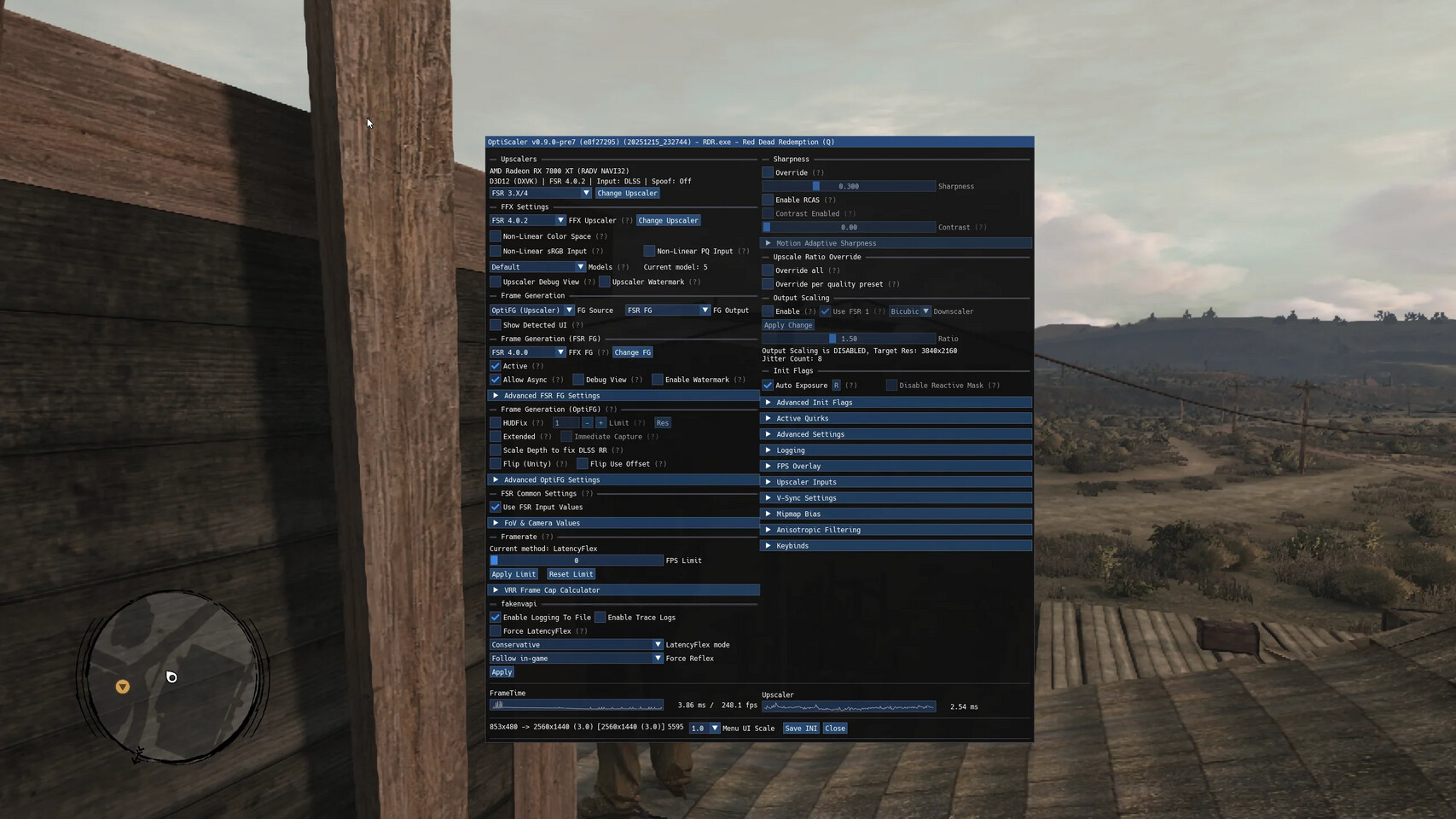
Proof emerged on r/radeon. An enterprising user combined two existing community tools—OptiScaler (an open-source scaling/frame-gen injector) and modified vkd3d-proton DLL files—to force-enable FSR 4’s frame generation pipeline on an RX 7800 XT. Crucially, they utilized an “FP8 workaround,” the same method previously adapting FSR 4 super-resolution for RDNA 3. This bypass tricks the API into processing FP8 instructions by emulating them on RDNA 3’s INT8 units. However, this Hack involved significant complexity:
- Linux Dependency: Requires Valve’s Proton compatibility layer (Windows translation) and specific Wine configurations.
- Modified Components: Custom-compiled vkd3d-proton DLLs replace stock files to handle FP8 instructions.
- OptiScaler Control: Sets
FSR4Update=truein config files, overriding built-in limitations.
Performance testing revealed compromises: doubled latency versus FSR 3 (0.14 ms vs. 0.07 ms per generated frame). The extra processing overhead stems from imperfect FP8 emulation. While image quality comparisons weren’t published, verified screenshots confirmed Redstone’s UI activates successfully. Compatibility remained limited strictly to RDNA 3; attempts on RDNA 2 failed, pointing to genuine architectural dependencies for core instructions. Sources like Valve’s ProtonDB confirm these methods involve deep API-level manipulations.
AMD’s Segmentation Strategy Under the Microscope
Why intentionally block RDNA 3? The workaround proves FSR 4’s core frame generation algorithm can run functionally on existing silicon. While latency increases suggest RDNA 4 offers hardware optimizations, locking out viable hardware serves clear commercial goals:
- Forced Upgrades: Creates a “must-have” incentive for RX 9000-series cards.
- Market Positioning: Prevents cannibalization of new GPU sales.
- Perceived Innovation: Framing Redstone as “impossible” on old hardware justifies premium pricing.
Industry analysts note this mirrors tactics seen with NVIDIA’s RTX 40-exclusive DLSS 3. AMD’s FSR prided itself on open standards and cross-vendor support. Redstone’s lockout contradicts this ethos and alienates loyal customers invested in recent RDNA 3 hardware. Social sentiment analysis of Reddit/forum reactions shows overwhelming negativity, citing anti-consumer “planned obsolescence.” Further, this decision risks fragmentation: Developers may hesitate prioritizing Redstone implementation, fearing limited hardware reach compared to FSR 3’s broader support.
Performance Concessions vs. Future Proofing
The latency penalty underscores hardware limitations. While Redstone technically functions on RDNA 3 via software emulation, doubling input lag compared to FSR 3 reveals compromises. For competitive gaming, an extra 0.14ms/frame accumulates rapidly—potentially adding 10ms total latency at 120+fps. This validates AMD’s technical argument for RDNA 4 optimization yet overlooks consumer expectations. Owners of $500+ GPUs expect longevity; blocking software-centric features smarts. Consider Intel’s approach with XeSS—widely compatible across vendors via DP4a instructions—versus AMD’s shift toward lockdowns. Redstone’s Linux unlock offers glimpse:
- Pro: Enables early Redstone access for tinkerers.
- Con: Increased latency affects fast-paced titles.
- Con: Stability concerns using unofficial DLLs/proton builds.
Community solutions highlight what’s achievable when hardware barriers vanish—but remain impractical for mainstream users. Imagine AMD using this community-proven FP8 path to offer degraded-Redstone modes? Silence instead reveals strategy driving exclusivity.
Navigating the Workaround: Only for the Determined
Attempting FSR 4 on RDNA 3 via Linux isn’t for novices. Beyond requiring granular terminal command skills, the process introduces dependency risks:
- Toolchain Complexity: Requires Proton+, Proton-EM builds, and manual DLL swaps.
- Configuration Fragility: Winecfg settings (Windows 11 emulation) and environment variables (
DXIL_SPIRV_CONFIG) must align precisely. - Version Lock-in: OptiScaler 0.9-pre7 remains essential today—later versions may break compatibility.
Successfully enabling Redstone brings partial victory. Flagship-tier RDNA 3 GPUs can access desired next-gen features, albeit with tradeoffs. However, AMD’s strategy splits its own ecosystem: Redstone adoption slows among developers targeting AMD cards, hurting long-term engagement. While NVIDIA leverages exclusivity consistently, AMD’s waffling stance—open with FSR3, closed with Redstone—damages trust.
Innovation Versus Artificial Scarcity: A Balancing Act
The FSR 4 Redstone controversy illuminates tensions inherent in tech evolution. AMD isn’t purely malicious; ensuring polished experiences on optimized hardware makes sense. Yet demonstrable usability on RDNA 3 using community workarounds—proving FSR 4 doesn’t require fundamentally new hardware—feels intentionally restrictive. This rollout channels profits over pragmatism, generating resentment rather than goodwill. History provides context: Even Apple eventually extended MetalFX upscaling support back to Intel Macs.
Ultimately, AMD’s approach prioritizes shareholder appeasement. Redstone exists not just to solve technical challenges, but to serve as a marketing sledgehammer. That prioritization ensures disappointment bleeds from forums onto store reviews. Perhaps RX 9000 sales will validate this strategy—or competitor moves toward inclusive software may expose its vulnerability. As one clever Redditor proved: Where there’s silicon, there’s a way… but users crave openness, proving artificial segmentation rarely survives community ingenuity unscathed. Love AMD’s hardware? Their sales tactics? Sound off below!


