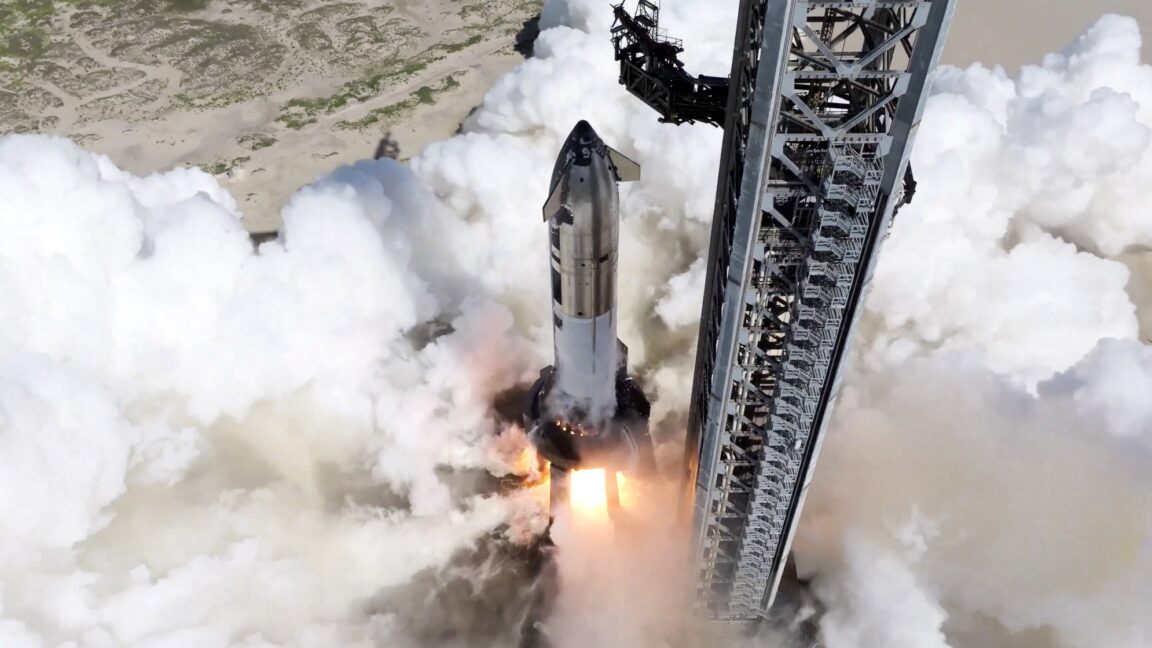

Grit and Iteration: How SpaceX Battled Back to Launch Starship Flight 10
What does it take to recover from not one, but two catastrophic failures in the relentless pursuit of interplanetary travel? The road to Starship Flight 10 has been anything but smooth for SpaceX, marked by fiery setbacks, meticulous investigations, and rapid engineering overhauls. Following a problematic in-flight test in May 2023 and a devastating ground explosion in June, the Federal Aviation Administration (FAA) has finally cleared SpaceX’s behemoth launch system for its tenth integrated flight test. This clearance represents a crucial step forward for a vehicle central to NASA’s Artemis moon missions and SpaceX’s own Mars ambitions, emphasizing the high stakes involved in pushing the boundaries of rocketry and aerospace safety. The lessons learned and hardware fixes implemented underscore the complex, iterative nature of developing the world’s most powerful rocket.
Anatomy of an In-Flight Failure: The Diffuser Dilemma
SpaceX’s rapid iterative development approach, famously summarized as “test, fail, fix, fly,” was put to the test after an anomaly during Starship’s previous orbital flight attempt. Key to the investigation was a critical component: the diffuser.
- The Failure Mode: During flight, a pressurized gas diffuser – essential for directing helium or nitrogen into the massive Super Heavy booster’s main fuel tanks to maintain structural integrity under changing pressures – malfunctioned. Engineers believe the failure compromised tank pressurization, likely contributing to the premature conclusion of the booster’s flight.
- Ground Recreation & Redesign: Underscoring SpaceX’s hands-on engineering philosophy, investigators meticulously recreated the diffuser failure in ground tests. This physical replication was vital to pinpoint the exact mechanism of failure. The insight gained led directly to a structural redesign.
- Enhanced Performance & Longevity: SpaceX states the redesigned part now “better direct[s] pressurized gas into the main fuel tank.” Beyond resolving the immediate malfunction, the redesign delivers a significant secondary benefit: it will “substantially decrease strain on the diffuser structure.” This translates to improved component reliability and potentially longer operational life under the extreme stresses of launch and ascent phases – a critical factor for achieving reusability. Diagnostics using ground recreation allowed engineers to target weaknesses precisely (SpaceX Operational Principle of Build-Fly-Learn-Refine).
The June Ground Explosion: A Rude Awakening
Just as teams were gearing up for Flight 10, targeting late June or early July, disaster struck on the ground. Ship 36, the Starship upper stage assigned to the mission, met a fiery end on a test stand during propellant loading for what should have been a routine static fire.
- Catastrophic Event: On June 18th, while being filled with intensely cold liquid oxygen and methane propellants at SpaceX’s Boca Chica, Texas facility (Starbase), Ship 36 violently exploded. The blast completely destroyed the vehicle and inflicted significant damage on its surrounding test infrastructure.
- Operational Ripple Effects: This forced a substantial delay – estimated at “another couple of months” – as SpaceX scrambled to recover. The sole active launch pad, primarily configured for integrated launches, needed urgent retrofitting to support testing the replacement vehicle, Ship 37. This highlighted the vulnerability inherent in relying heavily on a single test complex at this stage of development. Testing focus shifted away from flight prep towards pure hardware and infrastructure recovery.
- Ship 37 Steps Up: After repairs, Ship 37 underwent critical testing on the recently damaged stand. A major milestone was achieved on August 1st with a brief static firing of all six Raptor engines – a testament to the ability of SpaceX teams to quickly rebuild and resume operations. Following successful pre-flight checks, including a final “spin prime test” (simulating propellant flow without ignition), Ship 37 was returned to the hangar while the pad was reconverted for the upcoming integrated flight. This hectic sequence showcased remarkable operational agility.
Decoding the COPV Catastrophe: Root Cause and Fixes
The June explosion required its own intensive investigation. SpaceX engineers diagnosed the root cause with surprising speed, pointing squarely to a critical pressure tank:
| COPV Failure & Mitigation Summary | |
|---|---|
| Failure Component | Composite Overwrapped Pressure Vessel (COPV) |
| Location | Inside Ship 36’s Payload Bay Section |
| Suspected Cause | Pre-existing damage aggravated by cryogenic conditions |
| Failure Mode | Violent rupture during propellant loading |
| Primary Mitigation | Reduced operating pressure for COPVs |
| Additional Safety Steps | Enhanced inspections, Proof testing at higher levels, Stricter acceptance criteria, Hardware redesign |
- The Culprit Identified: The investigation concluded the explosion resulted from the catastrophic failure of a Composite Overwrapped Pressure Vessel (COPV). These high-tech tanks use lightweight carbon fiber overwraps bolstering a metallic liner to store gases like helium or nitrogen at immense pressures. COPVs are common in aerospace but have a history of sensitivity, notably involved in incidents like the Falcon 9 AMOS-6 pad anomaly (NASA Investigation Reference).
- Failure Mechanism: Engineers believe a COPV located within Starship’s payload bay likely sustained undetected damage, potentially during manufacturing, handling, or prior testing. When subjected to the intense thermal and pressure stresses of cryogenic propellant loading (-300°F), this compromised tank violently ruptured, triggering an explosion that consumed the entire vehicle.
- Overhauling COPV Safety: SpaceX implemented a multi-pronged approach:
- Reduced Operating Pressure: Future COPVs will operate at lower pressures, inherently decreasing the stored energy and potential for energetic failure.
- Enhanced Scrutiny: Stringent new inspection protocols have been mandated to detect even minor damage before COPVs are integrated and used.
- Robustness Verification: More rigorous proof testing will subject COPVs to pressures exceeding planned operational limits to validate their safety margin.
- Higher Acceptance Standards: Stricter acceptance criteria will filter out any components showing even marginal deviations from specification.
- Hardware Modification: A specific, though undisclosed, hardware change addresses the root vulnerability leading to the rupture.
Flight 10 Objectives: Pushing Boundaries Towards Reusability
With investigations closed, FAA approval secured, engineering fixes in place, and Ship 37 prepped, Starship Flight 10 is poised to tackle its most ambitious test objectives to date.
- Booster Evolution: SpaceX explicitly states the mission will “continue to expand the operating envelope on the Super Heavy booster.” This includes conducting multiple landing burn tests, crucial for mastering the controlled descent and precise touchdown required for routine reuse. Success here is fundamental to Starship’s economic viability.
- Starship’s First “Payload”: In a major program milestone, Flight 10 marks Starship’s first planned payload deployment. While likely test mass(es) rather than a commercial satellite, demonstrating the ability to successfully deploy payloads in orbit is essential for future operational missions.
- The Reentry Challenge: Arguably the most critical technical hurdle for Starship is surviving Earth’s atmosphere at orbital velocity. Flight 10 includes “multiple reentry experiments.” Crucially, these experiments are explicitly “geared towards returning the upper stage to the launch site for catch.” This signifies SpaceX actively testing the precision control, thermal protection system resilience, and aerodynamic maneuvering (using large flaps) necessary for Starship to glide back to a specific landing point for capture by launch tower arms – a revolutionary reuse concept. Mastery of this reentry will enable rapid turnaround crucial to the mission architecture (Wider Context of Starship Role in Lunar Exploration).
- Integrating Lessons: Beyond these headline objectives, Flight 10 serves as the ultimate validation test for the redesigned diffuser and the overhauled COPV safety protocols under real flight conditions. Each subsystem working in concert during ascent, orbit, deployment, descent, and potentially landing/catch, is critical data.
Conclusion: Resilience and the Unrelenting Drive Forward
SpaceX’s journey to Starship Flight 10 vividly illustrates the harsh realities and necessary resilience of cutting-edge rocket development. By meticulously dissecting in-flight anomalies and catastrophic ground failures, the team engineered targeted solutions – from a robust diffuser redesign to a comprehensive overhaul of COPV safety practices. Securing FAA approval validates the thoroughness of this corrective work. The ambitious goals set for Flight 10 – payload deployment, advanced booster recovery trials, and pioneering Starship reentry experiments targeting a tower catch – represent a quantum leap in operational capability. Success would not only mark a significant technical milestone but solidify the path towards the fully reusable, high-capacity launch system that could reshape access to Earth orbit, the Moon, and eventually Mars. Does this gritty, iterative approach hold the key to making humanity multi-planetary? The next fiery leap of Flight 10 will provide compelling clues. What potential payloads or future missions are you most excited about Starship enabling? Share your thoughts below!
Sources & Further Reading:
Original article at arstechnica.com


