
Powering Your Mobile Workstation: Cutting the Cord Without Losing Juice
Ever found yourself frantically hunting for an airport outlet as your laptop battery dips into the red zone? You’re not alone. Modern professionals constantly face the tension between mobility and productivity, and there’s nothing more frustrating than watching your battery evaporate during a long layover or client presentation. Laptop power banks are essential tools that solve this problem, offering substantial external battery reserves designed to recharge laptops to around 75% capacity and breathe hours of extra life into phones, tablets, and camera gear. Crucially, nearly all comply with airline carry-on regulations, falling under the FAA-mandated 100-watt-hour limit. With features like built-in cables and smart displays simplifying use, investing in the right battery charger transforms travel and remote work from a charging scavenger hunt into focused productivity. Let’s explore the top performers and crucial considerations.
Testing Methodology: Putting Laptop Power Banks Through Their Paces
For rigorous evaluation beyond specs, Engadget’s Amy Skorheim combined scientific measurement and real-world use cases:
- Devices: Each bank charged an iPhone 15/16 (drained to 0-5%), Galaxy S23 Ultra (0-5%), M1 iPad Air (0-5%), and a 16-inch M1 Pro MacBook Pro (10% minimum).[1]
- Process: Devices charged individually (avoiding simultaneous drain skewing comparisons). The MacBook Pro simulated a working session (WiFi, VPN, Bluetooth peripherals) during charging.
- Metrics: Recorded charge time to full (phones/tablet) and partial (MacBook), plus remaining bank capacity post-charge. Port efficiency, heat dissipation, design practicality, and feature usability were noted.
- Capacity Focus: Primarily tested banks >=20,000mAh (aiming for 25,000mAh+), ensuring relevance for laptop charging.
Top Picks for Purpose-Driven Power
Anker Cables & Convenience Champion:
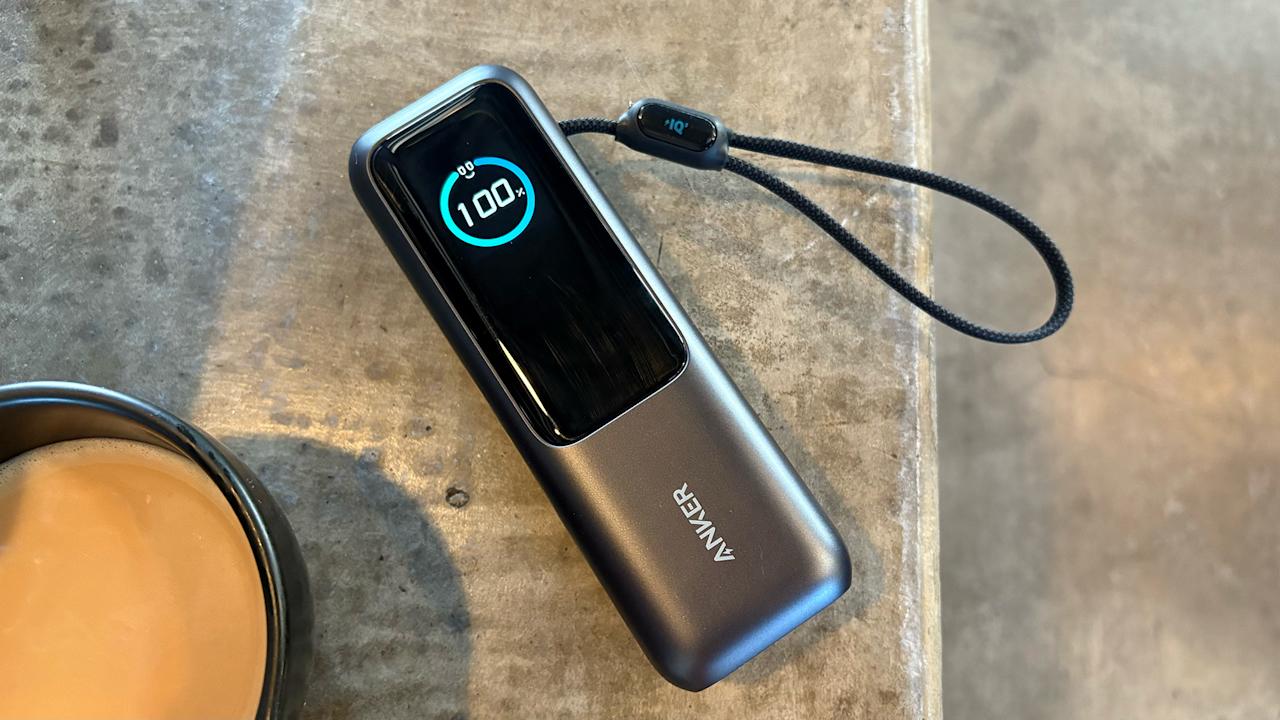
Standout features like dual built-in USB-C cables elevate this Anker beyond basic specs.[Am Skorheim/Engadget] One functions as a strap/carry loop, another retracts neatly. The surprise? A precise digital display showing charge level, output wattage per port, and even estimated time to full recharge. While its 25,000mAh capacity sacrifices ~5% of the FAA limit, it compensates with superb efficiency. Testing revealed consistent power output (unaffected by display calculations), delivering rapid charges comparable to larger rivals:
| Device | Charge Time | Charges Possible |
|---|---|---|
| iPhone 15 | ~5% to 100%: 1h 54m | 4-5 |
| Galaxy S23 Ultra | ~5% to 100%: 52m | ~4 |
| MacBook Pro M1 | From 10%: ~53m | ~0.68 |
Pro: Unmatched convenience factor, fast delivery, reliable display.
Con: Screen prone to scratching; maximum capacity trade-off.
Lion Energy Eclipse Mag: Wireless Freedom on the Go
This wireless powerhouse caters to travelers drowning in cables. Its three integrated Qi pads uniquely charge a phone, Apple Watch (dedicated), and earbuds simultaneously. While its single USB-C port is a constraint, the massive 27,000mAh capacity (near FAA ceiling) delivers serious laptop juice:
- Charged MacBook Pro M1 (10% → 89%) in 1h 18m.
- Maintained 64-81% charge capacity post tablet/phone refills.
Pass-through charging allows topping up the bank while using wireless pads. The angular, compact design belies its 2lb weight, and a five-year warranty underscores quality.
Pro: Excellent multi-device wireless charging, near-max FAA capacity, long warranty.
Con: Heavy, no percentage display, only one USB-C port.
Anker Prime Premium Performance:
For speed demons, the Anker Prime dominates. Boasting 300W max combined output – enabling dual 140W USB-C ports – it charged devices remarkably fast:
- MacBook Pro (10% → 75%) in just 45 minutes.
- iPhone (~0% → 60%+) in 30 minutes.[Am Skorheim/Engadget]
Its compact, sleek profile houses safety features, including a temperature gauge. An optional, costly ($110) charging base adds station functionality and accelerated bank recharging.
Pro: Blazing speeds, high capacity (26,250mAh), premium build/temperature monitoring.
Con: Very expensive, especially with the charging base.
Baseus Blade: Budget-Friendly Speedster
Tipping scales under 1.2lbs and sporting a sleek, flattened profile, the Baseus Blade excels in value. Though only 20,000mAh, it punched above its weight:[Am Skorheim/Engadget]
- MacBook Pro charged in 1h 6m (10% → 62%).
- Competitive phone/tablet speeds + dual USB-C ports.
A conservative battery display avoids premature “empty” scares.
Pro: Excellent price-to-performance, lightweight/easy carry, fast charging.
Con: Lower capacity limits laptop boost.
Goal Zero Sherpa 100AC: Rugged Field-Ready Backup
Built for demanding environments, the Sherpa targets photographers, researchers, or remote crews with its aluminum body and multiple charging options – including solar readiness. Features include:[Am Skorheim/Engadget]
- Wireless charging pad.
- Various ports (USB-C, USB-A, dedicated AC outlet).
- Accurate status display/internal cooling fan.
Powerful (25


