![[Interview] From Stage to Screen: Samsung TV Plus and Eclipsa Audio Usher in a New Era of Home Entertainment](https://techkyskills.com/wp-content/uploads/2026/08/88661-interview-from-stage-to-screen-samsung-tv-plus-and-eclipsa-audio-usher-in-a-new-era-o6a76f45cb6efa-696x392.jpg "interview-from-stage-to-screen-samsung-tv-plus-and-eclipsa-audio-usher-in-a-new-era-o6a76f45cb6efa.jpg")

What if a TV could recreate the atmosphere of a live performance? Eclipsa Audio, a 3D audio technology jointly developed by Samsung Electronics and Google, makes that possible.
Built on the open 3D audio standard, Immersive Audio Model and Formats (IAMF), Eclipsa Audio optimizes the spatial positioning of sound for playback devices such as TVs and soundbars to deliver a more immersive listening experience. From the music on stage to the cheers of the audience, the technology brings musicals and live performances on Samsung TV Plus to life.
Eclipsa Audio is the result of close collaboration between Samsung Research, which developed the underlying 3D audio technology, and the Visual Display (VD) Business, which brought it to Samsung products and services.
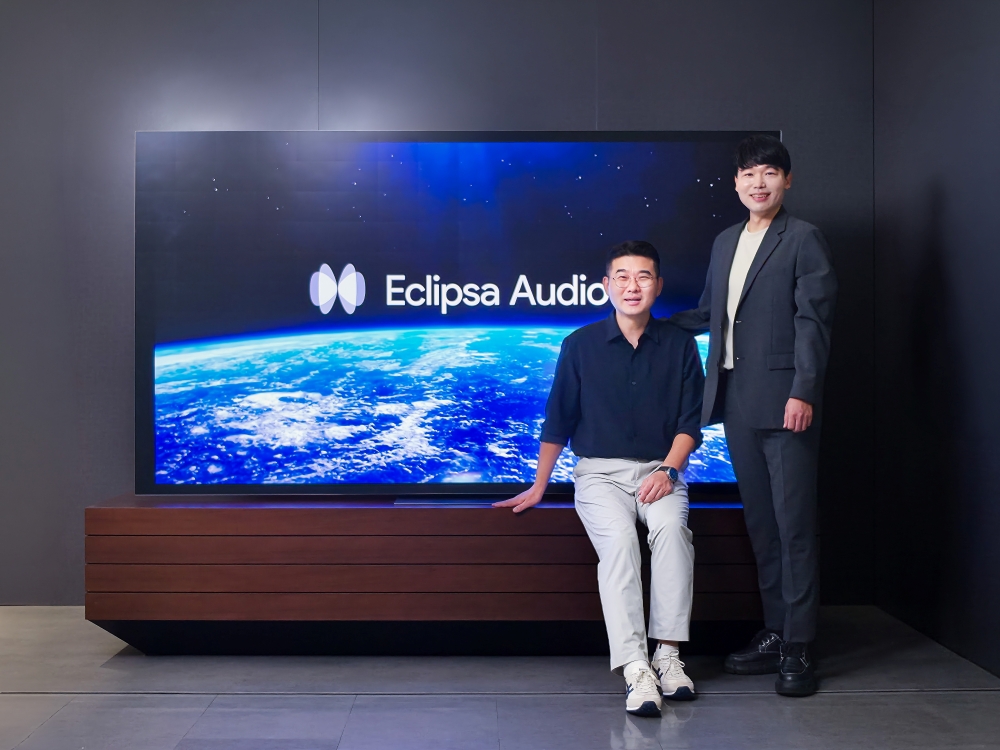
Samsung Newsroom spoke with Woohyun Nam, Head of the Display Innovation Lab at Samsung Research, and Joonhun Choi, Head of Samsung TV Plus at the VD Business, to learn more about Eclipsa Audio and the story behind its development.
A Front-Row Experience at Home
A live performance is about more than what appears on screen. From performers’ voices and music on stage to the applause and cheers of the audience, Eclipsa Audio on Samsung TV Plus adds a new dimension to the viewing experience.
Q. What’s the biggest difference viewers will notice with Eclipsa Audio on Samsung TV Plus?
Choi: People can now enjoy the thrill of musicals and live performances from home. While Samsung TV Plus makes this content more accessible, Eclipsa Audio recreates the rich, immersive sound of the venue in the living room.
Instead of merely watching on screen, viewers can immerse themselves more deeply in its music and emotion.
* For the best listening experience, earbuds are recommended.
Q. Audio plays an extremely important role in the musicals recently added to Samsung TV Plus. How does Eclipsa Audio enhance that experience?
Nam: Unlike regular video content, musicals rely on performers’ singing and dialogue, orchestral music, sound effects and audience reactions to create an emotional impact. Eclipsa Audio captures each of these elements with its own spatial characteristics. Performers’ voices stay clear and centered, the orchestra surrounds the stage with rich, full sound, and audience reactions appear to come from all around the viewer.
Eclipsa Audio also adjusts sound balance and placement based on the playback setup, whether viewers are listening through a TV alone or with a connected soundbar. As a result, they can experience the depth of the stage, the richness of the music, and the audience’s energy from the comfort of home.

Spatial Audio for Live Performances
A live performance comes to life when every sound — and its position throughout the venue — is faithfully reproduced. Spatial audio technology is essential to creating that experience.
Q. How does Eclipsa Audio recreate the immersive atmosphere of a live performance?
Nam: Eclipsa Audio goes beyond stereo by reproducing sound in three-dimensional space. Instead of limiting sound to left and right channels, it adds front, back, left, right, and height information to create a more realistic sense of space. Performers’ voices, musical instruments, venue acoustics, and audience reactions are reproduced with their original positioning intact, making viewers feel as though they’re sitting in the audience.
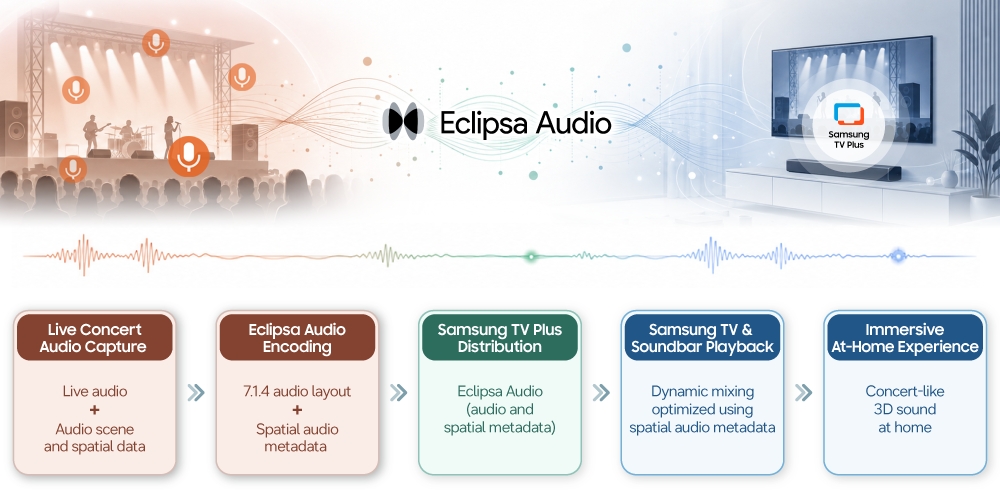
Built on the IAMF standard, Eclipsa Audio reconstructs the spatial metadata embedded in the content, including the position and movement of sounds, to match the speaker configuration of a TV or soundbar. This preserves the depth and immersion intended by the creator, naturally bringing the live performance experience into the home.
Because IAMF is an open standard independent of any specific codec or licensing model, Eclipsa Audio can be extended across a wide range of content and devices. Beyond musicals and concerts, it delivers immersive audio for movies, sports, and other content where realistic sound is essential.

From Innovation to Implementation
Bringing Eclipsa Audio to Samsung TV Plus required close collaboration between Samsung Research and the VD Business. Together, the two organizations combined expertise in audio technology research and product implementation.
Q. How did Samsung Research and the VD Business collaborate to bring Eclipsa Audio to Samsung TV Plus?
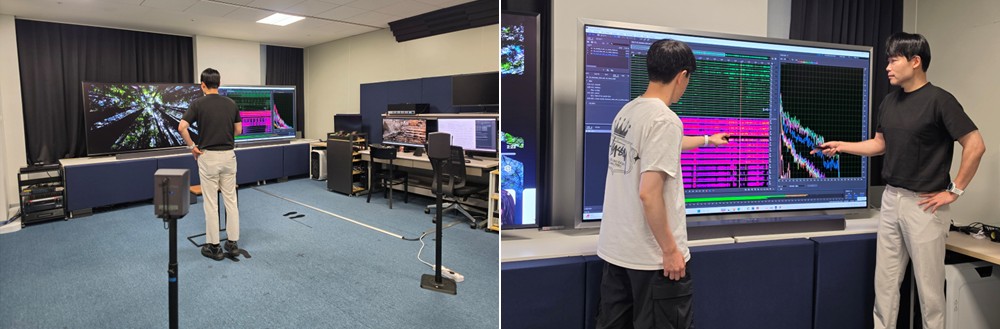
Nam: Samsung Research developed the core audio technologies and underlying systems to ensure that Eclipsa Audio content could be reliably transmitted and played back on Samsung TV Plus. We built the IAMF-based framework for spatial audio metadata and developed the encoding and playback technologies needed to support it. We also ensured compatibility across various setups, including TVs and soundbars, while allowing unsupported devices to play content in standard stereo.
In short, Samsung Research laid the technical foundation that enabled Eclipsa Audio to move beyond the research stage and function reliably on Samsung TV Plus.
Choi: The VD Business commercialized Eclipsa Audio for Samsung TVs, secured compatible content for Samsung TV Plus, and made it accessible to viewers.
Q. What was the biggest focus when integrating Eclipsa Audio?
Nam: Our top priority was ensuring viewers could fully experience the immersion of a live performance. We worked closely with the VD Business to verify that Eclipsa Audio could be delivered seamlessly through Samsung TV Plus and that the spatial audio of live performances was faithfully reproduced.
One of the biggest tests took place in a 280-seat concert venue with a professional sound engineering firm. Using a live performance, we captured the venue’s spatial audio, converted it to Eclipsa Audio, streamed it live through a Samsung TV Plus channel, and played it back on a Samsung TV. We verified that the music, vocals, audience reactions, and venue acoustics were recreated accurately, validating both the technology and viewing experience.
Choi: We focused on securing Eclipsa Audio content and encouraging content partners to adopt the technology. Because spatial audio was still new to many production companies, implementation required extensive preparation and collaboration. We demonstrated how Eclipsa Audio could create a more immersive viewing experience while helping their content reach a much wider audience.
Q. What was the biggest challenge in bringing Eclipsa Audio to Samsung TV Plus?
Choi: The biggest challenge was ensuring a seamless transition between Eclipsa Audio content and stereo ads. Samsung TV Plus is a free ad-supported streaming TV (FAST) service, which means content delivered in IAMF-based immersive audio must transition seamlessly to stereo commercials during the same viewing session.
It was also critical to ensure smooth transitions without disrupting audio timing or audio-video synchronization. Samsung Research evaluated technical solutions based on audio formats and processing technologies, while the VD Business shared the service requirements and ad delivery systems. The two teams developed transition policies that enabled smooth playback throughout.
Nam: Another challenge was ensuring content played seamlessly across a wide range of devices — including TVs, TVs paired with soundbars, and devices that don’t support Eclipsa Audio. We developed a playback architecture that delivers immersive audio on supported devices while automatically falling back to standard stereo on unsupported ones.
Expanding the Live Entertainment Experience
Eclipsa Audio takes the at-home live performance experience a step further, giving viewers new ways to enjoy content.
Q. How have users responded so far? Do you have any tips for getting the most out of live performance content?
Choi: Users said they felt as though they were sitting in the audience at a live performance. Some even said certain scenes were more vivid than watching from a small theater. Many also noticed a clear difference compared to content that doesn’t support Eclipsa Audio and hoped to find more compatible content and features.
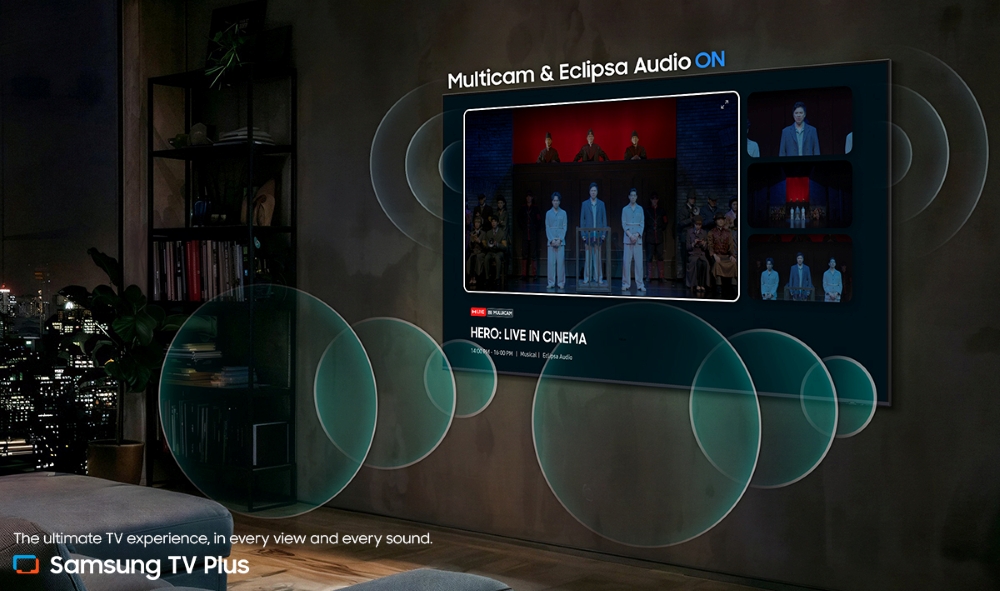
For the best experience, I recommend pairing a Samsung TV with a Samsung soundbar. Together, they deliver rich multi-channel audio that enhances spatial depth, allowing viewers to hear the music, performers’ voices, and audience reactions more naturally. I also recommend using the Multi-Cam feature. Viewers can switch between full-stage and close-up views during key moments, focusing on a particular performer’s expressions and movements.
Q. What are your goals and plans for the future?
Nam: Our goal is to make the technology fade into the background, allowing users to simply enjoy better sound. We want viewers to turn on their TV and instantly feel as though they’re at a live performance or in the heart of a stadium during a sporting event. Long-term, we hope to bring more personalized audio experiences. For music, viewers might emphasize vocals or specific instruments, while for sports, they could choose between commentary and venue sound.
“Our vision is ‘Spatial Audio for Everyone,’ where anyone can enjoy Eclipsa Audio through Samsung TV Plus.”
Choi: Beyond musicals, we plan to expand Eclipsa Audio to K-pop concerts, classical performances, movies, and sports. Ultimately, we want Samsung TV Plus to become a platform for live entertainment, making high-quality performances accessible to everyone, anytime, and anywhere.
“We aim to bring the immersive atmosphere and spatial depth of a premium live venue into the living room.”
Samsung TV Plus and Eclipsa Audio will continue to evolve, delivering even more immersive viewing experiences. By combining advanced audio technology and streaming services, Samsung is redefining how people experience entertainment.


