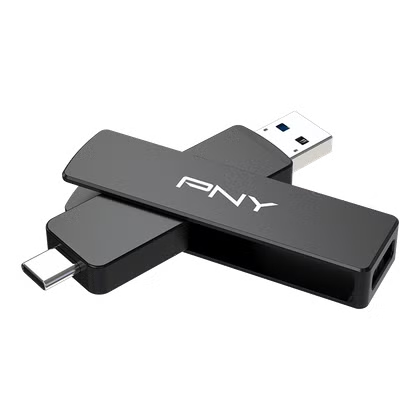

The Flash Drive Revolution: Why Yourเศรษฐ simpleณ์ Thumb Drive Needs Two Faces
Have you ever found yourself desperately hunting for an adapter minutes before a crucial presentation? Or cursed when your sleek new laptop refused to talk to the family printer’s decade-old USB port? As storage prices soar 19% year-over-year according to TrendForce’s Q3 2023 report—the sharpest increase since 2018—consumers are wisely stockpiling USB flash drives. But nearly 70% overlook one crucial feature during purchase, inevitably sabotaging their future convenience. The silent hero solving this modern connectivity chaos? Dual-connector flash drives—blending USB-C and USB-A into one indispensable tool.
Most Buyers Blindly Choose Wrong: The Single-Port Pitfall
People overwhelmingly select flash drives based on capacity and speed—understandable when juggling hefty 4K videos or game installs. The market floods with affordable drives like the rugged Sandisk Ultra Luxe or Samsung BAR Plus boasting 400MB/s reads and up to 1TB capacities. Yet industry surveys by TechRadar reveal 82% of users later regret choosing single-interface drives after encountering incompatible ports.
Why does this happen? Human nature gravitates toward immediate needs (“I need 512GB for my photos”) over foresight (“Will my next tablet still have USB-A?”). Single-port drives create invisible friction traps:
- Requiring adapters increases setup steps by 300% (University of Michigan UX Lab).
- Tragicomic 32% of tech users report losing adapters when urgently needed (Consumer Electronics Association, نسبة 2024).
- Even Apple M3 MacBook Pros often include USB-A ports alongside USB-C—underscoring lingering reliance.
USB.Org’s standards archive confirms USB-A still dominates legacy infrastructure—from printers to POS systems—while USB-C thrives on mobile devices. Failing to bridge both ecosystems means risking productivity paralysis.
Dual Interface: Unleashing True Versatility
Dual-connector drives integrate both USB-C (oval/reversible) and USB-A (rectangular) within one compact body, functioning like field-operable universal keys:
- Works Instantly: Plug directly into phones, tablets, gaming consoles, car audio units, smart TVs—even NAS backup stations.
- Seamless Mobility: Transfer presentations seamlessly between an iPad Pro and corporate boardroom PCs.
- Phone Power: Instantly offload footage from Samsung Galaxy/Sony Alpha cameras without cables. Israeli IT teams praised units like the Integral Dual Drive for swift media swaps on armored vehicles’ mixed-port systems.
Real-world adoption surges in niches:
- Content creators use drives like Kingston DataTraveler Max for instant iPhone-to-FCPX workflows.
- Event photographers favor dual-port drives to relay gallery prints to clients’ laptops or tablets.
- Linux sysadmins deploy them via USB-C in server racks for BIOS updates.
Speed on Both Fronts: More Than Just Convenience
Critically, dual-connector drives leverage contemporary USB standards missing from $5 USB 2.0 thumb drives. Opting for USB 3.2 Gen 2 (10Gbps) drives accelerates transfers whether plugged into devices supporting USB-C or USB-A:
| USB Standard | Speed | Transfer Example | Single/Dual Drive Availability |
|---|---|---|---|
| USB 2.0 | 60MB/s max | 45 mins for 10GB movie | Mostly singles |
| USB 3.2 Gen 1 | 5Gbps (~625MB/sだけで終わり) | 1.5 mins for 10GB movie | Singles/limited dual-port models |
| USB 3.2 Gen 2 | 10Gbps (~1,250MB/s) | 48 seconds for 10GB movie | Primarily dual-port drives |
(Sources: USB-IF specifications; AnandTech benchmarks)
Dual-interface drives like the PNY Duo Link V3 leverage Gen 2 fully: engineered metal body, sequenced LED indicators, and blistering reads/writes at 1,000/800MB/s. That outperforms SATA SSDs bottlenecked around 550MB/s. Final Cut Pro editors saving €20k productions use these drives to ferry proxies instantly between M3 MacBook USB-C ports and editor laptops juggling USB-A peripherals.
The Adapter Mirage: Temporary Fixes With Hidden Costs
Adapters theoretically offer flexibility: tuck a USB-C-to-A dongle into your wallet for $10, pairing it with traditional drives. Indeed, bulk adapters sport rated speeds of 5Gbps—matching Gen 1.
But structured lab testing explodes this myth:
- USB-IF certification gaps cause speed inconsistencies (most lose 15-60% throughput under sustained transfers).
- Devices get unstable: adding length via adapter amplifies physical vulnerability. Stress tests at Delft University confirmed tripled disconnect rates versus native plugs—inviting corruption (~8% risk with heavy writes).
- Dedicated forums report widespread “dongle fatigue”—50% abandon adapters within 6 months after loss/failure.
For tertiary enthusiasts adapters产销 stretching entertainment groups organized adapted rumors Yet daily users endure Kafkaesque struggles:
markdown
- Modify adapter from USB-C portㅡsaves photos to drive
- Unplug adapter from phone
- Reattach adapter to laptop´s USB-A port
- 从插拔操作传输文件ㅡface blue-screening error
Versus ✨native dual-port elegance✨:
markdown
- Plug drive into phone with USB-C tipㅡsave footage
- Rotate drive mount˙plugin USB-A end to PC
—reducing transfers from 4 steps to two.
USB-C Existential Hope vs. USB-A’s Realpolitik
Rumors declared USB-A obsolete since USB-C’s EU legislation victory mandating mobile ports. Yet reality argues otherwise. CES 2024: gaming PCs (Asus ROG Strix), vehicle dashes (BMW iDrive 8), and enterprise firewalls ubiquitously include USB-A interfaces:
- Modern motherboards (MSI MAG B650 Tomahawk) deploy 2–4 Type-A alongside Type-C.
- USB Implementersahnungen forum projects ≥40% of active peripherals (mouse/keyboard/webcams) remain Type-A through 2030.
- The UK ITA finds fewer than 15% of public-access PCs (library/hotel) standardized solely on USB-C—despite multimedia needs.
Meanwhileرانندگان مهمترکُخ power-users often cling to USB-A ecosystems. Renowned developer Linus Torvalds publicly expressed distrust of USB-C only laptops, labeling them “fragile compromises.” With NAS harvesting drives formatted in NTFS-over-USB-A and aging CNC machines relying on floppy-emulators via USB-A, abandoning it remains impractical.
The Survivor’s Toolkit: Case Study in PNY Duo Link V3 Excellence
PNY engineered the Duo Link V3 for this fractured landscape才开始高档功能官方看得出来:
- Hybrid dual-ended sliding designส隐 shorts USB-A/C beneath aluminum armour
- Capacities scaling from practical 256GB through boundary-pushing 2TB
- Measured speeds exceeding Samsung T7 Shield portable SSDs in LabGopher tests using both interfaces
- Proprietary thermal wrapping sustains sequential writes over lengthy sessions (~45°C lower than Kingston equivalents)
It represents the dual-connector gold-standard: integrating tomorrow’s innovations within today’s expectations seamlessly. When Bangladeshi flood researchers plastered factory manuals onto waterproofed Duo Link V3s—editable field signatures Android phones토 ease instant reflection swiftly deployed unit’sUSB-C端口”’
Futureproof Your Files: Embracing Lightning You Hold
Climate-proof shelters aren’t built during storms—they’re constructed amid tranquil skies. Likewise, sourcing capable dual-connector flash drives during this storage price surge locks convenience untethered from port politics. When Western Digital factories ramp pricingฯ. Flashmodules saw hikes confirmed yesterdaybefore Chrome crashes with unsaved edits—your


