
The as soon as familiar panorama of VR headsets is starting to soften. As tidy glasses flood the zone, VR units are changing draw. And units which could possibly be nearly VR, too. Meta’s glasses-relish headset, referred to as Meta VR Glasses, is coming next year for $1,299, however the Xreal Air of mystery, a pair of bid glasses with a computer puck that furthermore turns into an AR/VR instrument, is coming even sooner for $1,279.
Xreal announced the Air of mystery’s tag on Wednesday, but now no longer a release date. It’ll possess to composed be coming in the following month or two, despite the undeniable fact that, and I’ve had a chance to strive it a entire lot of times over the final year. It’s at bid simplest accessible to preorder if you positioned a $100 shield for the licensed to command one earlier this year, but more concepts to amass are coming in a pair of weeks, in line with the company.

Xreal’s Mission Air of mystery helps hand monitoring, and it works gorgeous relish it does on VR headsets to pinch, scroll and abet watch over apps.
Scott Stein/CNET
What Xreal Air of mystery can draw
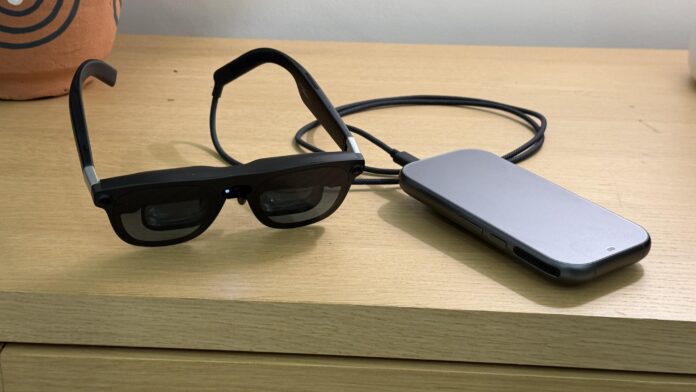
I discovered the Xreal Air of mystery to be one amongst potentially the most charming units I’ve tried rapidly, on story of it bridges among the crucial gaps between glasses, AR and VR. The Air of mystery is a more superior pair of Xreal bid glasses (which I’ve reviewed in diverse forms over the final few years) linked to a processing puck that runs Android XR, floating apps and experiences into the enviornment with micro-OLED displays. The displays are effectively mirrored down from the tip of the glasses and projected over clear lenses which possess layers of dimming. Google’s visually mindful Gemini AI can trudge on the same time, recognizing apps which could possibly be start and things in the right world round you.
The Air of mystery has a bigger 70-level self-discipline of peek than previous Xreal glasses (which top out at 57 degrees), which allows more viewing home and more apps to be laid out. It’s now no longer as a lot as long-established VR, but in my demos, it felt relish it approached usefulness end to what VR headsets can provide. It furthermore has hand monitoring by design of exterior cameras, and can drift 3D experiences and even VR apps in Android XR into the room surprisingly effectively.
The $1,279 starting tag for Xreal Air of mystery involves 256GB of storage and 12GB of RAM. There’s furthermore a $1,500 model with 512GB of storage and 16GB of RAM.

The Air of mystery comes with its personal jog back and forth case. The processor puck it uses is referring to the scale of a phone.
Scott Stein/CNET
Meta VR Glasses and Xreal Air of mystery in comparison
Meta’s VR Glasses possess the same, yet varied, proposition. They’re more relish sliced-off Apple Imaginative and prescient Mavens and exercise pass-thru cameras to enable you check out the start air world in place of truly clear lenses. However they furthermore possess note monitoring as effectively as at hand monitoring, and can work with Meta Quest controllers and Quest apps. Their 84-level self-discipline-of-peek micro-OLED displays are more gargantuan and bigger-res than the Air of mystery’s. Meta’s VR Glasses possess simplest one storage config we know of (128GB), but furthermore possess a MicroSD card slot that can retailer apps too.
Every the Xreal Air of mystery and the Meta VR Glasses connect with exterior processing pucks which could possibly be roughly phone-sized, both the usage of Qualcomm Snapdragon XR Elite chipsets. Every furthermore possess the distinctive ability to port in other USB-C video-out units, floating a phone screen, laptop, iPad or Steam Deck licensed alongside other apps. Clearly, a allotment alternate in draw is underway.
Google’s got more glasses coming
Google’s got many of Android XR units deliberate, including a line of Gemini-powered tidy glasses made with Samsung, Warby Parker and Subtle Monster coming sometime sooner than the extinguish of the year. However the Xreal Air of mystery is Google’s next Android XR product on deck since its Samsung Galaxy XR partnership final year, and can draw lots of the same things in a smaller draw for less.
Between the Meta VR Glasses and the Xreal Air of mystery, it already feels relish the distinctions between “VR” and “AR” are starting to soften away. However at their nearly-the same come-$1,300 costs, they’re furthermore surroundings the tone for what these gadgets will worth going forward. Valve’s Steam Frame VR headset is over $1,000, and Snap’s upcoming Specs AR glasses worth $2,195. At these costs, despite the undeniable fact that a long way now no longer as a lot as Apple’s $3,699 Imaginative and prescient Pro, they’re furthermore design more expensive than Meta’s Quest VR headsets. Whereas you happen to’re involved by spending up on the hypothesis of immersive displays that can also even be old faculty for work or taken on the jog, despite the undeniable fact that, you should possibly possess to composed shield set and are trying how these units invent after I evaluate them.

Scott Stein
Editor at Expansive
I started with CNET reviewing laptops in 2009. Now I detect wearable tech, VR/AR, tablets, gaming and future/rising trends in our changing world. Other obsessions contain magic, immersive theater, puzzles, board games, cooking, improv and the Original York Jets. My background involves an MFA in theater which I note to involved by immersive experiences of the future.
Survey corpulent bio


