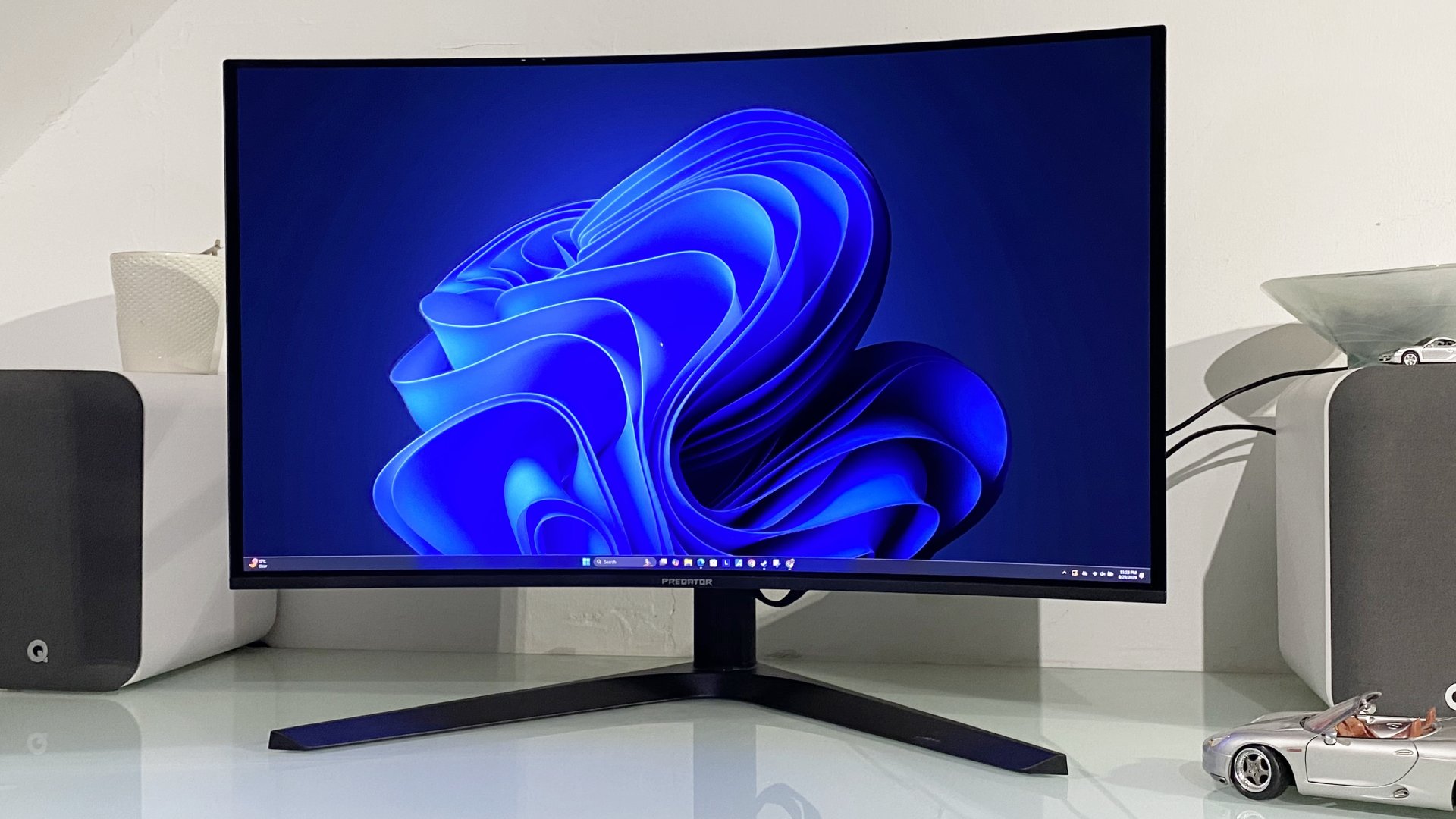

Strategic Edge: Why This Gaming Monitor Commands Your Attention
Is navigating the alphabet soup of gaming monitor models leaving you more confused than enlightened? When even a cursory glance at product codes like X32 Xbmiipphuzx feels like deciphering cryptographic puzzles, it’s easy to dismiss them as marketing noise. Yet, look beyond the bewildering suffixes, and contenders like the Acer Predator X32 X emerge – not merely as another screen, but as a calculated assault on the premium gaming display market, blending Samsung’s potent QD-OLED technology with a remarkably pragmatic feature set at a surprisingly aggressive price point near $1,200. This gaming monitor doesn’t just dazzle with raw specs; it strategically integrates capabilities rarely found together at this level, fundamentally altering the value proposition for discerning gamers and multi-tasking professionals alike. Its arrival forces a critical reassessment of what premium 4K OLED gaming should realistically deliver and cost.
Navigating Price and Availability: The Value Proposition Takes Centre Stage
Positioned at $1,199 (approx. £885 / AU$1,800), the Predator X32 X strategically undercuts other 32-inch 4K QD-OLED competitors like the Alienware AW3225QF and MSI MAG 321UPX, despite offering arguably a more compelling feature suite. Crucially, this price includes perks often reserved for higher tiers:
- KVM Switch: Effortlessly toggle between two source devices (e.g., gaming PC and work laptop) using a single keyboard and mouse.
- USB-C Hub with 65W PD: Power and connect compatible laptops and devices via a single cable – perfect for creators or gamers using laptops.
- Robust Port Selection: Two HDMI 2.1 ports (ideal for next-gen consoles or PCs), DisplayPort 1.4, and multiple USB-A downstream ports.
However, navigating availability challenges, particularly in the UK (current stock issues noted), can frustrate potential buyers. Patience or careful retailer monitoring might be required, but the feature set justifies the effort, delivering immense value that overshadows minor pricing differences among competitors. You aren’t just paying for the panel here; you’re investing in unparalleled convenience.
Beyond the Panel: Feature Arsenal Defining User Experience
Samsung’s standout 31.5-inch QD-OLED panel – offering breathtaking 4K resolution (3,840 x 2,160) and a blistering 240Hz refresh rate – serves as the dazzling foundation. But Acer elevates the experience with thoughtful integrations:
- The Curve Debate: Its 1700R curvature diverges from many similarly sized competitors. While personal preference reigns supreme, a gentle curve enhances perceived immersion for solo users, potentially reducing eye strain during extended sessions. For productivity or multi-user viewing, flat might be preferable.
- Glossy Glory (or Gamble?): Opting for a glossy coating maximizes contrast and colour vibrancy by reducing light diffusion. This amplifies the QD-OLED’s inherent strengths but makes the panel more reflective than matte alternatives. Ideal for light-controlled environments (like dedicated gaming setups), but potentially problematic in bright, sunlit rooms where reflections become distracting (source: OLED-Info.com contrast fundamentals).
- The Connectivity Crown: The X32 X shines brightest beyond the screen itself. The inclusion of both a fully functional USB-C hub (with sufficient 65W power delivery for most thin-and-light laptops and ultrabooks) and a KVM switch is exceptional at this price point. For multi-device users (gaming PC + MacBook for work?), this combination is transformative:
- KVM allows instantaneous control swapping.
- USB-C provides power/video/data to the laptop through one cable.
- This synergy makes desk mounting seamless.
The Predator X32 X isn’t just a display evolution; it strategically redefines monitor utility for demanding, dual-purpose lifestyles.
Design Compromise: Form Follows Function (Mostly)
Unmistakably gamer-focused aesthetics dominate the Predator X32 X. Angular lines and RGB lighting accents at the rear declare its purpose. Thankfully, the front retains relative sobriety:
- Narrow, uniform bezels on all sides.
- Minimal “Predator” branding.
- Excellent ergonomics: Height, tilt, and swivel adjustment ensure optimal viewing angles.
Build quality feels robust, justifying the price. The glaring ergonomic compromise? The large external power adapter. It disrupts cable management elegance in setups where clean integration is prized, serving as a reminder that features often come at a cost beyond pure financials.
Performance: QD-OLED’s Signature Brilliance with Known Constraints
The visuals delivered are nothing short of spectacular, showcasing the unique advantages of Samsung’s self-emissive QD-OLED display technology:
- Infinite Contrast & Per-Pixel Precision: Pixel-level lighting delivers true blacks alongside intensely bright highlights within the same frame – impossible for even the best full-array local dimming LCDs. Scenes from Cyberpunk 2077 or Alan Wake 2 explode with depth and realism.
- Pixel Response & Motion Handling: 0.03ms GTG times and 240Hz refresh rate translate to astonishing fluidity and near-zero blur. Fast-paced titles like Counter-Strike 2 or competitive shooters benefit hugely.
- 4K Clarity: High pixel density (>140 PPI) ensures sharp detail eliminates text fringing common on lower-resolution OLEDs. Clarity extends to both games and desktop productivity.
However, acknowledge the inherent constraints despite the stunning QD-OLED performance:
| Acer Predator X32 X Key Performance Factors | |
|---|---|
| Strength | Limitation |
| Infinite Contrast Per-Pixel Lighting | ABL reduces full-screen brightness (250 nits) |
| Exceptional HDR Brilliance (1000+ nits peaks) | Lower sustained brightness impacts very bright game scenes |
| Perfect Motion Clarity (0.03ms / 240Hz) | Glossy coating prone to reflections in bright rooms |
| Superb Text Clarity Thanks to 4K Density | Requires careful ambient light management for optimal contrast |
- ABL in Action: Auto Brightness Limiting (ABL) circuitry caps full-screen white brightness at a modest ~250 nits to protect the panel. Consequently, predominantly bright scenes (e.g., snowfields in Horizon Forbidden West) won’t pop like mixed scenes. Peak HDR brightness exceeding 1000 nits, only achievable in small highlights like explosions, remains spectacular (source: RTINGS.com ABL analysis).
- Ambient Light Sensitivity: The glossy finish produces stunning contrast but performs best in environments controlled for light sources, minimizing reflections. This impact is shared across all glossy QD-OLED competitors.
Alternatives on the Horizon: Strategizing Your Choice
While the X32 X excels, the QD-OLED arena thrives. Compare strategically:
- Alienware AW3225QF: AWS model wasn’t detailed but offers a functionally similar flat panel experience often slightly more costly. Often lacks comparable KVM/USB-C PD flexibility. A direct competitor prioritizing raw panel performance.
- MSI MAG 321UPX: Extremely close in price and panel technology to the X32 X. Flatter design, potentially weaker HDR calibration out-of-box, benefits from MSI gaming software ecosystem. Another strong value option, often neck-and-neck.
- LG-WOLED Models (e.g., Predator X32 X3): LG’s WOLED panel (like in the LG UltraGear 32GS95UE) typically uses a white subpixel + colour filter structure. Offers higher full-screen brightness (>300 nits) and potentially better text rendering due to standard RGB arrangement but potentially slightly less peak colour luminance vs. QD-OLED. Often traces higher in price at launch. Trade-offs involve sustained brightness vs. ultimate colour sparkle.
The Predator X32 X maintains its edge through its feature-rich ecosystem, often finding a unique balance hard to replicate elsewhere without compromises elsewhere.
The Final Verdict: Beyond Pixels, Towards Ecosystem Conquest
The verdict crystallizes around core differentiators. As a value proposition, the Acer Predator X32 X stands tall: its $1,200 price tag isn’t the absolute lowest for a 32-inch 4K QD-OLED monitor, but no other model combines this panel technology, 240Hz speed, USB-C/KVM versatility, and aggressive pricing as effectively. Despite gaming-centric design cues and an external power brick, it delivers a premium construction and ergonomic freedom. The QD-OLED panel, while marking an earlier generation, remains a marvel for contrast, colour vibrancy, and responsiveness. While enthusiasts anticipating brighter, next-gen QD-OLED might hesitate, and those requiring intricate colour grading should verify professional calibration depth, the package is formidable. For gamers demanding breathtaking 4K HDR visuals and unmatched motion clarity, and professionals juggling multiple devices eager for seamless switching ideally suited for glossy panel conditions, the Predator X32 X is a strategic powerhouse excelling across diverse roles. It isn’t merely a great monitor–it completely reconfigures expectations for value-driven tier giants. Share your thoughts or concerns below: Is connectivity versatility a decisive feature potential buyers should prioritize above minor brightness leaps?


