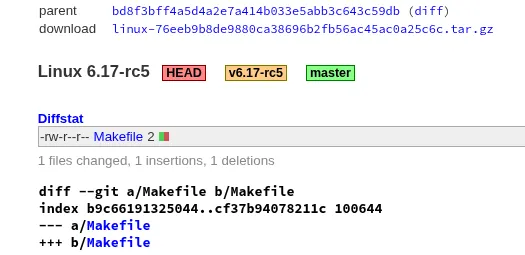

Linux 6.17-rc5: Is the Next Kernel Release Shaping Up Nicely?
Are you eager to see the latest improvements and refinements in the Linux kernel? The Linux kernel is the foundation of countless systems, from embedded devices to supercomputers, and its continuous development is crucial. The latest release candidate, Linux 6.17-rc5, has just been released for testing, signaling we’re nearing the stable Linux 6.17 release expected in late September. This article dives into the key changes, fixes, and noteworthy developments included in this release, giving you a sneak peek at what’s to come.
Key Updates in Linux 6.17-rc5
The fifth release candidate for Linux 6.17 showcases a collection of targeted improvements and bug fixes. Let’s take a closer look at some of the most prominent changes:
NVIDIA Nouveau Driver Stability Fixes
One of the highlights of this release candidate is the inclusion of important stability fixes for the open-source NVIDIA “Nouveau” graphics driver. The Nouveau driver aims to provide open-source support for NVIDIA GPUs, allowing users to utilize their NVIDIA hardware without relying solely on proprietary drivers. These fixes are crucial for improving the overall user experience, particularly for those relying on Nouveau for their graphics needs. While the Nouveau driver may not offer the same level of performance as the official NVIDIA drivers, it offers a free and open alternative, which is very important to many linux users. This continues the trend of improved open source GPU driver support.
Why is this important? For Linux users who prioritize open-source solutions, the Nouveau driver is a valuable resource. Improving its stability enhances the usability of NVIDIA hardware within a fully open-source environment. This translates to fewer crashes, better performance, and a more reliable experience overall.
Preparing for Rust 1.91
The Linux kernel is increasingly incorporating Rust as a second language for driver development. This is a relatively new, but important development in the linux kernel. Linux 6.17-rc5 includes preparatory work for the upcoming Rust 1.91 release, slated for October. Rust offers memory safety features that can help prevent common vulnerabilities in kernel code, such as buffer overflows and use-after-free errors. Wikipedia article on Rust. By integrating Rust, the kernel developers aim to improve the overall security and reliability of the Linux kernel. This move reflects a broader trend in the software industry towards adopting memory-safe languages to mitigate security risks.
The benefits of using Rust in the kernel:
- Enhanced security: Rust’s memory safety guarantees can help prevent common vulnerabilities.
- Improved reliability: Reduced risk of crashes and unexpected behavior.
- Modern language features: Rust offers modern programming constructs that can lead to more efficient and maintainable code.
New x86 Hardware Support and Device Quirks
Linux 6.17-rc5 includes updates to support new x86 hardware and address specific device quirks. These updates are essential for ensuring that the kernel can properly identify and utilize the latest hardware components. Device quirks are specific configurations or workarounds required for certain hardware devices to function correctly. By incorporating these quirks, the kernel can ensure compatibility with a wider range of hardware configurations.
What are device quirks? Device quirks are often necessary because hardware manufacturers may not always adhere perfectly to industry standards or may introduce subtle variations in their designs. The kernel developers must then identify and address these inconsistencies to provide a seamless user experience.
PCMCIA Fixes: Dead Code Removal
The release candidate also contains some unusual PCMCIA noise, specifically the removal of dead code. PCMCIA (Personal Computer Memory Card International Association) is an older standard for expansion cards, once commonly used in laptops. While PCMCIA is less prevalent today, maintaining a clean and efficient codebase requires removing obsolete or unused code related to this technology.
Why remove dead code? Dead code can contribute to code bloat, making the kernel larger and potentially less efficient. Removing it simplifies the codebase, making it easier to maintain and understand. It also reduces the potential attack surface, as unused code can still contain vulnerabilities.
Resurrected DLink/Sundance Driver
In a surprising move, the DLink/Sundance driver has been resurrected in this release. As Linus Torvalds points out, this is a significant revert, adding back approximately 2,000 lines of code. The driver likely provides support for older network adapters from DLink and Sundance. While the rationale behind this resurrection isn’t explicitly stated in the release announcement, it could be due to ongoing demand from users still utilizing these legacy devices or a renewed effort to support older hardware.
Potential reasons for resurrecting the driver:
- Continued user demand: Some users may still rely on these older network adapters.
- Historical preservation: Maintaining support for older hardware can be important for preserving computing history.
- Reverse engineering efforts: Resurrecting the driver could be part of a larger effort to understand and improve support for legacy hardware.
Linus Torvalds’ Criticism of “Link: ” Tags
Beyond the code changes, Linus Torvalds also voiced his opinion on the use of “Link: ” tags in Git commits, describing them as “garbage” unless they provide additional value beyond the patch message itself. Torvalds emphasizes that links should only be included when they offer supplementary information or context that is not already covered in the commit message. This reflects a broader concern for maintaining clean and informative commit logs.
Key takeaway: Commit messages should be self-contained and provide sufficient context for understanding the changes being made. Links should only be included when they genuinely add value to the commit message.
Categorization of Changes
According to Torvalds, the remaining changes in Linux 6.17-rc5 can be broadly categorized as follows:
- Drivers: A significant portion of the changes involve drivers, with networking, GPU, and sound drivers being particularly prominent.
- Tooling: Updates and improvements to tools such as
perfand self-tests. - Filesystem: Various fixes and improvements to filesystem-related code.
- Architecture: Architecture-specific fixes and enhancements.
- Memory Management (MM): Fixes and improvements to the kernel’s memory management subsystem.
This distribution of changes is fairly typical for Linux kernel development, with drivers consistently representing a significant portion of the overall work.
The Road to Linux 6.17 Stable
The release of Linux 6.17-rc5 marks another step towards the stable Linux 6.17 release, which is currently scheduled for the end of September. The release candidate process involves extensive testing and bug fixing to ensure that the final release is as stable and reliable as possible.
What happens next? Over the next few weeks, developers and testers will continue to evaluate Linux 6.17-rc5, identifying and addressing any remaining bugs or issues. Additional release candidates may be issued if necessary before the final stable release is declared.
Conclusion: A Promising Release
Linux 6.17-rc5 presents a promising snapshot of the upcoming Linux 6.17 kernel. The inclusion of stability fixes for the Nouveau driver, preparations for Rust 1.91, and various hardware support improvements demonstrate the ongoing commitment to enhancing the Linux ecosystem. While the resurrection of the DLink/Sundance driver is an unusual development, it highlights the kernel’s ability to adapt to diverse needs. The stable Linux 6.17 release is expected to arrive by the end of September, bringing with it a host of improvements and new features. What do you think about the changes in Linux 6.17-rc5? Are you excited for the stable release? Share your thoughts in the comments below!
Sources & Further Reading:
Original article at www.phoronix.com


