
Beyond the Hype: Can a $700 Triple-Screen Laptop Truly Deliver Desktop-Level Multitasking?
Picture this: you’re juggling spreadsheets, video calls, research tabs, and real-time analytics. Standard single-screen laptops feel suffocating. Extending to multiple monitors creates desktop dependence. So when whispers emerge of a $700 portable triple-screen laptop boasting a combined 29.5-inch workspace, it sparks immediate intrigue. Could this be the holy grail of mobile multitasking? Yes, a triple-screen laptop could revolutionize productivity for some. But emerging from obscure corners of Aliexpress, this ambitious Chinese-made device – unceremoniously listed as a “NEW Triple Screen Gaming Laptop” by the YCX & GPD Laptop Store – raises critical questions about feasibility, build quality, and real-world usability. Is this innovative design a genuine leap forward, or a complex exercise in compromise destined for the gadget graveyard?
Engineering an Expandable Workspace: The Fold-Out Design
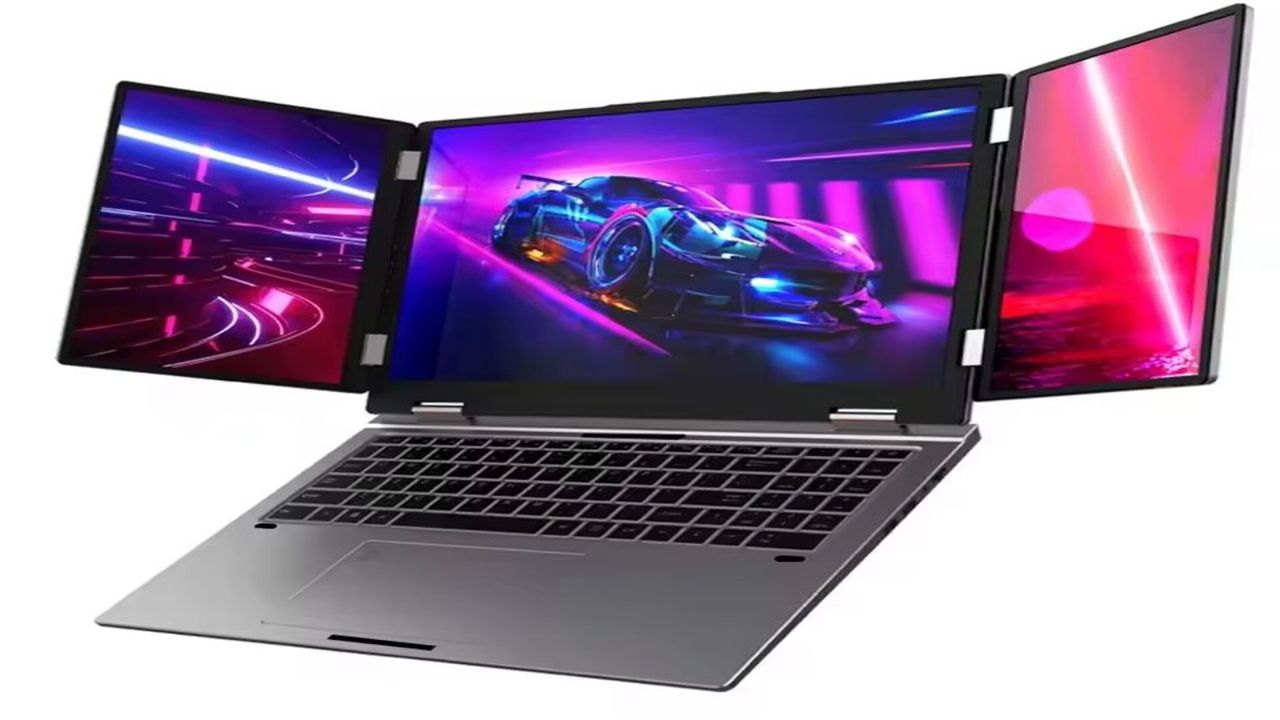
This isn’t Intel’s dual-screen Vision concept or Apple’s sleek continuity flow. This approach is distinctly utilitarian. Picture not a detachable second screen, but two integrated 10.5-inch panels physically hinged on either side of the primary 16-inch display. For transport, they fold back onto the main screen like protective covers. It’s fundamentally bulkier than any standard clamshell. Specifications peg it at 374 x 261 x 28mm and a hefty 2.6 kilograms – significantly heavier than mainstream 16-inch laptops (Apple’s MacBook Pro 16″ M3 Max, for instance, weighs around 2.15kg or less, despite comparable screen size). While carrying a laptop and two separate portable USB-C monitors remains more cumbersome, the weight and thickness are undeniable trade-offs for this integrated multi-display laptop.
The payoff unlocks upon opening these wings. When deployed, the trio forms a contiguous visual field equivalent to a single 29.5-inch monitor. Theoretically, this creates a vast digital canvas ideal for traders, programmers needing extensive code views, content creators managing timelines and assets, or professionals juggling diverse applications. However, reality bites: thick bezels inevitably fragment this view, disrupting visual continuity and preventing true seamless workflow immersion. Your brain never quite stops noticing the black borders.
Design Implications at a Glance:
- Portability Cost: Significant weight increase (2.6kg) vs. single-screen counterparts; chunky profile (28mm thick).
- Setup Simplicity: Zero cables needed beyond the primary laptop – unfold and work.
- Screen Real Estate: Massive combined workspace in a self-contained, travel-ready unit.
- Visual Downside: Thick bezels break the illusion of a truly contiguous display.
Peering Under the Hood: Capabilities and Limitations
Ambition in form factor needs horsepower to match. Here, the specs land firmly in the mid-range category:
- Processing: Options include Intel’s Alder Lake Core i7-1260P or i7-1270P (P-series focused on balanced power/performance). These are respectable 28W TDP processors common in business-focused notebooks in 2022/2023, but not cutting-edge (Raptor Lake or current-gen mobile Ryzen).
- Memory: Upgradeable DDR4 via two SODIMM slots (up to 64GB). Good capacity, though DDR4 is becoming legacy tech eclipsed by DDR5 in newer premium systems (TechSpot).
- Storage: Single M.2 2280 slot supporting fast PCIe 4.0 NVMe SSDs. Adequate but limited – adding bulk storage internally isn’t possible.
- Battery Life: A 77Wh battery sounds sizable, but powering three screens creates a significant drain. Extended unplugged use is unlikely. Benchmarks suggest mainstream laptops push 8-10 hours on similar capacity; expect far less here.
- Other Features: Includes backlit keyboard, fingerprint sensor, a basic 1MP webcam, stereo speakers, and a decent port selection (USB-A, USB-C, HDMI, Ethernet).
The foldable screen laptop makes basic functional promises as a workstation. However, bottlenecks surface:
- Graphics: Intel Iris Xe integrated graphics struggle to smoothly render demanding content simultaneously across three panels. This pushes users towards the controversial eGPU promise.
- Cooling: Adequate thermals for mobile CPUs under heavy multi-monitor loads are crucial but not detailed.
- Webcam: A low-resolution 1MP camera is subpar for professional video conferencing on such a large display surface.
The External GPU Conundrum: Feature or Fantasy?
The most puzzling claim centres on external GPU support. Listings tout it as a feature, likely aiming at gamers or intensive creative users. However, glaring technological omissions cast strong doubt:
- Lack of Key Interfaces: The device lacks essential high-bandwidth ports like Thunderbolt 3/4, USB4, or the specialized OCuLink (Open Compute Link) standard. These interfaces offer the necessary ~40 Gbps speeds for a viable eGPU experience (external GPU connectivity speeds).
- Dubious Workaround: Listings imply using the internal M.2 slot with an adapter for an external PCIe enclosure. This creates major hurdles:
- Sacrifices Storage: Using the M.2 slot means no internal NVMe SSD – a fundamental storage conflict.
- Bandwidth Limitations: While M.2 supports PCIe lanes, real-world throughput via an external adapter typically falls far below the theoretical maximum and significantly below Thunderbolt, impacting high-end GPU performance.
- Complexity & Stability: This solution is fragmentation-prone, requires specific docks, and is not user-friendly or officially supported by major GPU vendors.
Unless explicitly engineered with a dedicated, high-bandwidth link absent from the described ports, this “eGPU support” resides firmly in the realm of impractical theory, potentially misleading unsuspecting buyers. A viable external GPU implementation requires seamless integration this seemingly lacks.
Market Position: Pricing vs. Performance vs. Risk
At $700-$1200, the price tag for a device with three integrated screens seems remarkably low. Context: mainstream 16-inch productivity laptops start near $1,000 often with single screens. Premium ultrabooks soar past $2000. On paper, this positions it as a budget laptop creature with a unique feature. However, scrutinizing the specs reveals underlying compromises:
- Mid-Tier Core Components: Alder Lake P-series CPUs and DDR4 were mainstream last generation, not latest tech.
- Bulk & Weight: Significantly heavier and thicker (2.6kg vs. sub-2kg for high-end 16-inch portables).
- Display Quality: Bezels aside – resolution, brightness, colour accuracy are unknown (common compromises in budget displays).
- Build Quality: Unnamed brand hints at potential material, hinge, or screen longevity concerns. Few details validate robustness.
Buying this becomes inherently risky:
- Obscure Source: Sold anonymously on AliExpress. Warranty, support, and return policies are major unknowns.
- Inconsistent Listings: Conflicting specs (Wi-Fi standards, USB capabilities) undermine trust in disclosure accuracy.
- Untested Ecosystem: Lack of reviews or tech community feedback means no validation of performance, stability, or driver/OS support quirks.
Comparison Snapshot: Value Equation
| Feature | Triple-Screen Laptop | Mainstream 16″ Productivity Laptop | Separate Laptop + Dual Monitors |
|---|---|---|---|
| Price | $700-$1200 (base to max) | $1000-$2000 | $1000 (laptop) + $200-$400+ per screen |
| Portability | ✔️ Single Unit (Heavy: ~2.6kg) | ✔️ Highly Portable | ❌ Requires separate carrying |
| Setup Complexity | ✅ Just Unfold | ✅ Open Laptop | ❌ Cable & Monitor Setup |
| Screen Space | ✅ ~29.5″ Equivalent | ⚠️ 16″ | ✅ Larger (Customizable sizes) ✅ |
| Power/Performance | ⚠️ Mid/Tier CPU, Limited Cooling | ✅ High Performance Options | ✅ Depends on chosen laptop |
| Display Continuity | ❌ Fragmented by Bezels | N/A | ⚠️/✅ Can be fragmented or seamless |
| eGPU Viability | Highly Doubtful | ✅ Common via Thunderbolt 4 | ✅ Depends on laptop ports |
| Reliability/Support | 🔴 High Risk (Unknown) | ✅ Established Brands | ✅ Established Brands |
Practical Realities: When Does the Gamble Make Sense?
Objectively, this device occupies a niche. It appeals primarily to users who:
- Prioritize Multi-Screen Needs Above All: For whom portable screen space is paramount, far outweighing concerns about weight, peak performance, bezels, or cutting-edge specs (e.g., day traders, niche field technicians).
- Operate on a Strict Budget: Can’t justify the cost of a premium comparable laptop plus two quality, portable USB-C monitors (easily exceeding $1500+).
- Embrace Technological Curiosity/Experimentation: Approach it as a proof-of-concept toy, acknowledging the potential for bugs or disappointment.
For most users seeking performance, portability, reliability, native gaming muscle, or flawless multi-display experiences, this configuration presents too many compromises and risks. The integrated graphics will stutter under multi-monitor loads, the bulk is substantial, internals are aging, and the eGPU promise fails beyond fantasy. Buying it essentially funds an experiment.
Unfolding the Verdict on Portable Screen Innovation
The emergence of this anonymous Chinese triple-screen laptop is a fascinating glimpse into how far the quest for portable multi-tasking has ventured. It demonstrates the engineering willingness to tackle the challenge of integrating significant screen real estate into a (relatively) compact form factor at a remarkably low price point. The core idea – instantly deploying three screens without cables – solves a specific problem elegantly in theory. However, the execution presents a mountain of caveats: significant heft for mobility, fragmented visual flow due to bezels, aging mid-tier components ill-suited to driving three displays effectively, debatable build quality, and misleading features like the practically non-existent eGPU support. Combined with the opaque nature of its marketplace listing on Aliexpress, this device represents a significant gamble. It serves best as a curiosity for the adventurous or potentially a functional compromise tool for those whose workflow absolutely demands portable multi-monitor immersion above all other considerations – performance, refinement, and reliability be damned. For the broader market seeking balanced, powerful mobile productivity, it highlights the persistent challenge: achieving seamless, powerful, truly portable multi-display computing remains elusive. Will you be tempted to roll the dice on this intriguing, yet deeply flawed, experiment in expanded vision? Do you prioritize ultimate screen space over nearly everything else? Share your multi-screen struggles (and solutions!) below!


