
Is Rust the Future of Core System Utilities? Ubuntu Embraces Rust Coreutils
Have you ever considered the backbone of your operating system? The core utilities that handle everything from listing files to manipulating text are often taken for granted. But what if these foundational tools could be significantly faster and more secure? The uutils project is aiming to achieve just that, and with the release of Rust Coreutils 0.2, their Rust-based alternative to GNU Coreutils is gaining serious traction. This release marks a significant milestone, as Ubuntu 25.10 is preparing to potentially adopt it as the default, signaling a possible shift in how core system utilities are developed and deployed. This article delves into the details of Rust Coreutils 0.2, its performance improvements, and its implications for the future of Linux distributions.
Diving Deep into Rust Coreutils 0.2
Rust Coreutils is a project dedicated to rewriting the traditional GNU Coreutils in the Rust programming language. The goal is to create a more secure, performant, and modern alternative to the aging GNU suite. Version 0.2 represents a major step forward in this endeavor.
Enhanced Internationalization and Unicode Support
One of the key highlights of the Rust Coreutils 0.2 release is its comprehensive internationalization (i18n) support. This means the utilities are now better equipped to handle various languages, character sets, and regional settings. Prior versions had limited or incomplete i18n capabilities, hindering their usability in diverse environments.
- Localization (L10n): The enhanced localization support ensures that the utilities can adapt to different regional formats for dates, numbers, and currencies.
- Unicode Handling: Improved Unicode handling allows the utilities to correctly process and display characters from a wide range of languages, addressing a common pain point in older systems.
- Non-UTF8 Path Support: Crucially, Rust Coreutils 0.2 introduces support for non-UTF8 paths. This is essential for systems that need to handle filenames and directory names that don’t conform to the UTF-8 encoding standard. While UTF-8 is widely adopted, older systems or specific use cases may still rely on other encodings. Handling these paths correctly is vital for seamless integration.
Massive Performance Improvements: A Game Changer
Perhaps the most exciting aspect of Rust Coreutils 0.2 is the reported “massive” performance gains. Rust, known for its memory safety and speed, shines when applied to tasks traditionally handled by C-based utilities. The release announcement highlights some impressive improvements:
- The
trcommand: This utility, used for translating or deleting characters, saw a remarkable turnaround. Previously, Rust Coreutils’trwas 9.8 times slower than the GNU version. Now, it’s 1.58 times faster, representing a 15x improvement. sortandcat: While specific figures weren’t given in the source material forsortandcat, these utilities also experienced significant performance enhancements.
To appreciate the impact of these performance gains, consider how often these core utilities are used in everyday computing tasks:
- Scripting: Many shell scripts rely heavily on coreutils commands. Faster utilities translate directly to quicker script execution and improved overall system responsiveness.
- Data Processing: Commands like
sort,uniq, andgrepare essential for processing large datasets. Performance improvements in these areas can significantly reduce processing time. - System Administration: System administrators use core utilities for a wide range of tasks, from managing files to monitoring system performance. Faster tools make their jobs more efficient.
The switch to Rust, with its focus on zero-cost abstractions and minimal runtime overhead, is a key factor in these performance improvements. Unlike C, Rust’s memory safety features prevent common programming errors that can lead to crashes and vulnerabilities, without sacrificing speed.
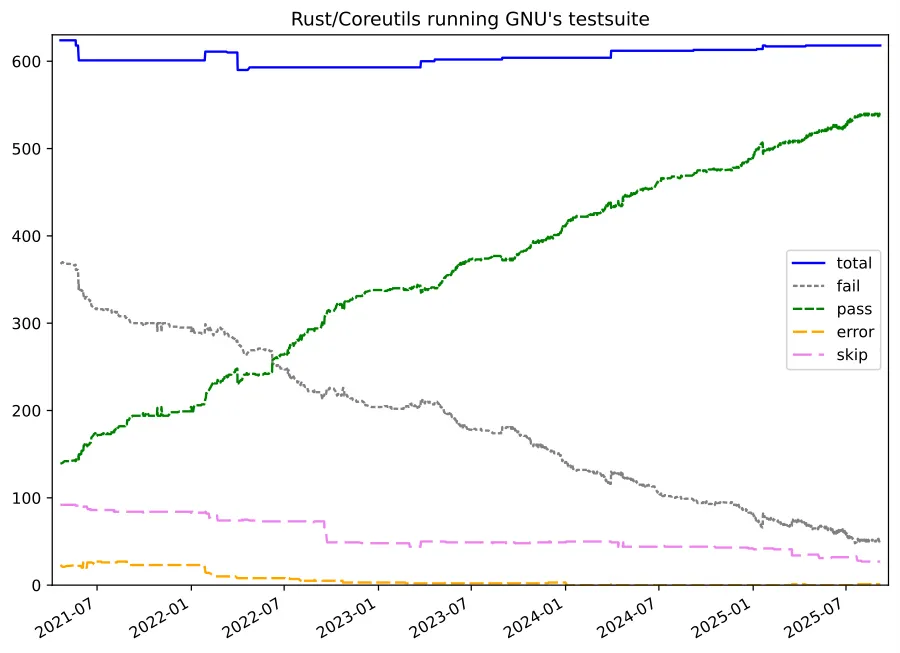
Closer to GNU Coreutils Compatibility: Passing the Test Suite
Rust Coreutils is continuously striving for compatibility with GNU Coreutils. The goal is to be a drop-in replacement, meaning that users can seamlessly switch from GNU Coreutils to Rust Coreutils without breaking existing scripts or workflows.
- Test Suite Progress: Version 0.2 boasts 538 passing tests, 16 more than the previous release. This incremental progress is crucial for ensuring compatibility and reliability.
- Ongoing Development: The uutils project is actively working on addressing failing tests and implementing missing features to further improve compatibility. They are committed to making Rust Coreutils a viable alternative for production environments.
| Feature | GNU Coreutils | Rust Coreutils (v0.2) |
|---|---|---|
| Language | C | Rust |
| Memory Safety | No | Yes |
| Internationalization | Yes | Improved in v0.2 |
| Test Coverage | High | Increasing |
Ubuntu 25.10: A Potential Turning Point
The prospect of Ubuntu 25.10 adopting Rust Coreutils as the default is a significant endorsement of the project’s maturity and potential. Ubuntu is one of the most popular Linux distributions, and its decision to embrace Rust Coreutils could have a ripple effect across the Linux ecosystem.
- “Production Ready” Support: The Rust Coreutils team considers version 0.2 to be “production ready” enough for Ubuntu to consider adopting it. This reflects the confidence in the stability and performance of the utilities.
- Preparation for Ubuntu 25.10: Ubuntu’s exploration of Rust Coreutils as a default component highlights the growing interest in Rust as a systems programming language.
- Potential Benefits for Ubuntu Users: If adopted, Ubuntu users could benefit from faster core utilities, improved security, and better internationalization support.
It is important to note that making Rust Coreutils the default set of utilities would be a very large and complex undertaking. The Ubuntu team will likely conduct extensive testing and evaluation before making a final decision, and will need to consider backward compatibility concerns and the potential impact on existing user workflows.
The Future of Core Utilities: Rust and Beyond
Rust Coreutils is not just about replacing GNU Coreutils; it’s about reimagining how core system utilities are developed and maintained. The project leverages the strengths of the Rust programming language to create a more secure, performant, and modern foundation for operating systems. The adoption of Rust for systems programming is a growing trend, driven by the language’s unique combination of safety, speed, and expressiveness. It’s possible that we will see other core system tools besides GNU Coreutils being rewritten using Rust.
Conclusion: A Promising Step Forward
Rust Coreutils 0.2 represents a significant step forward in the quest for faster, more secure, and more internationalized core system utilities. The performance improvements are impressive, the compatibility with GNU Coreutils is steadily increasing, and the potential adoption by Ubuntu 25.10 signals a growing confidence in the project’s maturity. The future of core utilities may very well be written in Rust.
What do you think about the potential of Rust Coreutils? Do you believe it’s a viable alternative to GNU Coreutils? Share your thoughts in the comments below!
Sources & Further Reading:
Original article at www.phoronix.com


