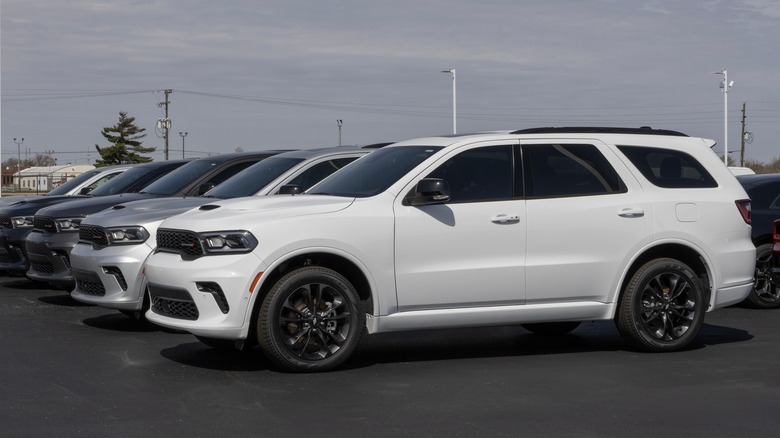

The Unexpected Muscle Revolution: Dodge Durango GT Ditches V6 for V8 Power
Imagine a world where a humble “GT” badge suddenly gains 65 horsepower overnight without any major redesign. That’s precisely what’s happening to the Dodge Durango GT. For years, “GT” on a Dodge SUV signaled competence, not conquest—a sensible trim above base. But Dodge is shattering expectations by announcing the V6 engine’s elimination from the entire Durango lineup for 2026. The result? The once-unassuming Durango GT transforms into a genuine muscle SUV, inheriting a roaring V8. This dramatic shift embodies Dodge’s “never lift” ethos but raises critical questions about practicality versus purist passion in an increasingly electrified market. The evolution of the Dodge Durango GT from family hauler to performance contender is more than a trim update; it’s a bold statement on the future of American SUVs.
Decoding the GT Enigma: Why Dodge Marches to Its Own Beat
In the automotive lexicon, “GT” (Gran Turismo) traditionally whispers of exotic flair and exhilarating speed—think Ford Mustang GT carving canyons or the Bentley Continental GT exuding continent-crushing opulence. Dodge, however, has long co-opted this badge differently. On the Durango, GT has denoted the mid-level trim, nestled comfortably above the entry-level SXT and below the performance-oriented R/T and SRT. This positioning meant capable, not captivating, performance. The Dodge Durango GT relied on the venerable 3.6-liter Pentastar V6, producing a consistent output hovering around 295 horsepower since its introduction in 2017, outpacing rivals like the Honda Pilot’s 285hp V6. Competent? Absolutely. Inspired? Arguably not.
- Traditional GT Meaning: High performance, sportiness, long-distance comfort (e.g., Porsche 911 GT3, BMW M8 Gran Coupe).
- Dodge’s GT Interpretation (Prior to 2026): Value-driven mid-trim level offering balanced features and power, prioritizing family utility over track focus.
The 2025 GT: A Fond Farewell to the Reliable V6
The current V6-powered Dodge Durango GT delivers adequate but unspectacular performance. Testing by Car and Driver on a 2017 model recorded a 0-60 mph time of 7.4 seconds and a limited top speed of 117 mph. Given the remarkably consistent power output (293 hp in 2017 vs. 295 hp for the 2025 model), significant improvements in acceleration are unlikely in the final year of the V6. This positions the outgoing Durango GT squarely in the middle of the three-row SUV pack, noticeably slower than some turbocharged four-cylinder competitors like the Kia Telluride (5.7 seconds in some tests) or even the similarly V6-powered Honda Pilot (6.9 seconds). It’s an engine designed for smooth highway cruising and daily practicality, emblematic of the Durango GT’s role as a versatile family transporter.
The Bombshell Announcement: Embracing V8s or Bust for 2026
Dodge shocked the automotive world with its announcement: For the 2026 model year, the V6 engine will disappear entirely from the Durango lineup. This “V8 or nothing” strategy is unprecedented in the mainstream three-row SUV segment. The ramifications for the Dodge Durango GT are profound:
- Engine Swap: The GT trim loses the Pentastar V6 and inherits the 5.7-liter Hemi V8.
- Power Surge: Horsepower leaps dramatically from 295 hp to 360 hp – a massive 65 hp increase.
- Performance Transformation: Projected 0-60 mph time plummets to approximately 6.2 seconds (based on previous V8 Durango tests by Car and Driver), fundamentally altering the GT’s character and capabilities.
This move signifies Dodge’s unwavering commitment to its performance heritage, even amidst a broader industry shift towards electrification and downsizing. It embraces the visceral thrill of a V8 rumble that resonates deeply with the Dodge brand identity but abandons buyers seeking a more fuel-efficient or affordable entry point.
Dissecting the 2026 Lineup: An All-Hemi Power Hierarchy
With the V6 gone, Dodge reshapes the Dodge Durango GT and the entire lineup into distinct, Hemi-powered tiers:
- Dodge Durango GT (2026): 5.7-liter Hemi V8, 360 horsepower. Estimated 0-60: ~6.2 seconds.
- Dodge Durango R/T (2026): Upgraded to the naturally aspirated 6.4-liter (392 cubic inch) Hemi V8, producing 475 horsepower. Estimated 0-60: Mid-4 seconds (based on Dodge Garage testing of the previous SRT 392 model).
- Dodge Durango SRT Hellcat (2025/2026): Continues with the supercharged 6.2-liter Hemi V8, unleashing 710 horsepower. Boasts a staggering manufactuer-claimed 0-60 time of just 3.5 seconds – supercar territory.
Comparing the Power Progression: Dodge Durango Engines (2025 vs. 2026)
| Model Year | Trim | Engine | Horsepower | Est. 0-60 mph (s) | Key Change |
|---|---|---|---|---|---|
| 2025 | GT | 3.6L Pentastar V6 | 295 hp | ~7.4 | Final year of V6 |
| 2026 | GT | 5.7L Hemi V8 | 360 hp | ~6.2 | +65 hp from V6 / Adopts base V8 |
| 2025 | R/T | 5.7L Hemi V8 | 360 hp | ~6.2 | |
| 2026 | R/T | 6.4L Hemi V8 (392ci) | 475 hp | ~4.4-4.6 | +115 hp / Return of 392 Hemi |
| 2025/26 | SRT Hellcat | Supercharged 6.2L Hemi V8 | 710 hp | 3.5 | Ultimate performance |
This audacious strategy creates an exceptionally clear, performance-focused hierarchy. The Dodge Durango GT is no longer the gateway; it becomes the entry-level V8 experience. The R/T transforms into a significantly more potent offering with the return of the beloved 392 Hemi. The Hellcat remains the unapologetic apex predator. Dodge is betting buyers will pay a premium for this level of exclusivity and power.
The Strategy and the Conundrum: Bold Vision or Risky Gamble?
Dodge’s elimination of the V6 and the subsequent empowerment of the Dodge Durango GT is a masterclass in brand storytelling (“muscle for the masses”) but presents significant challenges:
- Doubling Down on Performance DNA: Dodge thrives on its “American Muscle” image. Removing the “mild” V6 reinforces this fiercely, appealing to enthusiasts longing for brawny powertrains. The Hemi engine (learn more about its storied history on Wikipedia) is central to this identity. Stuffing V8s across the board makes the Durango a genuine standout.
- Differentiation in a Diluted Market: In a sea of increasingly homogenous turbocharged four-cylinder and hybrid SUVs, the roar of a V8 offers unique sensory appeal. It creates a niche appealing to those prioritizing driving emotion over efficiency.
- The Price and Efficiency Dilemma:
- Cost: V8 engines are significantly more expensive to produce and purchase than V6s. The Dodge Durango GT‘s price will inevitably rise in 2026, potentially pricing out budget-conscious buyers. What was once a mid-trim becomes a premium entry point.
- Fuel Economy: Hemi V8s, especially the larger displacement ones, are notoriously thirsty. With stringent CAFE standards and high gas prices, this move seems counterintuitive to global trends pushing efficiency. Expect the Durango’s EPA ratings to become less competitive against rivals offering hybrid or plug-in options (like the Toyota Highlander Hybrid or upcoming Ford Explorer EV).
- Market Reach: By eliminating the V6, Dodge potentially shrinks its addressable market. Fleet sales and eco-conscious families looking for 3-row utility might simply look elsewhere.
This is undoubtedly a bold move celebrating internal combustion muscle, perhaps foreshadowing the final act for large-displacement engines before electrification dominates. It courts enthusiasts but risks alienating pragmatic SUV shoppers, making the Dodge Durango GT a fascinating test case for brand purism versus market realities.
Beyond the Hemi: How the Revamped GT Competes
The V8-powered 2026 Dodge Durango GT will enter a competitive landscape transformed by its newfound muscle:
- Against Mainstream V6s (e.g., Honda Pilot, Kia Telluride, Toyota Grand Highlander): The GT will now offer vastly superior straight-line acceleration and perceived performance cachet. However, it will almost certainly lag in fuel efficiency, potentially have a higher MSRP, and may lack the latest efficiency technologies like hybrids common among its peers.
- Against Performance SUVs (e.g., Ford Explorer ST, Jeep Grand Cherokee 4xe): With an estimated 6.2-second 0-60 time, the V8 GT will be competitive with middle-tier performance SUVs. It offers that naturally aspirated V8 character cherished by enthusiasts, a contrast to forced-induction (turbo/supercharged) opponents. However, rivals might offer more sophisticated chassis tuning or hybrid/electric torque.
- Value Proposition: The GT becomes a tempting proposition for buyers seeking foundational V8 performance in a practical 3-row package. It leverages the Hemi’s inherent appeal, recognizable roar, and Dodge’s performance reputation. It may become the affordable V8 SUV entry point.
Ultimately, the V8 Durango GT carves an utterly unique niche: a mainstream-branded, family-sized SUV with genuine, accessible muscle-car pedigree. It will no longer blend in; it will demand attention.
The Weekend Garage: A Hemi History Footnote
The heart transplant in the Dodge Durango GT is made possible by decades of Hemi development. Chrysler’s hemispherical combustion chamber design traces its roots back to the iconic FirePower engines of the 1950s, famed for efficiency and power. The modern “Eagle” Hemi generation, revived in 2003, became synonymous with the Charger, Challenger, and Ram Trucks’ muscle renaissance. Its relatively compact size (for a pushrod V8), durability, and immense torque potential made it the perfect candidate to inject real performance into vehicles like the Durango. Placing this legendary powerplant into the GT trim elevates it from appliance to aspirational (Dodge Garage often celebrates this heritage).
Shifting Perspectives on a Performance Icon
The journey of the Dodge Durango GT from dependable V6 workhorse to V8-powered contender marks a pivotal moment. Dodge has chosen to unleash raw, authentic American muscle into a segment dominated by compromise. For fans craving the growl and punch of a Hemi engine in a practical wagon, the 2026 GT represents a thrilling, relatively accessible option. Yet, this focus comes with undeniable trade-offs: higher costs, thirstier fuel consumption, and a potentially narrowed audience. As environmental pressures mount and competitors rush towards electrification, this V8-or-nothing strategy feels defiantly nostalgic, perhaps representing the last stand for affordable large-displacement engines in mainstream family vehicles. Dodge is betting fervently that a significant segment of buyers still prioritizes that visceral thrill over all else. Only time will tell if the roar of the Hemi in a Durango GT is the sound of triumph or the last wail of an era’s end. What side of this high-stakes bet do you land on? Let us know your thoughts below!


