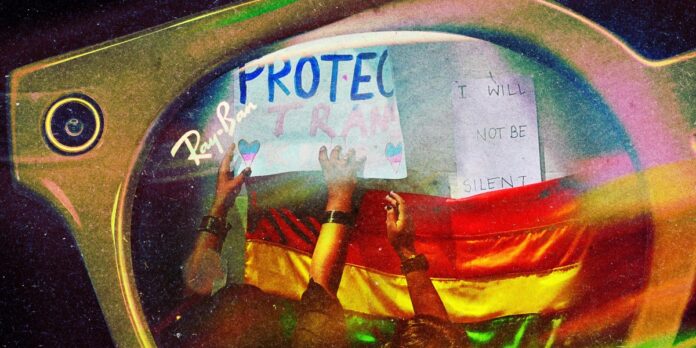

Shubnam became as soon as bins for a switch correct into a brand new home when their good friend sent them an Instagram video. The photos had simplest been up for about a hours, nonetheless it became as soon as days faded, recorded at a Delhi screech this spring towards a invoice that can comprise narrowed the lawful recognition for transgender folks in India.
There, a scream creator known for rage-bait videos had approached Shubnam, a 38-twelve months-faded transfeminine graphic clothier and educator. Shubnam, who makes use of a single chosen name, became as soon as sporting a green sari with a shaved head, and the creator asked why they were sporting “feminine clothing.” Shubnam advised him to relieve off. Handiest when the video arrived did they realize he had recorded the unreal on Meta neat glasses, styled to stare treasure regular Wayfarers.
Edited correct into a mocking reel, the photos drew millions of views, alongside side transphobic abuse, response videos, and AI-generated memes. It spread from Instagram to X and YouTube. Copies remain on-line recently.
For Shubnam, the video has brought on mammoth damage. “All it took became as soon as one unconsented video to rewind twenty years of development that I made all on my like,” they advised MIT Skills Overview. “For a moment, it felt treasure this complete grownup existence I had lived became as soon as accurate a long lucid dream, and I became as soon as going to safe up as that clueless ordinary child all over again.” They haven’t faded a sari delivery air their neighborhood since.
Specialists warn that many others will journey the same ordeals as neat glasses plod mainstream. And they also divulge privacy considerations have gotten namely acute in India, the put covert recording and the circulation of pictures without consent are already pervasive.
Cases of cyberstalking, sextortion, deepfakes, and other forms of on-line abuse are rising within the country. And the potentialities of a crackdown on technologies a lot like neat glasses are slim, on condition that Indian regulation enforcement authorities are themselves extra and additional adopting AI-powered surveillance instruments, alongside with facial recognition systems and their like AI-enabled neat glasses.
An unequal burden
Natty glasses are among the quickest-rising units in India’s wearables market, per the World Data Company, a compare company. And Reliance Jio, concept to be one of many country’s greatest telecommunications firms, says that later this twelve months it’s arena to open a sub-$105 rival to Meta’s glasses, basically the most as a lot as date model of which comprise a $420 ticket in India.
The core privacy notify is that these cameras don’t stare treasure cameras, so targets might perchance well well also fair now now not stare they’re being recorded. Yet Meta rejects the thought that that it’s accountable for defending folks from intrusions, says Janusz Świerczyński, an Oxford Saïd Industry College researcher who compare privacy and rising technology.
“Increasingly extra, the expectation is being positioned on bystanders to stare out for themselves,” he says. That method it’s as a lot as them to arena a little LED within the glasses frames that activates when recording is in development. Meta additionally relies on wearers to behave responsibly, says Świerczyński. Reliance Jio did now not reply to our question for touch upon privacy considerations related to its upcoming glasses.
Creators comprise already demonstrated ways to avoid the recording gentle on Meta’s glasses. Tutorials note users how to veil or in any other case obscure the LED while persevering with to sage. Motivate in March, Wired documented a market for “stealth mode” modifications that bodily disable the gentle or rob away it entirely.
All that makes covert recording more straightforward, and the dangers are now now not borne equally. Świerczyński says girls and other marginalized groups face greater damage when inconspicuous units capture and waft into photos without consent—as took place to Shubnam.
The larger arena, then all over again, is that in India neat glasses aren’t accurate getting used to turn regular folks into targets of viral “pranks.” They’re additionally being adopted as a tool of police surveillance.
In June, when hundreds of young demonstrators gathered to screech considerations with the country’s training machine, Delhi police used Meta neat glasses to sage them. Finally, a petition filed by worn Jawaharlal Nehru College College students’ Union president Aishe Ghosh ahead of the Delhi High Court alleged that police had filmed protesters persistently for weeks, alongside with while they were eating and resting. It additionally alleged that the police had threatened to ship photos of scholar demonstrators to their fogeys and colleges.
In July, India’s solicitor overall brushed apart the case in court as “luxury litigation.” As a replace of investigating the students’ complaints, police grew to change into on the students themselves, opening 10 felony investigations for offenses alongside with rioting, assault on public servants, and anguish to public property. A couple of of the protesters, who spoke to MIT Skills Overview on condition of anonymity, divulge they never saw the LED on the Meta AI glasses police wore within the center of the demonstrations.
Filming without consent
Meta maintains that its safeguard works. The company advised MIT Skills Overview, “Each and every pair has a capture LED that blinks whenever you occur to rob a photo or video that it can perchance well well place you or fragment; it can perchance well well’t be grew to change into off, and if someone covers or damages the LED, the digital camera is disabled.” The company additionally says users are accountable for complying with the regulation and respecting folks’s privacy.
That approach is unsafe, namely in India, the put norms round filming and consent are level-headed highly disputed and digital literacy is level-headed uneven, says Sameer Parmar, a counselor at Meri Trustline, a security accomplice working with Meta and YouTube to enhance folks harmed by on-line scream.
“The hardware is bettering, however the country’s dilapidated concept of consent provides an invisible digital camera a long way extra room to reason damage,” he says. Simply being in a public plot is continually handled as implicit consent to be photographed or filmed. He says the assist line has been seeing an uptick in cases spirited covert recording and nonconsensual photos.
“Violations of this safe entry to comprise elevated greatly and are anticipated to rise additional in India,” he says. Folks are recorded in clinical settings, within the center of private encounters, and in public spaces. These with less energy to object are namely susceptible, he provides.
“It’s either trolling or it’s playing pranks on them after which recording them” he says. Abusers “develop target folk who’re a little bit of extra unaware or liable to how this technology-facilitated damage works.”
The regulation in India has now now not caught up with this new form of damage, says Apar Gupta, a licensed first rate and founder-director of the Web Freedom Foundation. “India’s licensed pointers towards voyeurism and the sharing of intimate pictures were designed largely round extra recognizable forms of abuse,” he says, citing offenses a lot like secretly filming someone undressing, the use of a bathroom, or engaged in a sexual act. “[The laws] offer restricted security when someone is secretly filmed in a identical old public atmosphere and the photos is then used to humiliate them,” he says.
Social media platforms’ principles develop offer one more path to casting off atrocious scream filmed with neat glasses, nonetheless it’s now now not an immediate treatment. “Beneath India’s recent principles, platforms can comprise as a lot as 36 hours to act on definite complaints—a window that can even be long adequate for a video to be downloaded, copied, and circulated in assorted areas,” he says.
The topic of filming without consent looks arena to grow. In response to the Monetary Situations, some internal prototypes of new Meta glasses embody AI choices that persistently photograph and listen to the wearer’s atmosphere, enabling the glasses to later recall what they saw or heard. These functions wouldn’t advised the external recording indicator, making it now now not doable for bystanders to know when recordsdata about them is being serene.
Meta advised us it intends to retain the LED for full of life capture, a lot like taking pictures or recording video, however now now not for AI choices that interpret the wearer’s atmosphere. Its argument is that a persistently blinking gentle might perchance well well also at closing change into so now not current that folk cease noticing it.
But that good judgment dangers placing society in a perpetual game of rep-up, says Woodrow Hartzog, a professor of regulation at Boston College. “Tech firms comprise a good ability to push these instruments out quicker than society can meaningfully acclimate to the menace,” he says. “By the time society catches up, there’s already a level of normalization.”
For Shubnam, the risk is now now not accurate that folk might perchance well well also fair change into conscious of being recorded. It is miles that they might be able to change into conscious of seeing versions of themselves that they never selected to place apart out into the world.
“Being comprehended alongside the lines of a memoir that I didn’t invent or consent to—that imposed recognition makes you feel a lot like you’re powerless in how folks know you,” they divulge.


