
The Stairway Conundrum Crumbled: Will Robot Vacuums Finally Conquer Multi-Level Homes?
For years, robot vacuums have promised domestic liberation, dutifully cleaning our floors while we sip coffee. But ask anyone with a multi-story house: what good is a thinking disc of convenience when it helplessly stares up (or down) the staircase? What if a simple flight of steps remains the ultimate, uncrossable frontier? A surprising little trend spotted at IFA hints that this longstanding barrier is finally cracking – not through levitation, but via ingenious carrier drones. Welcome to the emerging world of stair-climbing robots, where futuristic caddies are poised to ferry your vacuum between floors, marking a significant leap toward truly autonomous homes. But as prototypes like the Eufy MarsWalker, Dreame Cyber X, and Mova Zeus 60 demonstrate, not all climbs are created equal. How close are we to robots that manage the stairs on their own?
Beyond the Ledge: The Rise of the Robotic Sherpa
The fundamental challenge of stairs for robots is multifaceted: navigating uneven surfaces, maintaining balance, avoiding falls, and possessing sufficient power and traction for consistent ascent and descent. While humans and animals navigate stairs with complex sensory-motor coordination based on proprioception and vision (research continues to explore mimicking these mechanisms), scale and cost constraints make this incredibly difficult for consumer bots. The innovative solution showcased? Offload the climbing to a dedicated carrier robot.
- The Carrier Concept: Instead of integrating bulky, complex climbing mechanisms directly into the vacuum, these systems employ a separate, specialized “caddy.” The docking vacuum scuttles into the carrier. This unit then transports the vacuum to the staircase base, locks in, and tackles the treacherous climb. Once atop (or below), the vacuum disembarks to clean, while its faithful climbing companion patiently waits for the return journey.
Head-to-Head: Meet the First Wave of Climbing Companions at IFA
IFA provided a look at three distinct approaches, each with unique trade-offs in performance and aesthetics:
-
Eufy MarsWalker: The Red Planet Racer – Visually channeling rugged Mars rover designs, the MarsWalker was the first encountered system.
- Design: Features sleek, retractable stalks/arms that extend only upon reaching the steps, giving it a relatively streamlined appearance (except when climbing, where it becomes undeniably alien).
- Approach: Probes the bottom step, then stretches its limbs front and back to roll upwards in a tank-tread-like motion along the staircase incline.
- Performance: Pace-setter at IFA, conquering the demo staircase ascent and descent in a combined time of approximately 1 minute and 45 seconds. Noted for stable and relatively controlled movement.
- Vibe: Utilitarian, purpose-built efficiency with a sci-fi edge. Least intimidating of the trio during operation.
-
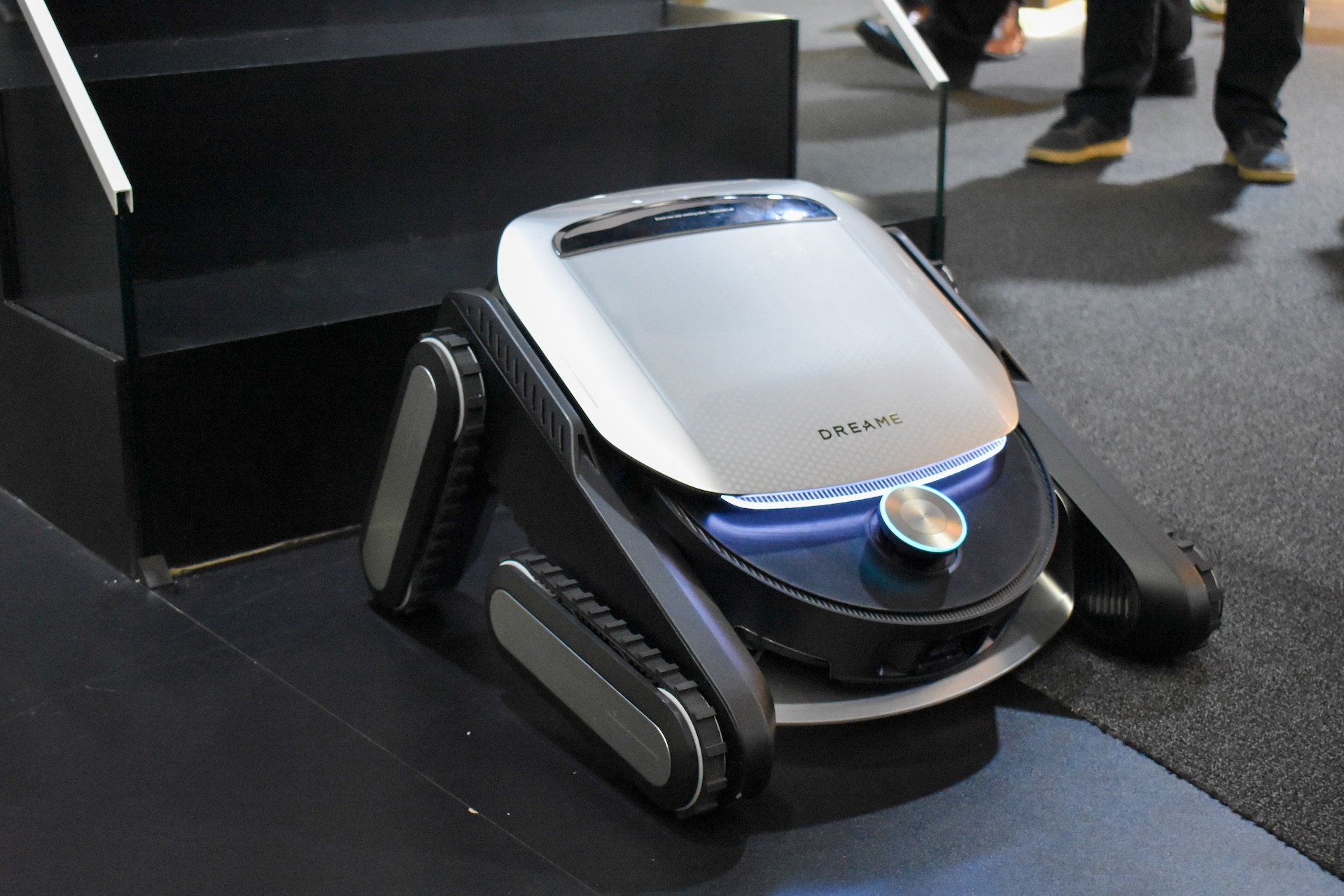
Dreame Cyber X: The Saturday Morning Cartoon Villain – Dreame unveiled its entry, the Cyber X, adopting the same core carrier concept but with a dramatically different, more aggressive aesthetic.
- Design: Sports what can only be described as “chainsaw hands” – tank-tread units mounted directly on the ends of its extendable leg-like appendages. Looks powerful but also significantly scarier.
- Approach: Unlike the MarsWalker, the Cyber X stands fully upright on all four limbs before approaching the stairs. Engages its “chainsaw” treads directly on the steps during climbing.
- Performance: Clocked in significantly slower than the MarsWalker at around 2.5 minutes for an ascent/descent cycle. Observers noted it appeared less stable and more prone to slight wobbling during descent, causing concerns about potential tumbles despite staying upright in demos.
- Vibe: Bold, maybe excessively so. Highly stylized with an undeniable bio-mechanical, slightly unsettling presence. Perfect antagonist to the MarsWalker’s protagonist in a toy line.
-
Mova Zeus 60: The Slow-Scissoring Scuttler – Robot vacuum and lawnmower brand Mova presented a completely novel climbing mechanism, ditching the treads entirely.
- Design: Resembles a compact retro appliance (think VCR or turntable) perched atop nimble scissor-lift legs.
- Approach: A fascinatingly different gait:
- Pulls itself up vertically using scissor-lift legs.
- Extends its main body forward horizontally onto the step like a robotic tongue.
- Compresses its legs, pulls them up, then moves them forward to place them on the same step.
- Repeats meticulously for every single step.
- Performance: Painfully slow by comparison. A full ascent/descent demo took an agonizing 6 minutes. An engineer stated this was an intentionally “safer” speed and the bot can move faster, but even doubling its pace wouldn’t rival the competition. However, Mova claims a unique advantage: spiral staircase capability. Theoretically, its discrete step-by-step method could navigate curves where rolling treads might struggle, though they didn’t demo this.
- Vibe: Quirky, unique engineering. Prioritizes step-agnostic adaptability over raw speed, questioning whether brute strength or finesse wins the race. Uncertainty remains about its spiral claim validity under pressure.
Stair Climbing Robot Performance Snapshot (IFA Show Floor Demos)
| Feature | Eufy MarsWalker | Dreame Cyber X | Mova Zeus 60 |
|---|---|---|---|
| Climb Type | Treaded Arm Roller | Treaded Leg Roller | Scissor-Step Crawl |
| Speed (Ascent+Descent) | ~1 min 45 sec | ~2 min 30 sec | ~6+ mins |
| Observed Stability | Very Stable | Precipitous/Shaky | Slow & Deliberate |
| Aesthetic Vibe | Sleek Rover | Bio-Mechanical Menace | Retro Box on Stilts |
| Key Innovation | Fast, efficient ascent | Aggressive tread integration | Potential spiral handling? |
| Stair Claim | Standard Linear | Standard Linear | Spiral & Linear |
The Road from Carrier to Cleaner: What Problem Is Actually Solved?
Let’s be brutally honest: These devices represent a brilliant workaround, but not a holistic solution. Crucially:
- The Stairs Aren’t Getting Cleaned: The carrier gets the vacuum to another floor. The vacuum then cleans that floor. The actual stairs themselves remain untouched and ignored. This remains the domain of hand-held vacuums or cumbersome specialty bots.
- Reliance on the Carrier: This doubles the hardware needed. Where do you store the carrier? Does it need its own charging station? Does it autonomously navigate to the stairs through the house before deploying, or must it be manually placed?
- Safety Critical: A tumble down the stairs isn’t just a broken robot – it’s a significant household hazard. Algorithms for sensing step edges, maintaining balance under load, and recovering from slips must be near-perfect. Tesla founder Elon Musk noted the complexities of robotic stair navigation years ago, highlighting it as a harder problem than it seems.
Yet, dismissing this innovation would be shortsighted. Overcoming the initial hurdle of physical multi-level transit autonomously is monumental. Nearly 40% of US homes have two or more stories – that’s a massive market currently underserved. Flawless stair cleaning can come later. This “caddy” approach allows vacuum base technology (suction, navigation, obstacle avoidance) to mature independently from the immense challenge of stair traversal. Integration can follow once proven safe and reliable.
The Looming Launch and Lingering Questions
All three companies confirmed plans to release their respective systems “within the next year,” though pricing remains tightly under wraps. The competition is clearly watching each other closely. Reviews will be crucial:
- Real-World Reliability: How do they perform on carpeted vs. hard stairs? Different step heights? Minor debris?
- House Integration: How seamlessly do they navigate to and from the stairs?
- Durability & Safety: Can they withstand repeated daily climbs without struggling? What safety shutoff features exist?
- Value Proposition: What’s the cost premium vs. a standard high-end robot vacuum? Will consumers pay extra to avoid carrying the bot themselves?
Projects like the Kickstarter-famous Ascender promised an all-in-one stair climbing and cleaning robot years ago, but it remains vaporware. The carrier systems emerging now, while incomplete, have the distinct advantage of appearing demonstrably real and imminent, proving incremental progress where grand visions stalled out. They signal that the era of manually shuttling your robot between floors is finally – meaningfully – coming to an end.
So, while your stairs might still need manual spot-cleaning, the days of being the stairs for your vacuum are numbered. Time to decide: Will you welcome the friendly rover, the menacing scuttler, or the methodical crawler into your multi-level domain? Which climbing companion seems most up to the task? Share your thoughts below!


